
Access all our platforms from a single account.

Strong US markets, weak USD: Why SGD investors need a global rethink

Key points:
- Currency matters more than it seems: While US equities posted strong gains in H1 2025, SGD-based investors saw much smaller returns—or even losses—due to a weaker USD.
- Opportunities may lie elsewhere: Markets in Europe, Hong Kong, and Singapore have outperformed in SGD terms this year, supported by local tailwinds, stable/stronger currencies and policy momentum.
- A chance to rebalance thoughtfully: With structural pressure building on the US dollar, investors may want to consider reviewing their exposure and incorporating income strategies anchored in more stable currencies.
Note: This content is marketing material.
The first half of 2025 has underscored a critical truth for global investors: returns are not just about what you invest in, but also where you're investing from.
While US equities have posted solid gains—with the Nasdaq 100 up 7.9% and the S&P 500 rising 5.5%—many Singapore-based investors are finding little to celebrate. The US dollar has weakened by over 6.9% against the Singapore dollar this year, significantly eroding returns when converted back to SGD.
This makes it an opportune time to reassess portfolio allocations, especially for those relying on US assets for growth or income.
Why SGD-based investors are not seeing gains from US markets
Despite strong performance in US dollar terms, SGD-adjusted returns tell a different story.
- Nasdaq 100: +7.9% in USD, but only +0.5% in SGD
- S&P 500: +5.5% in USD, but -1.8% in SGD
Meanwhile:
- Germany’s DAX: +27.1% in SGD
- Hang Seng Index: +10.5% in SGD
- Singapore’s STI: +4.7% in SGD
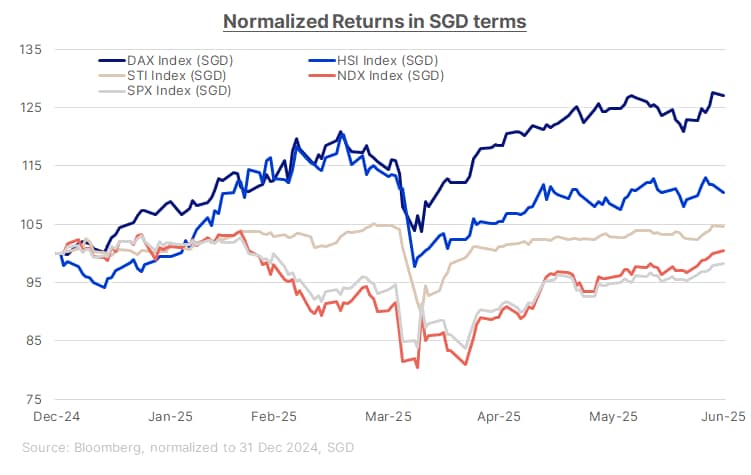
These figures highlight the growing importance of currency effects when allocating capital globally. For SGD investors, 2025 has shown that FX can be a decisive factor in portfolio returns.
What's driving the USD lower?
Several structural and cyclical factors are putting pressure on the US dollar, and more downside could be in store:
- Fed policy pivot: Market expectations for multiple rate cuts are reducing interest rate differentials that previously supported the dollar.
- Fiscal concerns: Rising US debt and widening deficits have reintroduced questions about long-term sustainability.
- Institutional risks: Policy uncertainty, Fed independence debates, and shadow chair speculation are increasing perceived risk in USD assets.
- Central bank reserve diversification: A longer-term structural trend is also gaining traction—global central banks are slowly reducing their reliance on the US dollar as a reserve currency, increasing allocations to gold, the euro, renminbi, and other alternatives. This gradual shift in global capital flows puts additional pressure on the dollar and raises long-term questions about USD dominance.
- Global capital rotation: With improved prospects in Europe and Asia, capital is flowing out of the US into regions with stronger relative growth and valuation appeal.
Strategic shifts for 2025
Investors should consider adjusting their portfolios in light of these developments, with a greater emphasis on regions and sectors better positioned for SGD-based returns.
Europe: Attractive valuations and dividend strength
European equities are showing strong momentum in 2025, driven by:
- A ramp up in fiscal spending on defense, infrastructure and clean energy
- Attractive valuations relative to US peers
- Stabilising inflation and policy clarity
- Higher dividend yields in key sectors including financials, energy, and industrials
Germany’s DAX index, for instance, has delivered a 27% return in SGD terms YTD. This underscores the case for increased exposure to European markets for both growth and income-focused investors.
For investors seeking exposure to Europe’s long-term structural shifts, our “European Independence” shortlist highlights companies at the heart of the region’s industrial transformation—spanning clean energy, defence, and semiconductor manufacturing.
Hong Kong: Recovery momentum and policy tailwinds
After years of underperformance, Hong Kong equities are regaining investor interest:
- Policy support from Beijing is stabilising sentiment
- Attractive valuations
- RMB stability has reduced FX volatility for international investors
The Hang Seng Index is up over 10% in SGD terms YTD, suggesting that a strategic re-entry into Hong Kong could enhance both return potential and diversification.
For investors looking to capture China’s structural growth in innovation and automation, our “China Innovation” shortlist offers a focused set of Hong Kong-listed stocks aligned with government priorities in advanced manufacturing, green energy, and AI technologies.
Singapore: Reliable income with currency stability
For investors seeking income without currency risk, Singapore-listed dividend stocks remain compelling. These stocks offer:
- Steady SGD-denominated payouts protect purchasing power
- Stable dividend-paying companies across infrastructure, banking, and utilities
- Strong local governance and economic fundamentals
Our “Dividend Aristocrats” shortlist features top dividend-paying companies across Singapore, the US, and Europe—screened for consistent payouts, market strength, and resilience. It’s a useful starting point for building a globally diversified, income-generating portfolio that doesn't rely solely on US stocks.
Preparing portfolios for a weaker USD
To position effectively, investors should consider the following:
- Review currency exposures and identify areas of USD over-concentration
- Rebalance regionally with a focus on Europe, Hong Kong, and Singapore
- Consider SGD-denominated or FX-hedged ETFs for global exposure with reduced volatility
- Shift toward income strategies anchored in SGD or more stable currencies
- Use curated stock shortlists to identify sector and theme-aligned opportunities
Conclusion
The strength of US markets in 2025 has not translated into strong returns for SGD investors. As the USD continues to weaken, the cost of holding US-centric portfolios is rising—both in terms of missed opportunity and FX drag.
This is a timely moment to rebalance towards regions offering better local-currency adjusted returns and to refocus on assets that generate reliable income in SGD.
For investors looking to protect purchasing power, generate sustainable income, and capture global opportunity, thinking beyond the US has never been more relevant.