
Access all our platforms from a single account.

Global Market Quick Take: Asia – May 21, 2025

Key points:
- Macro: Fed members state that monetary policy remains well-positioned
- Equities: US stocks snap 6-day rise; CATL gains 16.4% on first trading day in HK
- FX: AUD fell post-rate cut; USDCAD dipped amid Canadian inflation
- Commodities: Oil rose after CNN report on potential Israeli strike on Iran’s nuclear sites
- Fixed income: Yield curve steepens as long end pushes higher
------------------------------------------------------------------
Disclaimer: Past performance does not indicate future performance.
Macro:
- Fed members stated monetary policy is well-positioned, with a balanced response to inflation and unemployment feasible if expectations remain anchored; otherwise, prioritising price stability is necessary. They outlined three tariff scenarios: growth uncertainty, inflationary tariffs, and likely stagflation. Treasury market instability adds uncertainty, and high tariffs require more certainty to adjust monetary policy.
- Canada's inflation rate fell to 1.7% in April 2025 from 2.3% in March, exceeding expectations of 1.6%. This is the smallest increase in consumer prices in seven months, mainly due to a drop in energy prices following the removal of the consumer carbon tax and OPEC's oil output hikes.
- CNN reported that US intelligence suggest Israel is preparing to strike Iranian nuclear facilities.
- Japan may accept a US tariff reduction instead of an exemption, reports Kyodo. Economy Minister Akazawa, the chief tariff negotiator, will visit the US for the third time on Friday, with a possible fourth visit this month, per Nikkei.
- Japan's trade deficit dropped to JPY 115.85 billion in April 2025 from JPY 504.69 billion a year earlier, below the expected JPY 227.1 billion surplus. Exports grew 2% to JPY 9,157.16 billion, despite slowing due to U.S. tariffs. Imports decreased 2% to JPY 9,273.00 billion, reversing March's rise, with a smaller drop than anticipated.
Equities:
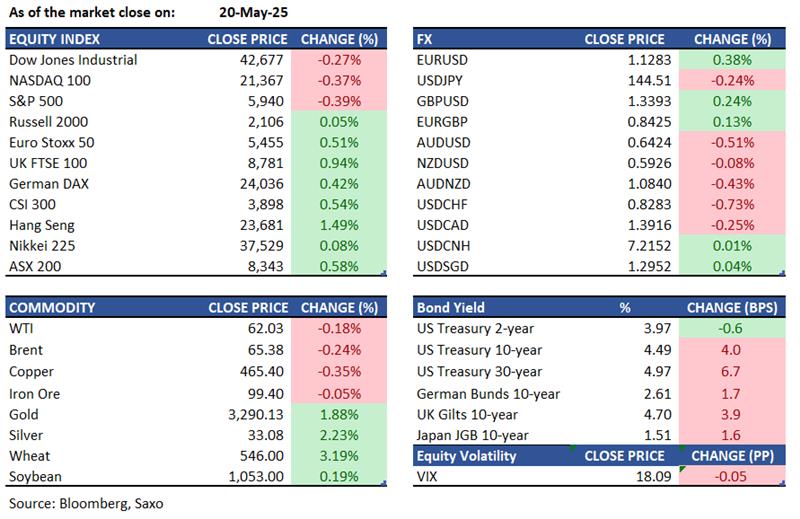
- US -US stocks fell on Tuesday, ending the S&P 500's six-day rise with a 0.4% drop. The Nasdaq also declined by 0.4%, and the Dow Jones lost 114 points. Caution returned amid renewed trade negotiation uncertainties and political opposition to the tax plan. A broad tech selloff impacted markets, with Alphabet (-1.5%) dropping after its Google I/O event, and Nvidia (-0.9%), Meta (-0.5%), and Apple (-0.9%) also declining. Tesla gained 0.5% after Elon Musk confirmed his CEO role for the next five years. Additional pressure came from mixed Home Depot earnings and warnings from JPMorgan and Fed officials, including St. Louis Fed President Alberto Musalem, who warned tariffs could hinder growth and lower inflation expectations.
- EU - European stocks rose sharply on Tuesday, rebounding from slight losses to reach a two-month high, driven by expectations of increased government spending. The Eurozone's STOXX 50 climbed 0.4% to 5,450, while the STOXX 600 rose 0.7% to 554, boosted by strong performances from major pharmaceutical companies. Consumer discretionary stocks recovered some losses, with LVM, BMW, and Kering gaining between 1.5% and 4%. Banks also advanced, led by BBVA, UniCredit, and Intesa Sanpaolo, each rising over 1%. Outside the Eurozone, Novo Nordisk jumped 4% following its CEO's resignation announcement, and Vodafone surged 5.7% after unveiling a €2 billion share buyback plan. Conversely, Swiss Life fell 0.4% despite reporting increased fee income and premiums for the first quarter.
- HK – HSI rose 1.5%, to 23,681 on Tuesday, rebounding from a subdued previous session as all sectors saw strong gains. Sentiment improved after the PBoC cut key lending rates to new lows, aiming to support the economy amid US trade war concerns. Alibaba Pictures surged 32% on strong revenue results, Xiaomi Corp. gained 4.7% after starting mass production of its mobile chip, and CATL closed at HKD 306.20, up 16.4% from its IPO price, raising USD 4.6 billion in Hong Kong's largest IPO this year.
Earnings this week:
- Wednesday: Target, Snowflake, TJX
- Thursday: Toronto-Dominion Bank, Analog Devices, Autodesk, Intuit, BJ’s Wholesale Club, Ralph Lauren
- Friday: Booz Allen Hamilton, Workday
FX:
- CHF and JPY rose slightly amid concerns over Israel-Iran tensions, boosting demand for safe assets. USDCHF fell 0.3% to 0.8260, its lowest in nearly two weeks, and USDJPY declined 0.1% to 144.36 for the third day. The dollar index dropped after fluctuating all day. DXY dropped below 100 level.
- AUD lagged after the central bank's rate cut and dovish outlook. AUDUSD dropped 0.6% to 0.6419 following the Reserve Bank of Australia's rate cut to 3.85%; Governor Michele Bullock noted the board considered a larger cut.
- USDCAD decreased 0.2% to 1.3918. Canadian inflation eased to 1.7% in April, above expectations.
- Economic data – UK Inflation Rate, CA New Housing Price Index, US Fed Barkin Speech
Commodities:
- Oil prices rose after a CNN report suggested Israel might strike Iranian nuclear sites, with WTI futures up 3.5% to $64.19 per barrel. Israeli leaders have not yet made a decision, according to unnamed officials.
- Gold surpassed $3,300 amid US dollar weakness as traders reassessed trade tensions and the Fed's rate path. It's up 25% this year, boosted by haven demand, ETF inflows, and Chinese investor interest.
Fixed income:
- Treasuries ended mixed, with a notably steeper yield curve. Long-term yields rose by about 6 basis points, driven by a busy corporate new-issue calendar, a Canadian bond selloff, US tax-cut bill negotiations, and an upcoming $16 billion 20-year bond auction. Earlier weakness in European and Japanese government bonds, along with pressure from German bunds, contributed to the rise in Treasury yields. The Dutch parliament's rejection of a pension reform amendment also influenced long-term European swap rates.
For a global look at markets – go to Inspiration.