
Access all our platforms from a single account.

Global Market Quick Take: Asia – March 21, 2025

Key points:
- Macro: BoE and SNB both kept policy rates unchanged
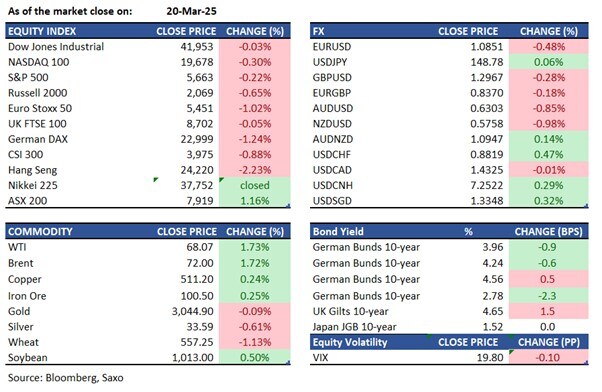
- Equities: S&P 500 lost its post FOMC gains, falling 0.2%
- FX: AUD and NZD fell almost 1%
- Commodities: Oil rose after US sanctioned a Chinese refinery
- Fixed income: Treasuries softened as the rally in gilts diminished
------------------------------------------------------------------
Disclaimer: Past performance does not indicate future performance.
Macro:
- Japan's inflation rate fell to 3.7% in February 2025 from 4.0% in January. Core inflation decreased to 3.0%, above the forecast of 2.9%. The CPI dropped by 0.1% monthly, the first decline since September, reversing January's 0.5% increase.
- BoE voted 8-1 to keep the Bank Rate at 4.5% in March, citing persistent inflation and global uncertainties. Swati Dhingra suggested a 25bps cut to 4.25%. The bank stressed a gradual approach to easing monetary policy.
- ECB President Lagarde warned that EU retaliation against US tariffs could weaken growth but downplayed inflation risks. A 25% US tariff might reduce euro area growth by 0.3 pp, with counter-tariffs worsening it to 0.5 pp. The initial impact would be strongest, with inflation pressures fading, suggesting no rate hikes.
- SNB reduced its key policy rate to 0.25%, the lowest since September 2022. Although expected, the bank did not commit to a specific policy path, stating that lower borrowing costs are suitable to align with low inflationary pressure.
Equities:
- US - US equities fell on Thursday, reversing some gains from the previous session as investors reconsidered economic risks and the Fed's stance on inflation and growth. The S&P 500 dropped 0.2%, the Nasdaq 100 fell 0.3%, and the Dow ended slightly down. Caution persisted as the Fed maintained rates, raised its inflation forecast, and lowered growth projections, with Chair Powell labelling tariff-driven inflation "transitory." President Trump intensified pressure on the Fed to cut rates, heightening expectations of market volatility. Broadcom led chip stocks lower with a 2% decline, while Accenture plunged 7.4%. Nike down 5% post market after reporting.
- EU - European stocks fell sharply on Thursday, ending a four-day winning streak as markets processed monetary policy decisions and considered the impact of increased deficit spending on growth. The Eurozone's STOXX 50 dropped 1% to 5,452, and the STOXX 600 decreased 0.4% to 553. The SNB cut its benchmark rate, while the BoE and Riksbank maintained borrowing costs, and ECB members suggested more cuts could come this year. Banks led the declines, with Intesa Sanpaolo, BNP Paribas, and BBVA falling nearly 3%, reducing their monthly gains. Defence stocks also fell as investors took profits, with Airbus, Rheinmetall, and Thales ending in the red.
- HK - The Hang Seng dropped 551 points or 2.2% to 24,220 on Thursday, breaking a two-day winning streak due to widespread losses. The index retreated from a three-year high as traders took profits. Concerns grew after Fitch Ratings warned that higher US tariffs, including a projected 35% effective rate on Chinese goods, could reduce China's GDP by one percentage point by 2026. Fitch also predicted global growth would slow significantly to 2.3% in 2025 from 2.9% in 2024 due to trade tensions. Tencent dropped 3.7% due to a cautious capital expenditure outlook, while Kuaishou Tech (-5.0%), KE Holdings (-4.9%), and Meituan (-4.2%) also declined.
Earnings this week:
- Friday: NIO, Carnival Corporation, MiniSO Group, Soy Good, Zeekr, Torrid
FX:
- USD Index touched 104 on Thursday before retreating, recovering from a five-month low of 103.2 earlier in the week, despite falling Treasury yields and dovish currency trends in the US Dollar.
- EURUSD traded below 1.0850 briefly, down from a near five-month high of $1.09547 on March 18th, after ECB President Lagarde warned of weaker growth but downplayed inflation risks from potential EU retaliation against US tariffs. She indicated a 25% US tariff could cut euro area growth by 0.3 pp, with counter-tariffs worsening it to 0.5 pp.
- GBPUSD traded slightly below 1.30, down from a four-month high, after the Bank of England kept its rate at 4.5% and signalled a cautious easing of monetary policy. Despite disinflation progress, trade uncertainty has increased due to US tariffs, potentially raising price pressures.
- USDSEK rose 0.2% to 10.1260; Sweden's central bank held its rate steady, ending easing.
- AUDUSD declined 0.9% to 0.6303 after a surprise employment drop.
- NZDUSD fell nearly 1% to 0.5759, the worst G-10 performer.
- USDCAD edged lower to 1.4320; PM Carney may announce a snap election.
- USDCHF rose 0.5% to 0.8820 after the Swiss National Bank cut rates to deter franc inflows.
Commodities:
- Gold stayed close to a record high as fears over Trump's tariffs increased haven demand. Trading about $10 below Thursday's peak of $3,057.49 per ounce, gold is poised for a third weekly gain amid escalating trade tensions. The planned tariffs on April 2 have further supported gold, despite unclear details.
- Oil rose as the US sanctioned a Chinese refinery to curb Iranian exports. WTI neared $69 a barrel, and Brent closed at $72. Crude is set for its largest weekly gain since mid-January.
- Copper in London fell after reaching $10,000 a ton, impacted by a stronger dollar and trade war uncertainties. Comex futures rose 0.2% to $5.112 a pound, nearing last May's record, with gains reaching 27% this year amid expected US tariffs.
Fixed income:
- The post-Fed steepening trend persisted, with the 5s30s spread reaching session highs. The front-end and belly outperformed due to the Fed's dovish shift, while the long-end lagged slightly. Treasuries eased as the gilts rally faded and the 10-year yield was at 4.235%, up 1.5 basis points. Gilts bear flattened after late selling pressure impacted Treasuries, following the Bank of England's decision to hold interest rates steady and warn of inflation risks.
For a global look at markets – go to Inspiration.