
Access all our platforms from a single account.

Asia Market Quick Take – 2 September 2026

Key points:
- Macro: US strikes Iran after they fired on tankers transiting SoH
- Equities: Dell rose 8% in post market after raising revenue outlook by $25b
- FX: Hawkish Fed and higher oil lift USD; USDJPY above 160
- Commodities: Oil at 6-week highs; gold at 2-week low
- Fixed income: Global yields hit 2008 highs; front-end Treasuries lead selloff
------------------------------------------------------------------
Disclaimer: Past performance does not indicate future performance.
Macro:
- US-Iran escalation drives global risk-off: The US launched a fresh wave of strikes against Iranian targets near the Strait of Hormuz, with Iran retaliating. President Trump confirmed the strikes on Truth Social, stating they were in response to Iran's attempt to deploy sea mines in the waterway. The escalation has sharply curtailed commercial vessel traffic through the Strait, stoking energy supply disruption fears globally.
- Bessent said Iran’s bankruptcy is in the “acceleration phase” and noted that 17 million barrels of crude moved through Hormuz on Monday, suggesting Tehran lacks control of the strait.
- Germany’s manufacturing PMI was revised up to 54.3 in August 2026 from 54.1 and 52.2 in July, the strongest since May 2022, driven by stronger new and export orders. Supply chain pressures worsened, prompting more input buying, while input cost inflation eased but stayed elevated.
- UK house prices rose 1.6% year-on-year in August 2026, up from 1.4% in July but below the 2.1% forecast, with activity still subdued amid economic uncertainty and higher energy costs. Affordability has improved as prices trail earnings, though higher mortgage rates offset some benefits. Month-on-month, prices rose 0.2% after a 0.1% fall in July.
- US JOLTS — July job openings: Available positions rose to 7.27 million from a downwardly revised 7.18 million in June, slightly below the Bloomberg consensus of 7.31 million. Layoffs fell, suggesting the labour market remains in a low-hire, low-fire environment.
- US ISM Manufacturing: The factory gauge eased but held close to a four-year high, providing a broadly constructive read on industrial activity even as rate-hike fears mount.
- Eurozone flash CPI — August: Headline inflation accelerated to 3.3% year-on-year from 2.9% in July, the highest reading in nearly three years, driven primarily by energy prices. Core inflation was little changed, providing some nuance to the print.
Equities:
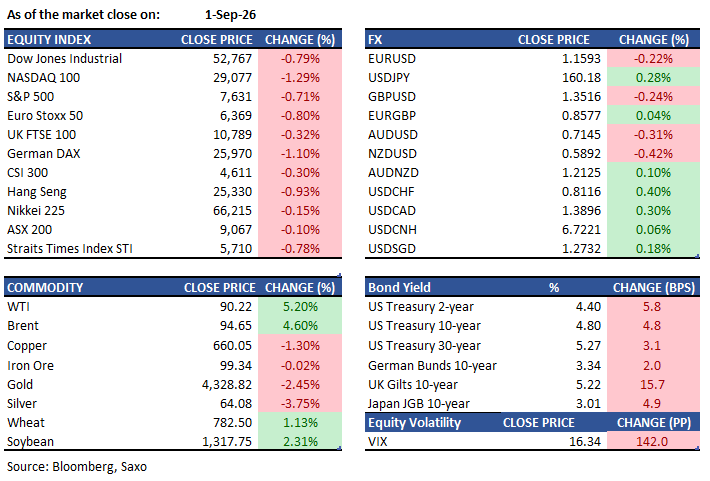
- US — US equities fell for a third consecutive session on Tuesday. The S&P 500 dropped 0.7% to 7,631.47, the Nasdaq 100 shed 1.3%, and the Dow Jones Industrial Average declined 0.8% to 52,766.88, breaking below its 50-day moving average. Energy outperformed while consumer discretionary and technology led declines. CrowdStrike fell nearly 7%, transportation stocks were hit hard (Saia -6.4%, Old Dominion -6.3%), and Micron weighed on semis after reports of threatened strike action at its Taiwan operations. Apple bucked the trend, rising after John Ternus took over as CEO from Tim Cook. Deere hit an all-time high. In after-hours, Dell surged ~7% after raising its annual sales outlook by $25b on strong demand for its AI servers, while Credo Technology (CRDO) slipped ~7.1%.
- EU — European equities fell on Tuesday, ending a five-month winning streak. The Stoxx Europe 600 dropped 0.6% to 647.46, the DAX fell 1.1% to 25,970.11, and the Euro Stoxx 50 declined 0.8% to 6,368.98. The FTSE 100 lost 0.3% to 10,789.28. Rolls-Royce was the largest drag on both the Stoxx 600 and FTSE 100, falling 4.6%. Partners Group had the largest percentage drop at -7.3%. SAP fell 3.5% in Frankfurt. Novartis bucked the trend, rising 6.3% and lifting the SMI 0.3%. In index news, Nokia and Engie will join the Euro Stoxx 50 on 21 September, replacing Volkswagen and Wolters Kluwer.
- Asia — Asian markets were mixed on Tuesday but futures point to a weaker open on Wednesday. Japan's Topix rose 0.6% for a ninth straight day of gains, led by utilities (Kyushu Electric +8.2%, TEPCO +6.4%) on oil price-driven tariff hike hopes, while the Nikkei 225 dipped 0.15% to 66,215.34 as semis weighed. MediaTek surged ~10% in Taiwan after Nvidia announced a $3.5 billion investment. The Hang Seng saw ICBC, Bank of China, and CCB hit record highs, though NIO fell as much as 9% after reporting flat August deliveries and missing Q3 revenue guidance. The STI fell 0.8% to 5,710.37, with DFI Retail the worst performer and Sembcorp Industries the top gainer (+2.4%). Kospi 200 futures closed down 3.5% overnight, pointing to a sharp open lower, with the SOX index down over 2% providing a weak lead for memory-related names.
Earnings this week:
- Wednesday: Broadcom, Snowflake
- Thursday: Ciena
FX:
- USD extended gains against most major peers on Tuesday, driven by rising oil prices following fresh US-Iran hostilities that heightened concerns over energy supply disruptions through the Strait of Hormuz. The Bloomberg Dollar Spot Index rose 0.2% to 1,198.31.
- USDJPY breached the 160 level, with risks skewed to the upside after clearing key resistance. Treasury Secretary Bessent signalled support for Japan raising rates to bolster the yen.
- GBPUSD came under pressure as gilts led a global bond selloff — 10-year UK yields climbed as much as 11 bps to 5.25%, with traders pricing in two Bank of England rate hikes by February.
- AUDUSD closed 0.3% lower in New York, weighed by rising bond yields and the US-Iran escalation. The pair consolidated in early Wednesday trade ahead of Australia's Q2 GDP release.
- USDCNH edged up 0.1% to 6.7224 after the PBOC set a slightly weaker fixing at 6.7809 vs. 6.7828 the prior day.
Commodities:
- WTI crude topped $90 per barrel and Brent traded above $92–$94 on Tuesday, the highest levels since late July, as fresh US strikes on Iranian targets near the Strait of Hormuz and Iranian retaliation sharply escalated supply disruption fears. European gas prices also surged to a three-year high.
- Gold dropped as much as 2.5% to around $4,330 per ounce — its lowest since mid-August — as surging global bond yields and a stronger dollar weighed on the non-yielding metal. The three-day decline is on pace for the largest such move in recent months, despite gold miners having posted their best August performance since 1994.
Fixed income:
- The US 10-year Treasury yield rose to 4.796%, its highest since January 2025, while the 2-year reached 4.392%. The 30-year yield climbed back to 5.27%, erasing gains from Treasury Secretary Bessent's August buyback expansion. Japan's 10-year JGB yield touched 3.00% for the first time since 1996, UK 30-year gilts hit 5.89% — the highest since May 1998 — and Germany's 10-year Bund reached 3.364%, a level last seen in 2011. The global bond selloff has spread to EM, pushing yields higher from South Africa to South Korea.
- The curve flattened as oil prices climbed, with rate-hike premium added into overnight swaps. A late block trade in ultra 10-year note futures added to downside momentum. Traders are actively buying Treasury options targeting further yield rises, including a $6.5 million position targeting the 30-year yield reaching as high as 5.7% by end of November. The 52-week bill auction, however, attracted the strongest investor demand in a year, with the buyside takedown the largest since September 2025.
For a global look at markets – go to Inspiration.
This content is marketing content and should not be considered investment advice. Trading financial instruments carries risks and historic performance is not a guarantee for future performance.
The instrument(s) mentioned in this content may be issued by a partner, from which Saxo receives promotion, payment or retrocessions. While Saxo receives compensation from these partnerships, all content is conducted with the intention of providing clients with valuable options and information.