
Access all our platforms from a single account.

Global Market Quick Take: Asia – March 18, 2025

Key points:
- Macro: US retail sales grew 0.2% but below expectations of 0.6%
- Equities: S&P 500 gained 0.6, but megacaps underperformed
- FX: NZD rose above 0.5820, driven by weak USD and strong China
- Commodities: Copper climbed to its highest level in five months
- Fixed income: Treasury curve flattened near the stable 7-year sector
------------------------------------------------------------------
Disclaimer: Past performance does not indicate future performance.
Macro:
- US retail sales grew by 0.2% in February 2025, recovering from a 1.2% decline in January but below the expected 0.6% rise. Seven categories saw declines, including food services (-1.5%) and gasoline stations (-1%). Non-store retailers led growth with a 2.4% increase.
- The NAHB/Wells Fargo Housing Market Index in the US fell to 39 in March 2025, the lowest in seven months, down from 42 in February and below the forecast of 42. Current sales conditions dropped to 43, while buyer traffic decreased to 24. Builders face high material costs, tariff issues, and supply challenges like labour and lot shortages.
- The NY Empire State Manufacturing Index fell to -20.0 in March 2025, the lowest since May 2023, below the expected -0.75. New orders and shipments decreased, while inventories reached a two-year high. Employment and hours worked declined slightly, and input prices rose sharply.
- China's industrial production grew by 5.9% year-on-year in January-February 2025, exceeding the forecast of 5.3% but slowing from 6.2% in December 2024. Manufacturing growth eased to 6.9%, while utilities maintained a 1.1% growth rate.
Equities:
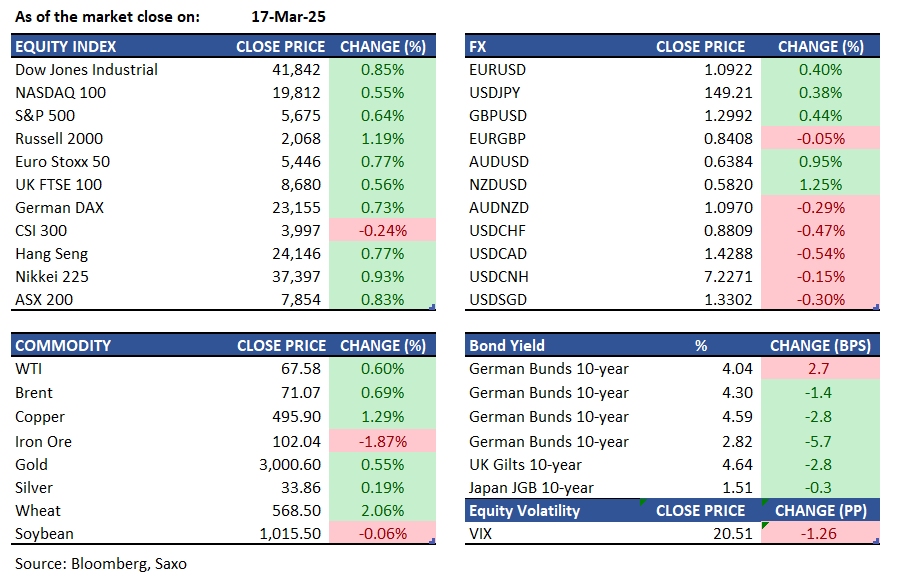
- US - Wall Street stocks rose as S&P 500 gained 0.6%, Dow Jones added 353 points, and Nasdaq 100 advanced 0.5%. February's retail sales increase of 0.2% spurred speculation on Fed rate cuts. Major tech stocks fell, with Tesla down 4.8% and Nvidia down 1.7%, due to valuation concerns. Treasury Secretary Bessent reassured markets, noting corrections are “healthy” but recession risks linger. Investors focus on the Fed's upcoming policy meeting amid changing trade policies. Berkshire Hathaway climbed over 1.5% to a record high.
- EU - The DAX rose 0.6% to 23,098 on Monday, with traders eyeing a crucial vote on Germany's spending plan, which includes exempting defense spending from debt limits and creating a €500 billion infrastructure fund. Most stocks rose, with SAP, Siemens Energy, HeidelbergCement, and Bayer up 1.4%, 2.9%, 1.9%, and 2.1%, respectively. The auto sector also did well, as BMW, Porsche, and Volkswagen gained 1.4%, 0.9%, and 0.6%.
- China – HSI gained 0.8% to close at 24,146, continuing its rise as most sectors grew. Investors reacted positively to China's "special action plan" aimed at boosting domestic consumption, with measures to increase incomes, stabilise markets, promote births, and support tourism. In the US session, Hang Seng futures were up a further 2% while Nasdaq Golden Dragon Index gained 4% as markets gained optimism.
Earnings this week:
- Tuesday: StoneCo, Maravai LifeSciences, Waldencast, HealthEquity, Surf Air Mobility, Inovio Pharmaceuticals, OmniAb, ZTO Express, Absci
- Wednesday: General Mills, Williams-Sonoma, Signet Jewelers, Five Below, Kingsoft Cloud, Tencent
- Thursday: Nike, Accenture, FedEx, Micron Technology, Pinduoduo
- Friday: NIO, Carnival Corporation, MiniSO Group, Soy Good, Zeekr, Torrid
FX:
- Dollar Index (DXY) weakened to 103.6 at the start of the week due to risk-on sentiment and anticipation of upcoming events, including Wednesday's FOMC meeting. Recent data was mixed: Retail Sales fell short on the headline but the control group, impacting GDP, was strong; NY Fed Manufacturing was poor, yet Business Inventories met expectations. Trump tariff discussions were minimal, though Bloomberg noted USTR Greer's efforts to organise reciprocal tariffs after previous disruptions.
- NZD rose above $0.582, its highest since December, due to US dollar weakness and positive Chinese data. Domestic services data suggested uneven recovery, hinting at more rate cuts. Traders await Q4 GDP data, expecting a slight economic rebound.
- EUR gained from dollar weakness, reclaiming the 1.09 level without currency-specific news. GBP rose as the USD faltered, nearing the 1.30 mark.
- JPY weakened past 149 against the USD amid risk-on sentiment, with the BoJ expected to maintain rates at 0.50% during its two-day policy meeting.
- Major economic data: US Building Permit Preliminary, US Housing Starts, Canada Inflation Rate, Eurozone Balance of Trade
Commodities:
- Oil prices stabilised at $71 a barrel after a two-day rise, with attention on China's economy and Middle East risks. Beijing plans to boost consumption, and US retail sales exceeded expectations, yet crude remains $12 below its January peak due to the global trade war and OPEC's upcoming production increase.
- Gold stayed close to $3,000 as US data hinted at an economic slowdown, boosting its safe haven appeal. It was near its record high after a 0.6% gain on Monday. February retail sales fell short of expectations, with January showing the largest drop since July 2021. Lower 10-year Treasury yields also supported gold.
- Copper reached a five-month high after China announced plans to increase spending. Despite property sector challenges, copper rose over 12% this year due to tariffs and mine supply issues. China's aluminium production grew 2.6% to a record high, aided by rising prices.
Fixed income:
- Treasuries' front end lost ground. February retail sales data led to the removal of rate cut premiums and increased demand for hawkish SOFR hedges. The curve flattened around the 7-year sector, with 20- and 30-year yields down nearly 3 basis points. Spread tightening brought 2s10s and 5s30s near session lows, flattening by 4 and 3 basis points from Friday's close.
For a global look at markets – go to Inspiration.