
Access all our platforms from a single account.

Global Market Quick Take: Asia – March 11, 2025

Key points:
- Macro: Trump does not rule out recession due to tariffs and Carney is new Canada PM
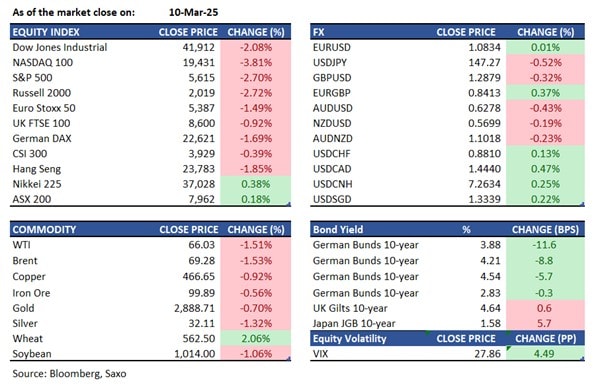
- Equities: Nasdaq 100 fell 3.9%, its worst since 2022, amid rising US economic concerns
- FX: JPY strengthened, USDJPY fell to 146.7 amid softer US yields and haven flows
- Commodities: Oil falls 2nd day in a row, below $66
- Fixed income: Treasuries rose, yields fell, curve steepened; 10-year yield at 4.22%
------------------------------------------------------------------
Disclaimer: Past performance does not indicate future performance.
Macro:
- President Trump did not rule out a recession due to tariff changes, calling the economy a “period of transition.” Fed Chair Powell noted rising uncertainty. Investors are focused on CPI and PPI data ahead of the FOMC meeting next week. Recent data shows concerns, with the jobs report indicating a weakening labor market and the full impact of DOGE cuts yet to be seen.
- US consumer inflation expectations for the year ahead increased to 3.1% in February 2025, up from 3% over the previous three months, reaching the highest level since May.
- Mark Carney became Canada's Prime Minister, keeping tariffs on U.S. goods until “Americans show us respect,” raising uncertainty over trade and policy. The February jobs report showed only 1,000 new positions, against 20,000 expected, raising economic concerns. U.S. threats, including a possible 250% tariff on Canadian dairy, may prompt the Bank of Canada to cut rates by 25 basis points, further pressuring the Loonie.
- Japan's economy grew by 2.2% annualized in Q4 2024, below the preliminary 2.8% figure but stronger than the revised 1.4% in Q3, marking the third consecutive quarter of growth.
Equities:
- US – US market sell-off deepened on Monday due to tariff uncertainty and recession fears. The S&P 500 fell 2.7%, Dow Jones dropped 890 points (2%), and Nasdaq 100 had its worst day since 2022, down 3.9%. Major tech stocks like Tesla (-15.4%), Nvidia (-5%), and Meta (-4.4%) were hit hard. Tariffs from the Trump administration raised inflation concerns, complicating potential Fed rate cuts. Despite Trump's comments on economic transition, investor anxiety remained.
- EU - European stocks fell sharply Monday, with STOXX 50 down 1.6% and STOXX 600 down 1.3%, amid spending and tariff concerns. DAX fell 1.7% to 22,621 amid economic uncertainty and tariff concerns. China's deflation and weak U.S. data worsened global outlook fears. German Greens opposed debt brake reform. Auto stocks led gains, while defence and aerospace stocks advanced.
- HK – HSI fell 1.9% to 23,784, its second consecutive drop, as US futures declined amid economic slowdown worries. Concerns grew over new US levies, rising jobless rates, and federal job cuts. China's deflation and planned tariffs on Canadian goods worsened sentiment. Tech, consumer, and property sectors led losses, with Kingdee Intl. Software (-7.4%), Shenzhou Intl. (-5.3%), Meituan (-4.7%), and Kingsoft Intl. (-4.3%) among the biggest decliners.
Earnings this week:
- Tuesday: Kohl's, Dick's Sporting Goods, Viking, Ciena, UNFI, Casey’s, FuelCell
- Wednesday: ZIM, Adobe, UiPath, SentinelOne, Crown Castle, Tilly’s
- Thursday: D-Wave, DocuSign, Dollar General, Ulta Beauty, Semtech, Futu
- Friday: Li Auto, Gogoro, WRD, Drilling Tools International, Hudson
FX:
- USD mildly strengthened, with the DXY briefly surpassing 103.80 amid risk-off sentiment and haven flows. Gains were capped by a light economic calendar and the Fed's blackout period, as markets await Wednesday's CPI release and US steel and aluminium tariff implementation.
- EUR weakened slightly to 1.0830, facing temporary challenges after reports emerged that Green party officials advised their lawmakers against supporting the spending plans bill.
- GBP fluctuated around the 1.29 level, eventually weakening as the negative market sentiment impacted cyclical currencies.
- JPY gained strength, with the USDJPY pair briefly dropping below the 147 level, influenced by softer US yields and haven flows, while the CHF lagged.
- CAD weakened past 1.44 against USD as Canada's PM pledged to keep tariffs on US imports, dimming hopes for a US-Canada solution before USCMA relief ends on April 2nd.
- Major economic data: US JOLTs Job Openings, US API Crude Oil Stock Change
Commodities:
- Oil fell for the second day, mirroring declines in markets. WTI dropped below $66, with Brent crude near $69. Investors pulled back due to economic concerns as Trump continues tariffs. Oil is down nearly 20% from its mid-January peak.
- Gold dipped to $2,890 per ounce amid trade tensions. Investors are watching U.S. inflation data for Federal Reserve insights. President Trump warned of possible tariffs on Canadian dairy and lumber, adding to uncertainty.
- Copper futures fell below $4.70 per pound on Monday, continuing losses as disappointing economic data from China affected market sentiment. Weekend data showed declines in China's consumer and producer prices in February, highlighting ongoing deflationary pressures.
Fixed income:
- Treasuries gained as yields in the front-end and belly dropped about 10 basis points, steepening the yield curve. Corporate bond sales didn't rise as expected, further supporting Treasuries. Yields fell by at least 5 basis points across maturities; the 10-year yield at 4.22% was 8 basis points lower compared to stable UK and German yields.
For a global look at markets – go to Inspiration.