Access all our platforms from a single account.

Asia Market Quick Take – 10 July, 2026
Key points:
- Macro: US–Iran tensions escalate with reciprocal strikes, while US jobless claims stay low
- Equities: Micron up 8.3% on $250B US capex plan; SK Hynix debuts record $26.5B ADR at $149
- FX: Dollar softens broadly; GBP outperforms, USDJPY elevated with intervention risk lingering
- Commodities: Oil pulls back as US–Iran tensions seen contained; gold stabilizes, silver outperforms
- Fixed income: US treasuries rallied as oil declined, with 10y and 1y yields falling
------------------------------------------------------------------
Disclaimer: Past performance does not indicate future performance.
Macro:
- The US–Iran conflict intensified as Washington conducted a second day of strikes across five Iranian provinces, including near the Bushehr nuclear plant and key transport and air-defence infrastructure, while Iran responded with drone and missile attacks on US bases in Kuwait, Bahrain and Qatar; reported Iranian casualties reached 14 dead and 78 injured, though markets still largely expect the conflict to remain contained and return to talks
- US initial jobless claims fell 2,000 to 215,000 in the week ended July 4, slightly below the 217,000 consensus estimate, signalling that layoffs remain at historically low levels.
- Fed rate-hike risks remain in focus. Fed minutes flagged live rate-hike risks, and markets are pricing in a hiking cycle beginning as early as October. Jupiter Asset Management has cut US Treasury holdings to zero in one of its main bond funds, citing overheating risks in the US economy.
- German exports unexpectedly rose 0.9% in May, defying expectations of a 0.4% decline, driven by a 23.1% surge in shipments to the US and a 7.1% increase to China.
- Japan’s producer prices rose 7.1% year-on-year in June 2026, up from 6.6% and above the 6.8% forecast, the fastest gain since March 2023, driven mainly by higher energy and input costs. Month-on-month, prices rose 0.4%, down from 1.1% in May.
Equities:
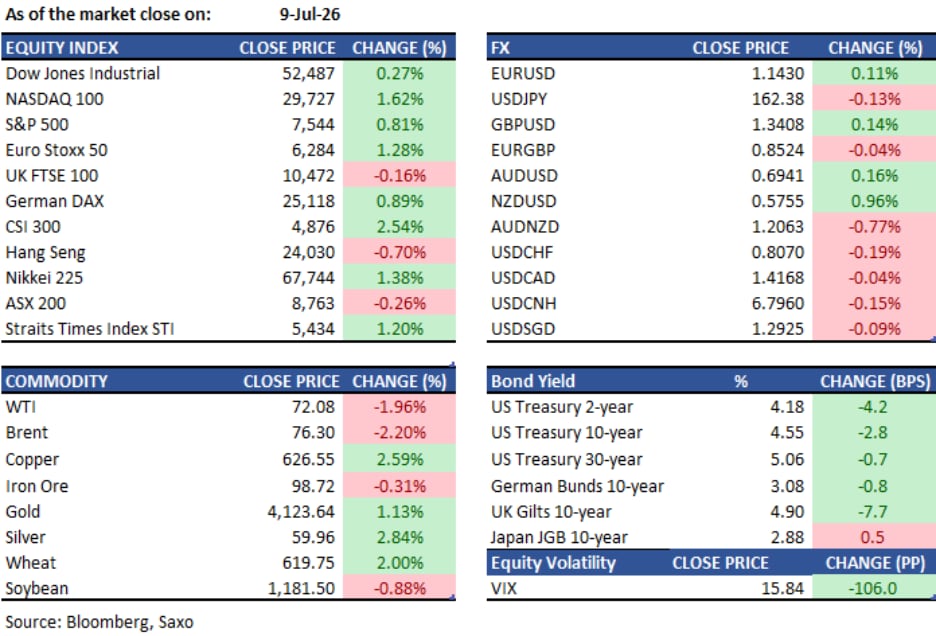
- US — Wall Street rebounded on Thursday as chipmakers led a broad rally. The S&P 500 rose 0.8% to 7,543.64 and the Nasdaq 100 gained 1.6%, with the Philadelphia Semiconductor Index surging 5.2%. Meta (+4.7%) and Lumentum (+11.1%) were among the top S&P 500 gainers. Micron jumped 8.3% after announcing plans to increase US plant spending to $250 billion. Healthcare distributors McKesson (-3.3%) and Cencora (-2.1%) fell after FedEx launched a competing life sciences logistics unit. Paramount slumped after Arete Research questioned the debt burden from its planned Warner Bros. Discovery merger. Meta launched a paid developer tier for its Muse Spark 1.1 AI model and is exploring renting out AI compute. S&P cut Oracle’s rating to BBB-, citing heavy AI-related capex, long-term data center commitments, and intensifying competition.
- EU — European stocks rebounded on Thursday after Wednesday's sharp selloff. The Stoxx 600 rose 0.8% and the Euro Stoxx 50 gained 1.3%, snapping a three-day losing streak. ASML led the advance, rising 4.8%, while Computacenter soared after raising its full-year outlook on the back of US hyperscaler data-centre demand. AstraZeneca was the standout decliner, falling 6.2% — its worst day in years — after its Wainua heart drug failed a late-stage trial. The FTSE 100 underperformed, falling 0.2%, dragged down by AstraZeneca's heavy weighting. The DAX rose 0.9% and the OMX Stockholm gained 1.3%, led by Ericsson (+6.7%). Volkswagen plans to cut its model lineup by up to 50% as part of a savings drive, while avoiding immediate large-scale job cuts or plant closures.
- Asia — Asian markets are set to open higher on Friday, with equity-index futures for Japan, South Korea and Hong Kong all pointing to gains following Wall Street's chipmaker-led rebound. SK Hynix raised $26.5 billion in a record US ADR debut by a foreign firm, selling 177.9 million AI-linked ADRs at $149 each. The oversubscribed deal funds capex, with when-issued trading Friday and regular Nasdaq trading from July 13. On Thursday, the Kospi saw foreign inflows for a second consecutive day, though the index has been under pressure this week amid AI sentiment volatility. Seven & i Holdings raised its full-year operating profit forecast to ¥425 billion, above prior guidance and analyst estimates. Fast Retailing also lifted its full-year operating income guidance to ¥730 billion, beating consensus. CICC shares rose after reporting preliminary 1H net income growth of 78%–90%.
Earnings this week:
- Friday – Delta Airlines
Key Event this week:
- Friday - SK Hynix ADR listing
FX:
- G10 FX saw mild, broad-based USD softness overnight with DXY index sits just above the 100 level.
- USDJPY slipped 0.14% to 162.35, just below its 52-week high and keeping intervention risk elevated.
- GBPUSD climbed 0.16% to 1.3410, extending gains in 10 of the past 11 sessions and making sterling the standout G10 performer.
- USDCAD edged down 0.02% to 1.4170 for a third straight day of USD weakness, its best run since early May.
- AUDUSD traded at 0.6940 and NZDUSD at 0.5760, both supported by a constructive risk backdrop after a strong US equity rally, while USDNOK at 9.72 and USDSEK at 9.6630 were little moved.
Commodities:
- WTI crude fell approximately 2% on Thursday to settle near $72 a barrel, and Brent settled near $76, as traders priced in a contained US-Iran conflict and expected energy shipments through the Strait of Hormuz to recover. This followed a 5.2% surge in Brent on Wednesday — its biggest single-day gain since May — after Trump declared the ceasefire over and the US revoked Iran's oil export waiver.
- Gold held near $4,120/oz in Asia after snapping a three-day slide, supported by renewed Middle East tensions and a softer dollar, but capped by rate worries. Silver outperformed, trading just above $60/oz with the gold/silver ratio around 68.7x.
- Copper on the LME closed $324 higher at $13,490 a ton on Thursday, supported by AI infrastructure demand tailwinds and a rebound in risk appetite. Tin surged $1,552 to $53,647 a ton, while nickel gained $249 to $16,587 a ton.
Fixed income:
- US 30-year auction cleared at 5.058%, the highest yield since 2007 but through the 5.061% when-issued level, signalling stronger-than-expected demand. Indirect bidders took 77.7% of the issue, among record highs, capping a week of stop-through 3y/10y/30y supply.
- US treasuries rallied as oil fell, with the 10-year yield down 4.3 bps to 4.541% and the 1-year down 4.7 bps to 4.024%. The 5s30s spread widened to 78.6 bps from 74.6 bps, extending curve steepening.
- Japanese government bond yields briefly topped 2.9% on Thursday, a 30-year high, extending a nine-session losing streak. The sustained JGB selloff is heightening concerns over global duration risk and potential implications for US equity valuations, given Japan’s large US asset holdings.
For a global look at markets – go to Inspiration.
This content is marketing content and should not be considered investment advice. Trading financial instruments carries risks and historic performance is not a guarantee for future performance.
The instrument(s) mentioned in this content may be issued by a partner, from which Saxo receives promotion, payment or retrocessions. While Saxo receives compensation from these partnerships, all content is conducted with the intention of providing clients with valuable options and information.