
Access all our platforms from a single account.

Global Market Quick Take: Asia – April 2, 2025

Key points:
- Macro: Trump reviews 3 tariff strategies set for release on Wednesday
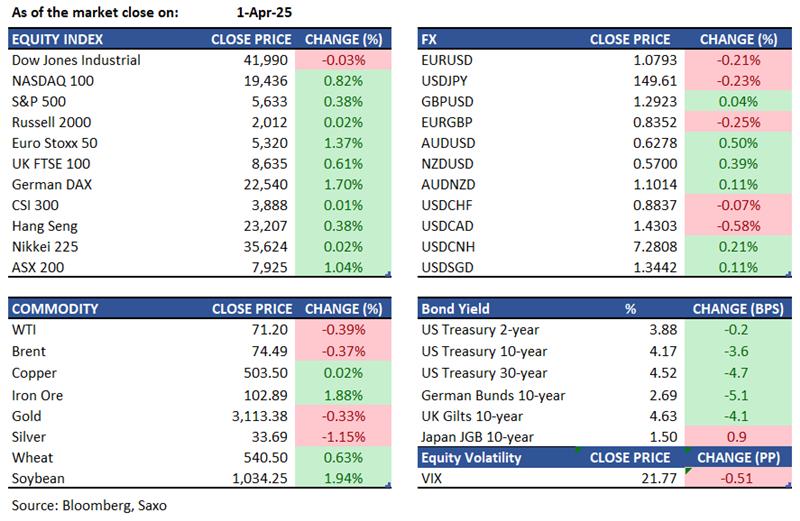
- Equities: Nasdaq 100 gains 0.8 ahead of Liberation Day. J&J fell 5.7%
- FX: USD remained flat amid tariff anticipation; CAD, JPY, NZD, and AUD strengthened
- Commodities: Gold fell from a record high amid tariff uncertainty
- Fixed income: Treasury futures volumes were 7% above average
------------------------------------------------------------------
Disclaimer: Past performance does not indicate future performance.
Macro:
- Trump is evaluating three tariff strategies: blanket 20%, tiered rates, and country-specific rates, with a focus on the latter. Upcoming announcements include tariffs on pharmaceuticals and semiconductors, lifting fentanyl tariffs for Canada and Mexico, and imposing secondary tariffs on Venezuela.
- The White House plans to unveil reciprocal tariffs and levies on Wednesday, which could exceed the scope of the 1930 Smoot-Hawley tariffs. Concerns are rising over a possible 20% tariff on most U.S. imports, with analysts warning that the market may be underestimating the trade risks.
- Job openings dropped by 194,000 to 7.568 million in February 2025, missing the 7.63 million forecast. Declines occurred in retail trade, finance and insurance, health care and social assistance, leisure and hospitality, and manufacturing.
- ISM Manufacturing PMI came in lower than expected at 49 vs 49.5 est while ISM manufacturing prices surged to 69.4, beating expectations of 64.6.
Equities:
- US - The S&P 500 rose 0.4%, the Nasdaq 100 gained 0.8%, while the Dow Jones ended slightly lower as investors awaited President Trump's tariff policy update. Consumer discretionary stocks like Tesla (+3.6%) and Nike (+2%) led the gains. The White House is set to unveil new tariffs, sparking concerns about a potential 20% levy on most U.S. imports, with analysts warning of underestimated trade risks. Johnson & Johnson fell 5.7% after a judge rejected its bankruptcy attempt for resolving talc lawsuits. Economic data revealed continued contraction in the factory sector for March, with price pressures peaking since 2022.
- EU - European markets rebounded with the Stoxx 50 and Stoxx 600 climbing over 1%, ending a four-day losing streak. This recovery follows a 1.5% drop the previous day, reaching two-month lows as investors prepared for new trade tariffs from President Trump, effective Wednesday. Despite uncertainty over the tariffs' scope, reports suggest a possible 20% levy on most U.S. imports. Eurozone inflation eased to 2.2% in March, matching expectations. In corporate news, Thyssenkrupp jumped over 7% after analysts at Kepler Cheuvreux upgraded it to "buy," highlighting increased steel and defence spending in Germany.
- HK - On Tuesday, the Hang Seng rose 87 points, or 0.4%, to 23,207, breaking a two-day losing streak and moving away from a four-week low, driven by growth in China's manufacturing sector. A private survey indicated four months of strong factory activity, coupled with Monday's official data showing the fastest manufacturing expansion in a year. Gains were limited by traders anticipating Trump's tariff announcement on Wednesday. Xiaomi fell 5.5% after a fatal accident involving its SU7 electric vehicle on March 29.
Earnings this week:
Wednesday: BlackBerry, RH, UniFirst, Penguin Solutions, Bassett.
Thursday: Conagra, Guess, Lamb Weston, MSC, Lifecore Biomedical.
Friday: Acuity Brands, Lindsay Corporation, RenovoRx, Simulations Plus, FranklinCovey.
FX:
- USD remained largely unchanged after a volatile session with weak data releases, as participants awaited Wednesday's 'Liberation Day' tariffs. President Trump is considering three options: blanket 20% tariffs, a tiered system, and country-specific rates, with blanket tariffs being the least likely. Canada and Mexico fentanyl tariffs are expected to be lifted.
- Ahead of "Liberation Day," G10 currencies generally strengthened against the USD, led by gains in CAD, JPY, NZD, and AUD, while GBP and CHF remained unchanged.
- EUR fell below 1.08 against the USD due to weak PMI figures and looming tariffs. The EU may target major US tech firms in response, with President von der Leyen stating the bloc can counter US tariffs using various measures.
- GBP returned to flat after recovering from a dip below 1.29, with BoE's Greene noting slack in the UK labour market and satisfaction with inflation forecasts.
- JPY gained slightly against the USD, with USDJPY fluctuating after dropping below 150 amid softer US yields.
- AUD choppy after the RBA maintained the Cash Rate at 4.1%. The statement highlighted uncertainty, moderating inflation, and prioritised inflation targets. Governor Bullock stated no rate cut discussion occurred, and the board remains undecided on a potential May policy change.
- Major economic data: US ADP Employment Change, US Factory Orders & Durable goods orders
Commodities:
- Gold stabilised as the market paused ahead of Trump's "reciprocal" tariffs, expected Wednesday. Trading was little changed, under $40 from its record. Details of the tariffs remain unclear before the 4 p.m. event in Washington.
- Oil dipped amid uncertainty over Trump's tariff plans, with WTI futures down 0.4% above $71 a barrel.
Fixed income:
- Treasuries rose as weaker-than-expected March ISM manufacturing and February JOLTS data were released. Gains continued after the White House confirmed immediate tariffs from Trump, effective today. Yields fell 2 to 5 basis points, tightening spreads. US 10-year yields ended around 4.16%. Treasury futures volumes were 7% above average, with increased activity in long-bond futures.
For a global look at markets – go to Inspiration.