
Access all our platforms from a single account.

Global Market Quick Take: Asia – April 17, 2025

Key points:
- Macro: Fed in wait and see mode till further clarity regarding tariffs on economy
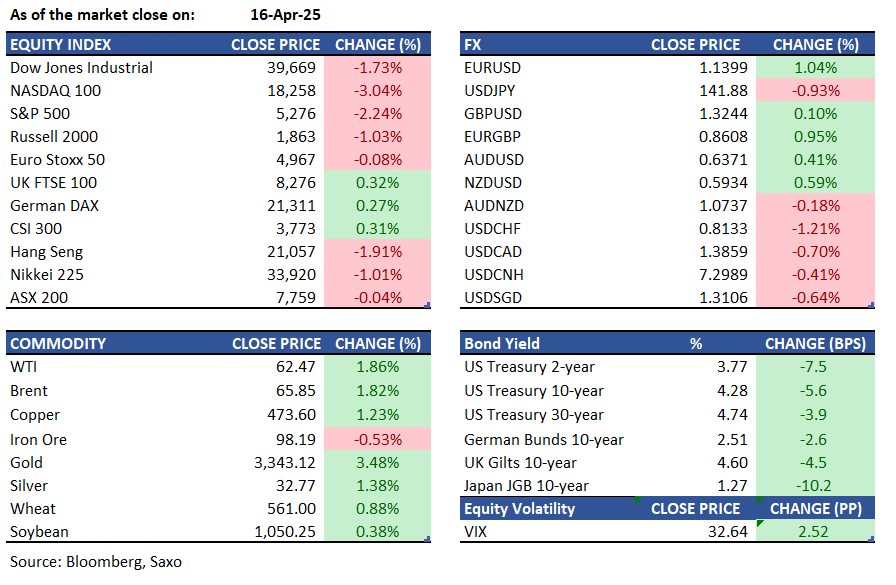
- Equities: S&P 500 fell 2.2% on Powell comments; Hertz up 56% on Pershing stake
- FX: Dollar index fell below 99.3 due to Powell's tariff concerns; CHF strengthened to 0.8150
- Commodities: Gold extends gains to another record high
- Fixed income: Treasuries rose for the third consecutive day
------------------------------------------------------------------
Disclaimer: Past performance does not indicate future performance.
Macro:
- China's Foreign Ministry urged the U.S. to stop maximum pressure tactics for dialogue, ending threats and blackmail. China is open to talks if President Trump shows respect and addresses Taiwan and sanctions concerns. It noted some exports face a 245% tariff and vowed to fight if their interests are harmed.
- Powell said the Fed will wait for clarity before changing policy, noting possible tension between dual-mandate goals. Policy effects may move the Fed away from its goals this year, with possible resumption next year.
- U.S. retail sales increased 1.4%, surpassing the 1.3% forecast and February's 0.2% rise. This was the largest jump since January 2023, driven by a 5.3% rise in motor vehicle and parts sales. Excluding autos, sales rose 0.5%.
- UK's annual inflation rate fell to 2.6% from 2.8% in February, below the 2.7% forecast. The slowdown was mainly due to declines in recreation and culture, including games and data equipment, and a 5.3% drop in motor fuel prices.
- The NAHB/Wells Fargo Housing Market Index increased to 40 from 39, surpassing the forecast of 37. Builder sentiment stayed negative due to tariff concerns and high material costs, despite lower mortgage rates. 60% of builders noted supplier price hikes averaging 6.3% due to tariffs.
- China's economy grew 5.4% year-on-year, exceeding the 5.1% forecast. This was the strongest growth in 18 months, driven by Beijing's stimulus, with March showing rapid industrial output, strong retail sales, and a lower jobless rate.
- Bank of Canada kept its interest rate at 2.75%, marking the first hold after seven consecutive cuts totaling 2.25 percentage points. The council cited tariff uncertainties as risks to growth and inflation, advising caution on further easing.
Equities:
- US - On Wednesday, Wall Street saw a major sell-off, mainly in tech stocks, amid trade tensions and comments from Fed Chair Jerome Powell. The S&P 500 fell 2.2%, the Dow lost nearly 700 points, and the Nasdaq dropped 3%. Nvidia plunged 6.9% due to a $5.5 billion charge caused by new US export restrictions on AI chips to China, affecting other chipmakers like AMD (-7.3%) and Micron Technology (-2.4%). Hertz is up 56%, and a further 33% in the post market after Pershing square revealed a 12.7M share stake.
- EU- European stocks fell on Wednesday, affected by poor earnings and fears that US tariffs will hinder growth in major economies. The Eurozone's STOXX 50 ended slightly down at 4,967, while the STOXX 600 fell 0.2% to 507. ASML reported reduced revenues, citing uncertainties in US economic policy impacting client orders, causing its shares to fall by 5.2%. LVMH dropped 1%, continuing a weekly decline of around 8% due to weak revenues. Conversely, banks like Nordea, UniCredit, and BNP Paribas rose nearly 2%, supporting the broader sector and mitigating losses.
- HK - On Wednesday, the Hang Seng dropped 409 points or 1.9% to 21,057, ending a six-session rally, influenced by U.S. futures falling due to ongoing tariff uncertainties. After reaching a two-month high, growth forecasts for China's 2024 were downgraded by banks like Morgan Stanley and UBS due to tariff concerns. Goldman Sachs noted that previous export frontloading might impact Q2 growth. China’s economy grew 5.4% yoy in Q1, beating the 5.1% forecast. Tech stocks led the decline, falling 3.7% after Nvidia’s potential $5.5 billion charge linked to U.S. export restrictions. Alibaba fell 4.1% and Tencent 2.6%, but losses were trimmed after Premier Li Qiang advocated boosting consumption and domestic demand.
Earnings this week:
Thursday - TSMC, Netflix, UnitedHealth Group, Huntington Bancshares, American Express, Regions Financial
Friday - D.R. Horton, Ally Financial, Hooker Furniture, Fifth Third Bank, Texas Capital Bank
FX:
- USD faced pressure throughout the day, and the DXY fell below 99.3 due to ongoing trade uncertainty and US-China tensions. Mixed data releases and Fed Chair Powell's cautious comments, contrasting with Waller's preference for earlier rate cuts, affected dollar sentiment.
- EUR gained from dollar selling, briefly reaching 1.14, ahead of the ECB meeting expected to cut rates by 25bps.
- GBP remained flat against the dollar after weaker UK CPI data led to a pullback from resistance near 1.33.
- CHF strengthened nearly 1% to near 0.815 against USD, nearing 2011 highs. It surged over 7% since the April 2 tariff announcement, driven by weakened dollar amid U.S.-China trade tensions and recession fears.
- JPY strengthened as USDJPY dropped below 142 amid a weaker dollar, softer US yields, and risk aversion.
- CAD strength below 1.39 level against USD persisted as BoC held rates amid tariff uncertainty. Governor Macklem outlined scenarios: limited tariffs with weak growth, or prolonged trade war causing recession and inflation above 3%. Both scenarios lowered 2025 growth, exports, and inflation forecasts.
- Major economic data: AU Unemployment Rate, BoJ Nakagawa Speech, Germany PPI, ECB Interest Rate Decision, ECB Press Conference, US Housing Starts, Fed Barr Speech
Commodities:
- Oil prices increased as the US aimed to cut Iran's energy exports. Brent crude topped $66, and WTI was near $63. The US sanctioned a Chinese refinery for processing Iranian oil.
- Gold rose to fresh high as Fed Chief Powell's trade war warnings increased volatility, leading to declines in stocks and the dollar. Bullion reached $3,357.78, while the dollar hit a six-month low amid tariff uncertainty.
Fixed income:
- Treasuries climbed for the third day as yields reached session lows, coinciding with a decline in US equities during Fed Chair Powell's speech. Powell noted potential tensions between trade policy and the Fed's employment and price stability goals and viewed recent market turmoil as normal amid uncertainty. Strong demand for a 20-year bond auction supported earlier gains.
For a global look at markets – go to Inspiration.