
Access all our platforms from a single account.

Asia Market Quick Take – 25 June, 2026

Key points:
- Macro: Iran told US that no tolls will be charged on ships transiting SoH
- Equities: Micron surged 15% on blowout guidance; Nasdaq 100 futures up 2% post mkt
- FX: Dollar surges to 52-week high, pressuring EUR, GBP, with AUD underperforming
- Commodities: Gold breaks $4,000 and silver below $60
- Fixed income: US Treasuries rallied with 10 year yield down to 4.4%
------------------------------------------------------------------
Disclaimer: Past performance does not indicate future performance.
Macro:
- US-Iran peace efforts have improved the oil supply outlook. Confidence in a lasting deal has increased tanker traffic through the Strait of Hormuz with signals on, and buyers now face more crude offers from the Middle East and West Africa. A temporary US waiver for already-loaded Iranian oil will further boost supply, and Brent’s prompt spread shifted into bearish contango on Wednesday for the first time since the conflict began.
- US new single-family home sales fell 7.3% in May 2026 to an annualized 580,000, a four-month low and well below forecasts. Higher mortgage rates weighed on demand, with sharp declines in the West and South and gains in the Northeast and Midwest. Inventory rose to 10.3 months of supply, the highest since 2009, while the median sales price increased slightly to $424,900.
- Trump said Iran has told the US it is not charging tolls, insurance, or other fees on ships transiting the Strait of Hormuz. He warned that if this proves false, negotiations will end immediately, and stressed that no money has been given to Iran or released from its funds.
Equities:
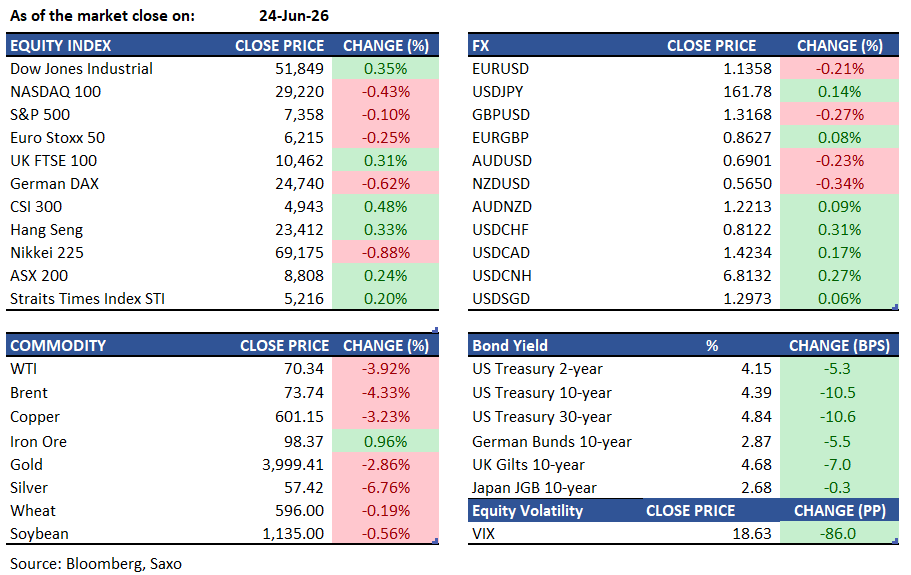
- US — US equities closed mixed on Wednesday for a third straight session of weakness, with the S&P 500 down 0.1% to 7,358, the Nasdaq 100 off 0.4%, and the Dow Jones up 0.4% to 51,849. Microsoft fell 2.3% and Apollo Global dropped 6.1%, the largest drags on the S&P 500. Wendy's surged as much as 42% on meme-stock retail inflows. KB Home beat on gross margins, lifting homebuilder stocks broadly. Home Depot rose 5.7% during the session but fell 5.4% in after-hours trade. In post-market, Micron surged ~15% on its blowout guidance, lifting Qualcomm and Western Digital by ~10% each, with Nasdaq 100 futures up ~2%.
- EU — The Stoxx 600 closed flat on Wednesday after a choppy session following Tuesday's tech-led retreat. The DAX fell 0.6% to 24,740, dragged by Rheinmetall which plunged a record ~19% after Germany withdrew from a key warships contract. The FTSE 100 rose 0.3% to 10,462, led by Segro (+17.4%) after the UK warehouse REIT rejected a £12.6 billion takeover approach from Prologis as "opportunistically timed." The SMI gained 1.5%, led by Nestle (+3.3%) and Givaudan (+4.4%). The Euro Stoxx 50 fell 0.25% to 6,215. Mining stocks were among the weakest performers as metals extended losses on the stronger dollar.
- Asia — Asian markets staged a cautious recovery on Wednesday from Tuesday's sharp tech-led selloff. The Hang Seng rose 0.3% to 23,412, led by Tencent (+3.4%) and SMIC (+8.9%), supported by HK$15.8 billion of net mainland buying via Stock Connect. The Kospi surged 2.9% to 8,717 on Thursday morning, partially recovering from Tuesday's 10% rout, with Samsung Electronics rebounding sharply. The Nikkei closed 0.9% lower on Wednesday but futures pointed ~1,755 points higher on the SGX heading into Thursday's open, supported by Micron's after-hours beat and lower oil prices. The CSI 300 gained 0.5% to 4,943 on Wednesday. SK Hynix launched a blockbuster $29.4 billion US ADR listing, underscoring continued investor appetite for AI-linked memory names. Sanrio shares swung sharply in Tokyo after its full-year operating income guidance beat estimates.
Earnings this week:
- No notable names
FX:
- USD extended its rally overnight, with the Dollar Index hitting a fresh 52‑week high at 97.73, supported by rising expectations of further Fed tightening ahead of today’s key US PCE inflation release.
- USDJPY held near a new 52‑week high around 161.81 amid elevated BoJ intervention risk. The next key level is 161.95, which would mark the weakest yen since December 1986.
- USDCAD climbed to 1.4234, also a 52‑week high and marking 10 straight sessions of gains for the dollar; and USDMXN continued higher to 17.61.
- EUR, GBP, and AUD slipped modestly, with EURUSD easing toward 1.1350 as Fed hike bets intensified and GBP attempted rebound faltered, while AUD was the largest overnight G10 mover on the downside.
- USDCNH rose to 6.8132, the highest since May 20 — up six consecutive days to its highest since May 19. Implied volatility on offshore yuan ticked up to levels unseen in over two months.
Commodities:
- Brent crude fell toward $73/bbl and WTI hovered near $70, extending a four-session decline that has nearly erased all wartime price gains. The Strait of Hormuz reopening has flooded markets with supply from the Middle East and Africa, while demand from China has also softened. Trump separately warned that Hormuz transit fees would be a "red line" in Iran negotiations.
- Gold broke below $4,000/oz for the first time since November, falling nearly 3% on Wednesday to trade as low as ~$3,960, as the stronger dollar and rising rate-hike expectations reversed the "dollar debasement" trade that had underpinned bullion's three-year bull run. Gold steadied near $4,000 in early Asian trading Thursday. Goldman Sachs cut its year-end gold target to $4,900 from $5,400.
- Silver fell below $60/oz for the first time since December, with its 14-day RSI approaching oversold levels. Copper dropped 2.1% on the LME to $13,086.50/ton, with aluminium, zinc, nickel and tin also declining, all pressured by the stronger dollar and hawkish Fed expectations.
Fixed income:
- US Treasuries rallied sharply across the curve, with yields falling 6–10 basis points led by the long end. The 10-year yield fell ~9bps to ~4.40%, the 30-year touched 4.85% — its lowest since April 8 — and the 2-year eased to ~4.14%. The rally was driven by falling oil prices easing inflation expectations, with crowded bearish Treasury positions unwinding in a technical squeeze.
- The Treasury sold $70 billion of 5-year notes at a yield of 4.200%, the highest auction yield since January 2025, with a slight tail versus the 4.193% when-issued yield and a bid-to-cover of 2.35x, indicating demand fell marginally short of expectations. Separately, demand for a $28 billion 2-year floating-rate note reopening was soft, as the discount rate has not kept pace with rising Fed hike expectations.
- European bonds rallied in tandem, with the German 10-year Bund yield falling as much as 6bps to 2.86% — its lowest since March — and Gilts also surging as lower oil prices reduced the perceived need for further monetary tightening. ECB rate swaps pointed to 29bps of tightening by year-end, 2bps less than Tuesday.
For a global look at markets – go to Inspiration.
This content is marketing content and should not be considered investment advice. Trading financial instruments carries risks and historic performance is not a guarantee for future performance.
The instrument(s) mentioned in this content may be issued by a partner, from which Saxo receives promotion, payment or retrocessions. While Saxo receives compensation from these partnerships, all content is conducted with the intention of providing clients with valuable options and information.