
Access all our platforms from a single account.

Asia Market Quick Take – 15 September 2026

Key points:
- Macro: AI slowdown call rattles risk sentiment globally
- Equities: CrowdStrike +13.8% after AI security boost while BOFA –5% on profit warning
- FX: Dollar climbs as yields breach 5%, Brent nears $110; USDCAD extends gains
- Commodities: Oil remains elevated while precious metal under pressure
- Fixed income: US 10-year breaches 5% for first time since 2023
------------------------------------------------------------------
Disclaimer: Past performance does not indicate future performance.
Macro:
- AI slowdown call: Anthropic CEO Dario Amodei published a weekend essay urging the AI industry to slow the pace of frontier model development for safety reasons, a view echoed by OpenAI's Sam Altman and Elon Musk. The call rattled risk sentiment globally, triggering a broad selloff in chip and AI-linked equities.
- Fed rate hike imminent: Markets are pricing in a ~92% probability of a 25bp Fed rate hike at the FOMC meeting on Wednesday (Sept. 15–16), which would lift the federal funds target range to 3.75%–4.00%. Goldman Sachs and HSBC both revised their calls to include a September hike following last week's hotter-than-expected August CPI print (core CPI +0.3% m/m).
- Oil surge on Middle East escalation: Brent crude topped $105–$108 intraday on Monday after Yemen's Houthis launched a large-scale ballistic missile and drone attack on Saudi Arabia's King Khalid Air Base. Saudi Arabia's East-West pipeline, shut last week following drone attacks from Iraq, remains a key supply risk. Trump later posted that Russia and Ukraine had agreed to halt strikes on energy targets, which helped oil ease from session highs.
- Trump-Xi summit: A Trump-Xi meeting is expected around September 24. Goldman Sachs survey data suggests most investors view the summit as "largely symbolic," with limited expectations for material deliverables on trade or currency.
Equities:
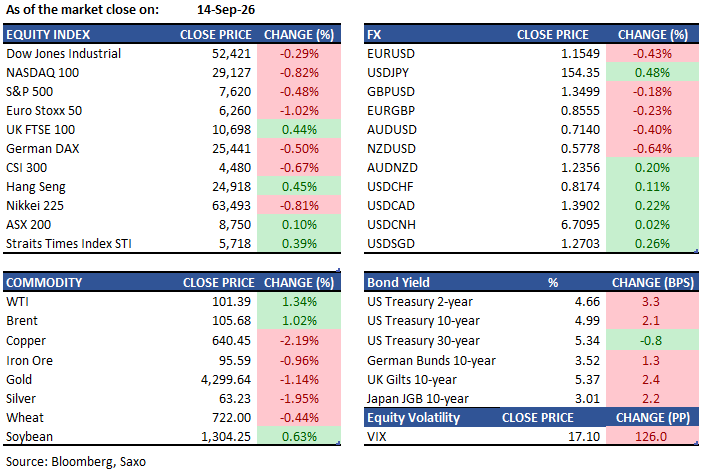
- US — US equities closed lower on Monday as AI slowdown fears hammered chipmakers and elevated oil prices stoked inflation concerns. S&P 500 fell 0.5% to 7,619.98, the Dow Jones dropped 0.3% to 52,421.20, and the Nasdaq Composite declined 0.6% to 26,186.41. The Philadelphia Semiconductor Index tumbled 5.9%, its biggest drop in over two months. Nvidia fell 3.4%, Broadcom, Intel (-5.6%), AMD (-4.4%), Marvell (-7.3%) and Micron (-5.3%) all saw heavy losses. Corning was the worst S&P 500 performer, down ~14%, hit by both AI sentiment and a $2bn at-the-market equity offering announced Friday. Goldman Sachs fell 4.0% and Bank of America slumped 5% on the trading revenue warning. On the positive side, software and cybersecurity stocks rallied with CrowdStrike gaining 13.8% and Palo Alto adding 13%.
- EU — European equities fell on Monday, dragged by the global AI and chip selloff. The Stoxx Europe 600 declined 0.5%, the DAX fell 0.5%, and the CAC 40 dropped 0.8%. The FTSE 100 was a relative outperformer, edging up 0.4%, supported by energy names as oil prices rose. Semiconductor and tech-linked names bore the brunt of selling across the continent, mirroring the US move. German Bund yields hit a 15-year high, tracking the move in Treasuries.
- Asia — Asian markets were mixed on Monday but face a broadly weaker open on Tuesday. The Hang Seng rose 0.5% to 24,917.60 on Monday, bucking the regional trend, led by tech and biotech gains — Xiaomi +3.0%, Hansoh Pharmaceutical +5.1%, and Akeso surged ~6.9% after reporting positive cancer drug trial results. Shein fell ~6.4% after Jefferies initiated at Underperform. The Kospi fell 3.4% on Monday, the worst performer in the region, as SK Hynix and Samsung each lost over 4% on AI slowdown fears; Kospi futures opened down a further 0.4% on Tuesday to 6,659. The Nikkei fell as SoftBank slumped ~11% — its biggest drop in nearly three months — given its deep exposure to OpenAI. The Topix, however, ended up 0.7% with financials leading. Kioxia announced yesterday that they are to consider $10b US listing.
Events this week:
- Tuesday: Trip.com
- Wednesday: FOMC rate decision
- Thursday: BOE rate decision
- Friday: BOJ rate decision
FX:
- USD strengthened broadly on Monday, with the Bloomberg Dollar Spot Index up around 0.3–0.4% as 10-year Treasury yields briefly broke above 5%, Brent neared $110/bbl, and risk appetite was hit by AI slowdown concerns.
- USDJPY rose to 154.35, though resistance around the 155 level capped further upside. Technical analysis suggests risks remain skewed to the downside near-term, with a potential test of 152 in coming weeks.
- USDSEK gained 0.63% and USDCAD rose for a fourth day to 1.3902, with strategists eyeing 1.3940 on Fed and geopolitical risks. USDCAD extended its winning streak to a fourth consecutive day, approaching the 100-day moving average at 1.3931. CIBC flagged a potential move toward 1.3940 on the back of a hawkish Fed outlook and Middle East tensions.
- AUD fell as much as 0.9% intraday to its weakest level since August 20, tracking the broader risk-off tone driven by falling equities and rising oil.
Commodities:
- Brent crude is trading at $105.68/bbl in early Asian trading on Tuesday, having topped $108 intraday on Monday before easing after Trump's post on energy target ceasefire between Russia and Ukraine. WTI is at $102.10/bbl, up ~0.7% on the day. The closure of Saudi Arabia's East-West pipeline following drone attacks from Iraq, combined with the postponement of Hormuz shipping lane talks, continues to underpin prices.
- Gold is trading below $4,300/oz in early Asian trading on Tuesday, having closed around $4,287 — down ~0.3% — as investors piled back into the dollar and out of bullion. The precious metal has struggled to reclaim its safe-haven role, weighed by rising real yields (US 10-year real yield at 2.60%, up 68bps YTD) and Fed hike expectations.
Fixed income:
- The 10-year Treasury yield touched 5.01% on Monday — a key psychological level not seen since October 2023 — before pulling back to close near 4.99%. The move was driven by surging oil prices, mounting inflation concerns, and swelling government borrowing needs. The yield is currently at 4.99% in early Asian trading on Tuesday.
- The Treasury curve twist-flattened on Monday, with the 1-year yield rising ~2.2bps to 4.355% as near-term rate hike pricing firmed to ~92% for Wednesday's FOMC. The 30-year yield fell ~1.6bps to 5.339%, flattening the 5s30s spread by ~3bps to 53.9bps. The 6-month T-bill was sold at 4.06% — the highest in over a year — at Monday's auction. The 10-year real yield rose to 2.60%, its highest in 18 years on a closing basis.
- German Bund yields hit a 15-year high on Monday, tracking the move in Treasuries as energy-driven inflation and fiscal concerns ripple across global sovereign debt markets.
For a global look at markets – go to Inspiration.
This content is marketing content and should not be considered investment advice. Trading financial instruments carries risks and historic performance is not a guarantee for future performance.
The instrument(s) mentioned in this content may be issued by a partner, from which Saxo receives promotion, payment or retrocessions. While Saxo receives compensation from these partnerships, all content is conducted with the intention of providing clients with valuable options and information.