
Access all our platforms from a single account.

Asia Market Quick Take – 13 May, 2026

Key points:
- Macro: Both US headline and Core inflation rise YoY
- Equities: Kospi tumbled 5.3% intraday before paring losses to close lower by 2.3%
- FX: Pound most bearish in five weeks amid doubts over Starmer’s future
- Commodities: Copper surges past $14,000 a tonne; WTI crude tops $100 a barrel
- Fixed income: Gilts lead the bond selloff; US Treasuries fall across the curve
------------------------------------------------------------------
Disclaimer: Past performance does not indicate future performance.
Macro:
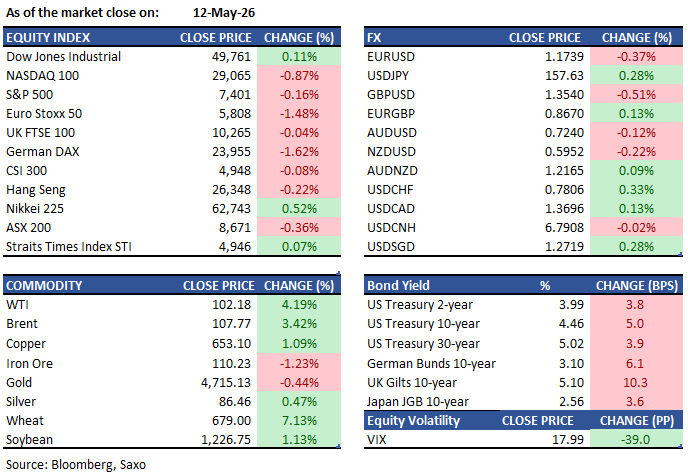
- US inflation rose to 3.8% YoY in Apr 2026 (vs 3.3%, above 3.7% forecast), driven by the oil shock. Energy surged 17.9%, led by gasoline (+28.4%) and fuel oil (+54.3%). Shelter (3.3%) and food (2.3%) also firmed. On a monthly basis, CPI increased 0.6% (down from 0.9% in March). Core inflation rose to 2.8% YoY (vs 2.6%, above forecast), with 0.4% MoM growth. Real wages declined for the first time in three years, while the US is issuing over $35.5bn in tariff refunds after a court ruled the policy unlawful.
- US is issuing over $35.5bn in tariff refunds after a court ruled the policy unlawful.
- Japan’s current account surplus rose to a record JPY 4,681.5 billion in March 2026 from JPY 3,625.3 billion a year earlier, beating expectations. The goods surplus increased to JPY 830.5 billion as export growth of 11.7% outpaced imports at 10.0%, and the primary income surplus also widened. The secondary income deficit narrowed, while the services deficit widened sharply to JPY 257.8 billion.
- The US recorded a $215 billion budget surplus in April 2026, down from $258.4 billion a year earlier and below expectations. Spending rose to $622.3 billion, led by Social Security, interest payments, Medicare, and defense, while receipts fell to $837.3 billion, mainly from income taxes. The fiscal year deficit has reached $954 billion so far.
Equities:
- US - US stocks pared losses late in the session, with the S&P 500 down 0.2%, the Dow flat, and the Nasdaq off 0.7%. A hotter April CPI heightened concerns that rising energy costs could weigh on earnings and reduce the likelihood of Fed rate cuts this year despite a strong labour market. Mega-cap tech was mixed—Alphabet, Amazon, Microsoft and Tesla fell over 1%, while Nvidia and Apple edged up. Chip stocks also declined, with Broadcom and AMD down around 2% amid policy concerns, and Hims & Hers slumped 15% after missing Q1 expectations. Sea Ltd. jumped 13% to a two‑month high after a profit beat, with net income up 6% to $428m and revenue up 47% to $7.1bn, boosting confidence in its strategy even as it prioritises growth over margins and targets ~25% e‑commerce GMV growth by 2026.
- EU - European stocks fell around 1%, with the Stoxx 600 hitting a one-week low amid a broad risk-off move driven by hotter US inflation. Tech and retail led declines, while UK stocks lagged on political uncertainty, with banks dropping over 3% and Vodafone sharply lower. Major indices also fell (DAX ~-1.6%, Euro Stoxx 50 ~-1.5%, CAC -0.95%), while Munich Re led losses; defensive sectors like food, beverages and healthcare outperformed.
- Asia - Asian markets look set for a weaker open after Wall Street losses, with futures pointing lower in Sydney and Tokyo and flat in Hong Kong. South Korea led declines, with the Kospi down 2.3% after earlier sharp losses, while chip stocks weighed on the MSCI Asia Pacific Index (-0.8%). Most regional markets fell, though Japan’s Nikkei rose, even as futures signal slight downside ahead. JD.com ADRs rose as much as 3.4% after a Q1 beat on JD Retail strength and narrower food‑delivery losses, even as net income fell 53% to 5.1bn yuan.
Earnings this week:
- Wednesday: Alibaba, Tencent, Cisco, SoftBank Group
- Thursday: Applied materials, Honda
FX:
- The onshore yuan remained largely stable at 6.7956 per dollar after the PBOC set a stronger fixing at 6.8426, though China's state-owned banks have been aggressively intervening to slow appreciation. The yuan strengthened past 6.8 per dollar at Monday's close, reaching levels last seen more than three years ago, as traders ramped up bullish bets ahead of President Trump's meeting with Xi Jinping in Beijing.
- Sterling slid across the board, with GBPUSD down 0.5% to 1.3538, the second‑weakest performer among major developed currencies. EURGBP edged up 0.1% to 0.8671, its fourth rise in five sessions. An Asia‑session dollar bid started the move, which extended as UK political risk took centre stage. Options pricing shows traders are the most bearish on the pound in five weeks amid uncertainty over Starmer’s future.
- EURUSD fell 0.4% to 1.1739, its third decline in four sessions.
- USDJPY briefly dropped 0.3% to 156.78 before reversing; it was about 0.3% higher at 157.63, holding above the 100‑day moving average at 157.37. Treasury Secretary Bessent stated that Japanese economy fundamentals are strong and resilient, with his FX remarks providing a boost to the yen in European trading hours.
Commodities:
- Brent crude rose 3.42% to settle at $107.77 per barrel, the highest settlement since May 5, while WTI gained to $100.32 per barrel. Oil extended gains amid growing doubts about the possibility of an agreement to end the war in the Middle East, following President Trump's statements that the ceasefire with Iran may collapse. Oil shipments from Iran's main export terminal appear to have come to a standstill over the past several days, according to satellite images.
- Copper jumped above $14,000 a ton, rising as much as 1.2% to $14,106.50 on the London Metal Exchange, closing in on a record high above $14,500 set in January. Comex copper settled 1.11% higher at $6.4850, setting a new record high. The rally came as a rebound in Chinese demand and mounting supply risks outweighed concerns about the Iran war's impact on global growth.
- Gold was trading around $4,718 an ounce after falling 0.4% on Tuesday and price action remains choppy while silver extends gains.
Fixed income:
- US Treasury yields rose across the curve in Tuesday trading, with the 10-year yield climbing 4.9 basis points to 4.463%, approaching its 2026 intraday high. The 30-year yield rose 4.3 basis points to 5.031%, the highest since May 2025. The Treasury's $42 billion 10-year note auction drew a high yield of 4.468%, the highest result since February 2025, and tailed slightly with a bid-to-cover ratio of 2.40 versus 2.43 at the previous auction.
- Gilt yields jumped as the potential for a leadership challenge to UK Prime Minister Keir Starmer stoked concern about UK finances, with gilts leading the selloff in developed market government bonds.
- Australian Office of Financial Management announced that issuance of Treasury Bonds including Green Treasury Bonds in 2026-27 is expected to be about A$125 billion, while issuance for 2025-26 has been revised to around A$120 billion.
For a global look at markets – go to Inspiration.
This content is marketing content and should not be considered investment advice. Trading financial instruments carries risks and historic performance is not a guarantee for future performance.
The instrument(s) mentioned in this content may be issued by a partner, from which Saxo receives promotion, payment or retrocessions. While Saxo receives compensation from these partnerships, all content is conducted with the intention of providing clients with valuable options and information.