
Access all our platforms from a single account.

Asia Market Quick Take – 05 June, 2026
Asia Market Quick Take – 5 June, 2026
Key points:
- Macro: Hezbollah rejects US-brokered ceasefire between Israel and Lebanon
- Equities: Dow gains 1.7% to close at all time high,
- FX: USDJPY at 160 previous intervention level
- Commodities: Oil falls due to hopes of Middle East resolution
- Fixed income: Treasury yield fell across the curve
------------------------------------------------------------------
Disclaimer: Past performance does not indicate future performance.
Macro:
- Trump is reportedly reluctant to resume full-scale war with Iran and would end the truce only if Tehran kills US troops. US–Iran talks show little progress, hindered by Israel’s operations in Lebanon.
- Hezbollah rejected a US-mediated Israel–Lebanon ceasefire, though Trump says the group has approached the White House about ending hostilities.
- US initial jobless claims rose 13,000 to 225,000 in the week ending May 30, above the 215,000 consensus, partly reflecting Memorial Day volatility, while continuing claims slipped 8,000 to 1.777 million.
- Japan’s average cash earnings rose 3.5% year-on-year in April, the fastest pace since December 2024 and 52nd straight gain, with wages up across all major sectors. Inflation-adjusted real wages increased 1.9%, extending their rise to four months.
- US nonfarm unit labor costs rose 1.8% in Q1, down from 2.1% and below the 2.3% estimate, as compensation growth slowed and productivity edged up. Manufacturing unit labor costs increased 2.2%, and year-on-year overall labor costs were up 0.5%.
- US employers announced 97,006 job cuts in May, up from 83,387 in April and the highest May total since 2020. AI was the top driver, with tech leading (38,242 cuts), followed by transportation, services, and fintech. Year-to-date cuts total 397,755, 43% below last year’s federal layoff–inflated figure and roughly in line with 2024.
- Eurozone retail sales fell 0.4% m/m in April after a 0.8% rise in March, with non-food and fuel down and food up. Germany and Spain saw declines, while France rose 0.3%. Year-on-year, sales were up 1%, down from 2.1% in March.
Equities:
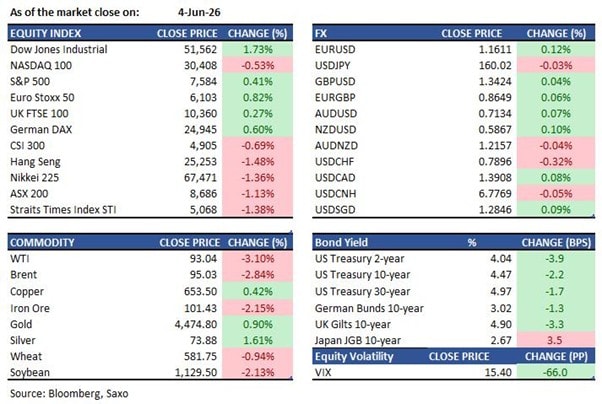
- US — The Dow Jones Industrial Average surged 875 points (+1.7%) to a record close of 51,562 on Thursday, its 15th record close of 2026, led by healthcare and financials. UnitedHealth rose 5.2% after a Bank of America upgrade, while Goldman Sachs, JPMorgan, American Express and Visa all gained over 3%. The S&P 500 rose 0.4% to 7,593, its 10th gain in 11 sessions. The Nasdaq 100 fell 0.5% as Broadcom tumbled 12% after its AI chip revenue guidance disappointed. After hours, Nasdaq 100 futures fell a further 0.9%, Guidewire dropped 16%, and Lululemon slipped 11% after reporting Q1 EPS of $1.69, missing estimates slightly.
- EU — European equities rebounded on Thursday after an initial AI-driven selloff. The Stoxx 600 rose 0.5% to 624.45, led by healthcare. The Euro Stoxx 50 gained 0.82% to 6,103. The DAX rose 0.6% to 24,945, with SAP the top gainer at +5.5%. The FTSE 100 edged up 0.27% to 10,360. Abivax surged 18% on a reassessment of clinical trial data, Remy Cointreau rose as much as 15% on strong earnings, and Maersk gained 8.3%. Pirelli fell 4.2% after Grizzly Research disclosed a short position citing governance concerns.
- Asia — Asian equities are broadly lower on Friday morning, with the Kospi the standout underperformer. South Korea's Kospi opened down 3.7% and extended losses to as much as 5%, with the Korea Exchange activating a sidecar mechanism to halt program selling after KOSPI200 futures fell over 5%. SK Hynix, Samsung Electronics and SK Square are the biggest drags, tracking the US chip sector's 2.2% decline overnight. The Kosdaq fell as much as 2.9%. The Nikkei is tracking lower alongside the Kospi, while the Topix is near flat given its more diversified sector exposure. The Hang Seng closed down 379 points at 25,253 on Thursday, with mainland Chinese investors reportedly rotating out of Hong Kong stocks and back into onshore AI-related names. The STI is also softer. The MSCI Asia Pacific Index is down approximately 1%.
Earnings this week:
- Friday: Sectra, Mr Price Group, ABM Industries, Foschini Group
FX:
- The Korean won weakened to its lowest level since 2009 against the dollar, touching 1,540.55 on Thursday, as foreign investors sold approximately $4.5 billion of local stocks amid ongoing Iran war concerns. The dollar opened at around 1,529 won on Friday morning.
- The Indonesian rupiah breached 18,000 per dollar for the first time ever on Thursday, weighed down by fiscal concerns, sovereign rating downgrade risk and a domestic equity selloff.
- The Japanese yen remains under pressure near 160 per dollar. Japan's Finance Minister Katayama reiterated readiness to act on FX at any time, noting that bold actions are permitted under the US-Japan FX statement. Japan's foreign reserves fell by $75.6 billion in May, suggesting the government may have tapped overseas assets to fund FX intervention.
- The Chinese yuan is near 6.77 per dollar, up over 3% year-to-date, making it Asia's best-performing currency. TD Securities sees potential for further CNY appreciation if portfolio inflows into China's tech rally accelerate, with an end-year target of 6.70.
- The dollar eased retracing part of Wednesday’s biggest gain since 19 May as an Israel–Lebanon ceasefire weighed on oil; Most G‑10 currencies rose while NOK and CAD lagged, and traders awaited US/Canada jobs data.
- USDCAD hit 1.3925 (highest since 7 Apr) before paring;
- EURSEK fell 0.2% to 10.8919 on softer-than‑expected Swedish core inflation; EURCHF slipped 0.2% to 0.9167 and USDCHF dipped 0.3% to 0.7895 after Swiss inflation undershot forecasts.
Commodities:
- Oil prices fell on hopes of a Middle East diplomatic resolution following the tentative Israel-Lebanon ceasefire, though the broader backdrop remains elevated given the ongoing US-Iran conflict and effective closure of the Strait of Hormuz.
- Copper is in focus ahead of the US Commerce Department's June 30 deadline to deliver an updated recommendation on import tariffs for refined copper. Citi sees copper potentially reaching $14,500/tonne in June as tariff fears fuel bullish sentiment, while the premium of US prices over global peers has widened again, prompting renewed metal flows into the US.
- Commerzbank raised its year-end targets for gold to $4,800/oz and silver to $80/oz, reflecting persistent inflationary pressures and geopolitical risk from the Iran conflict. Energy analysts warn that rapid inventory drawdowns from the Strait of Hormuz closure are likely to deliver fuel price shocks, with prices across the energy complex expected to remain higher for longer.
Fixed income:
- US Treasury yields fell modestly, with the 10-year yield declining 2.5bps to 4.471% and the 30-year falling 1.9bps to 4.975%, as easing oil prices and a softer risk tone supported bonds. The 30-year yield is now down nine of the past 11 trading sessions and off 20bps from its 52-week high of 5.18% hit on May 19.
- Large options trades in the Treasury market this week targeted a move higher in 10-year yields, with a $15 million put position on Wednesday targeting 4.70% and a $5 million put on Thursday targeting 4.65% by end of July, signalling that some market participants are positioning for a renewed bond selloff.
- JGBs edged higher in early Tokyo trade, tracking overnight Treasury gains. However, with the dollar recovering to around 160 yen, Barclays' Japan rates strategists note that expectations for a BOJ rate hike in June are resurfacing, which could limit further JGB upside.
For a global look at markets – go to Inspiration.
This content is marketing content and should not be considered investment advice. Trading financial instruments carries risks and historic performance is not a guarantee for future performance. The instrument(s) mentioned in this content may be issued by a partner, from which Saxo receives promotion, payment or retrocessions. While Saxo receives compensation from these partnerships, all content is conducted with the intention of providing clients with valuable options and information.