Access all our platforms from a single account.

Asia Market Quick Take – 7 August, 2026
Key points:
- Macro: Trump imposes 15%% tariff on polysilicon products
- Equities: OCBC and UOB reported earnings that beat expectations on wealth fees
- FX: short: USDJPY rose 0.5% to 158.50, breaking above 200-day moving average
- Commodities: Copper neared a record; Brent climbed to ~$83
- Fixed income: UST yield rose; Alphabet’s 10-tranche bond sale
------------------------------------------------------------------
Disclaimer: Past performance does not indicate future performance.
Macro:
- The Trump administration imposed price floors and a 15% tariff on polysilicon products, used in semiconductors and solar panels, under Section 232 of the Trade Expansion Act, aiming to shield US polysilicon producers from rising Chinese competition in the chip supply chain.
- Tensions in the Strait of Hormuz have unsettled markets and clouded plans to fully reopen the route. Iran says it struck “hostile targets” after explosions near Qeshm Island. A draft Iran‑Oman deal would bar US and Israeli ships, require compensation from “hostile” states, and impose cargo-based penalties, with full reopening conditioned on lifting the US maritime blockade.
- Japan’s household spending fell 3.3% yoy in June 2026, the seventh straight and steepest decline, defying expectations for a 1.0% rise. Weakness was broad-based, led by food, clothing, and transport, while housing and recreation edged up. Month-on-month, spending slumped 6.4%, the first fall since March and the sharpest since January 2021.
- US initial jobless claims rose by 1,000 to 199,000 in the last week of July, below the 202,000 forecast and near a 57-year low. Continuing claims increased by 24,000 to 1.801 million, remaining low and signaling a strong labor market. Federal employee claims ticked up by 32 to 450.
- US nonfarm unit labor costs rose 1.3% in Q2 2026, matching Q1 but below the 2.1% forecast, as compensation increased 2.7% and productivity 1.4%. Manufacturing unit labor costs were flat, with 1.9% gains in both pay and productivity. Year-on-year, nonfarm costs rose 1.4% and manufacturing 3.5%.
- Euro Area retail sales fell 0.3% m/m in June 2026, reversing most of May’s 0.4% gain and missing expectations for a 0.1% rise. Food and non‑food sales declined, while auto fuel rebounded. Sales dropped in Germany and France but rose in Italy, Spain, and the Netherlands. Year-on-year, sales grew 0.7%, the weakest increase since July 2024.
Equities:
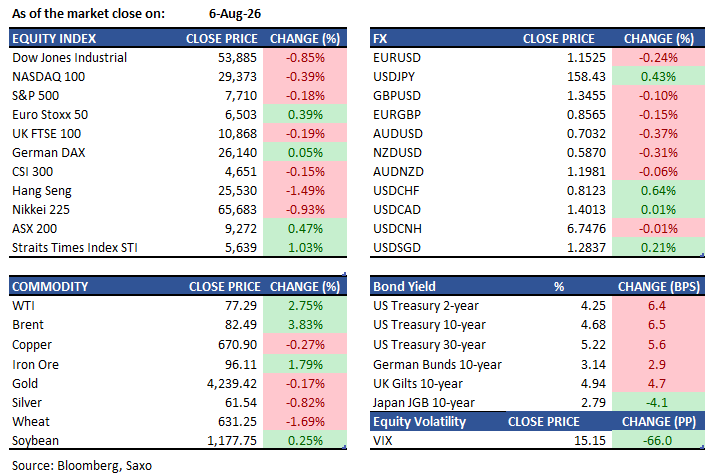
- US — S&P 500 fell 0.2% to 7,709.96 on Thursday for a second consecutive session of losses, pulling further from its all-time closing high set on Tuesday. Dow Jones dropped nearly 500 points (~0.9%) to 53,875, while the Nasdaq 100 declined 0.4%. Fiserv slumped after slashing its full-year profit outlook. Hertz surged 29% on earnings day. Memory names Sandisk and Western Digital sank on weak results. In after-hours trading, Airbnb rose ~8% after boosting its annual revenue forecast, while Atlassian surged on a 28% revenue beat. AppLovin sank ~18% after a weaker-than-expected EBITDA outlook.
- EU — European markets were in a holding pattern ahead of the US payrolls report, with geopolitical risk from the Middle East and rate-hike concerns keeping sentiment cautious. Flutter fell 4.2% in premarket trading earlier in the week after cutting its US revenue guidance for the full year. The MSCI World Index shed 0.2% on Thursday. Equity-index futures pointed to modest declines across the region heading into Friday.
- Asia — Asian equity markets are set to edge lower on Friday following the overnight deterioration in US sentiment. Equity-index futures pointed to modest declines in Japan, Hong Kong and Australia, while South Korea contracts edged higher. On Thursday, the STI gained 1.0% to 5,638.99, led by DFI Retail Group (+3.7%), with Mapletree Pan-Asia Commercial Trust the worst performer (-3.0%). The Kospi 200 futures closed up 1.5% at 995.4. In Hong Kong, Wharf Real Estate surged as much as 32% — its biggest intraday gain on record — after 1H revenue beat estimates. The MSCI China Index fell 1.2% on Thursday. OCBC reported Q2 profit rises 22% to S$2.2b vs S$1.91b consensus driven by wealth management fees, and declared interim dividend of $0.47 vs $0.41 last year. UOB also reported that Q2 profit rose 10% to S$1.48b driven by wealth fees, beating est of S$1.45b, declaring dividend of S$0.88.
Earnings this week:
- Friday: OCBC, UOB, Cisco, Applied Materials
FX:
- USDJPY rose 0.5% to around 158.47–158.55, breaking above its 200-day moving average and triggering stop-loss orders. The move came just one week after the historic US-Japan joint intervention, with 155 now seen as a key support level for the yen. Fitch noted that further yen appreciation will likely require BOJ rate hikes.
- The Australian dollar steadied as traders awaited key US nonfarm payrolls later Friday, after overnight losses on worries about a potential US-Iran deal. AUDUSD was little changed around 0.7033, after closing 0.4% lower in New York.
- USDCNH and USDCNY were little changed at 6.7517, with the yuan holding steady despite the PBOC setting a slightly weaker fixing of 6.789 per dollar. Chinese banks are expanding direct yuan settlement to additional currencies, including the Thai baht and Brazilian real, as part of yuan internationalisation efforts.
- Most emerging market currencies weakened as the Hormuz deal details reignited tensions. The South African rand and Hungarian forint fell sharply. The Mexican peso was the best performer among 14 major currencies, gaining 0.26%, while the Swedish krona was the worst, falling 0.38%.
Commodities:
- Brent crude surged to around $83 per barrel in late US hours, up more than 5% on the day, after Iranian media reported strikes on "hostile targets" in the Strait of Hormuz and Iran sought to restrict passage for US and Israeli vessels. The move revived inflation concerns and weighed on risk assets globally.
- Gold extended its recent strong run, trading around $4,280–$4,328 per ounce after jumping 4.1% in the prior session — its biggest single-day gain since February. The rally has been driven by a combination of Hormuz-related rate-cut optimism earlier in the week, a technical breakout, and strong central bank and institutional demand. Gold is up more than 5% in August alone.
- Copper surged to near a record, rising as much as 1.8% to $14,369.50 per ton on the London Metal Exchange, after Reuters reported that the Democratic Republic of Congo halted exports of copper and cobalt concentrates. Analysts noted the ban captures only a small portion of Congo's exports, but the move adds to a broader supply-tightening narrative, with copper imports into the US running at the highest monthly volume in at least 12 years.
Fixed income:
- The US Treasury yield curve shifted higher across all tenors. The 10-year yield rose ~5.9bps to 4.676% and the 30-year rose ~4.8bps to 5.218%, driven by the FT report on Warsh's September rate-hike readiness, the rebound in oil prices, and supply pressure from Alphabet's 10-tranche bond offering.
- The "Sell America" trade debate intensified, with global bond investors questioning the Fed's inflation-fighting credibility under Chair Warsh, whose preference for sparse communication and reported proximity to the White House has raised concerns. JPMorgan lifted its year-end forecasts for 10- and 30-year Treasury yields and pushed back its forecast for larger bond auctions by six months, citing the Treasury's "subtle" change in debt issuance guidance as a sign of discomfort with rising yields.
- Japan's FX intervention last week is adding to Treasury repatriation risk, as reserve assets deployed to support the yen reduce Japanese demand for US Treasuries, contributing to upward pressure on yields and term premia.
For a global look at markets – go to Inspiration.
This content is marketing content and should not be considered investment advice. Trading financial instruments carries risks and historic performance is not a guarantee for future performance.
The instrument(s) mentioned in this content may be issued by a partner, from which Saxo receives promotion, payment or retrocessions. While Saxo receives compensation from these partnerships, all content is conducted with the intention of providing clients with valuable options and information.