
Access all our platforms from a single account.

Asia Market Quick Take – 07 April, 2026
Key points:
- Macro: Iran rejects 45-day ceasefire and offers 10-point plan which Trump dismissed
- Equities: AI chip demand boosts Samsung earnings; Broadcom gains on new Google partnership
- FX: SEK and AUD led G10 gains; USDJPY remains above 159
- Commodities: WTI trades near $113 after highest close since June 2022
- Fixed income: JGBs seen lower ahead of a ¥600bn 30-year auction
------------------------------------------------------------------
Disclaimer: Past performance does not indicate future performance.
Macro:
- Trump intensified threats against Iran ahead of his Tuesday 8 p.m. ET deadline, warning of strikes on civilian infrastructure, including bridges and power plants, if no deal is reached to reopen the Strait of Hormuz. Markets grew more optimistic after Trump said Iranian negotiators wanted a deal, though Iran rejected a 45‑day ceasefire and offered a 10‑point plan he dismissed.
- G-7 finance ministers vowed to closely coordinate on the Middle East and flagged extreme market volatility and sharp oil price swings. Japan’s Finance Minister Katayama declined to comment on specific levels amid rising government bond yields.
- ISM Services PMI fell to 54 in March from 56.1 in February (below 55 forecast), signaling slower growth. Business activity and employment weakened, prices jumped on higher oil and fuel, supplier deliveries slowed, inventories and backlogs eased, and new orders rose faster, with ISM pointing to the Iran conflict and higher oil prices.
Equities:
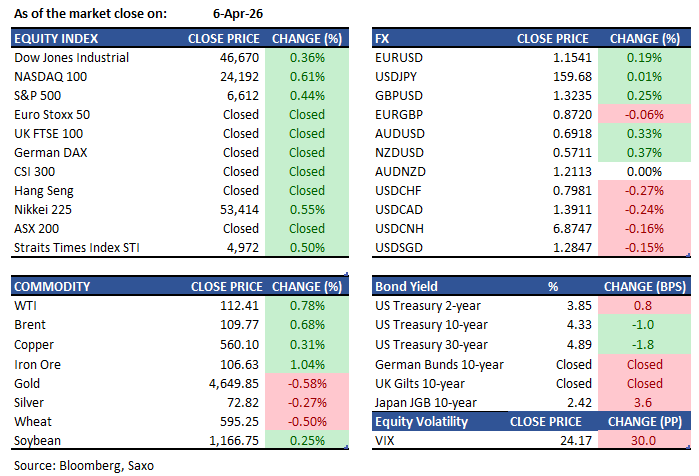
- US: On Monday, the S&P 500 rose 0.4% to 6,611.83, the Nasdaq Composite gained 0.5% to 21,996.34, and the Dow Jones Industrial Average climbed 0.4% to 46,669.88. Apple led the S&P 500 advance with a 1.2% gain. Seagate Technology surged 5.6% after Morgan Stanley named it a top pick on AI tailwinds. Broadcom rose 2.4% in after-hours trading following news of a deal with Google for AI chip design. Anthropic announced its revenue run rate topped $30 billion, up from $9 billion at end-2025. Overnight futures dipped 0.2% as Trump intensified Iran threats.
- Asia: South Korea's Kospi opened Tuesday up 1.9% to 5,552.19 and later rose 2.1% to 5,562.62, driven by Samsung Electronics which surged as much as 4.9% after reporting preliminary Q1 operating profit that beat estimates eight-fold on strong AI chip sales. SK Hynix climbed 3.5%. Japan's Topix rose 1% to 3,681.40. Singapore's Straits Times Index gained 0.5% to 4,972.40 on Monday, with Yangzijiang Shipbuilding up 3.1%. Bank of Queensland shares jumped 4.3% with volume quadrupling average levels. Suzuki Motor fell 6.8% in Tokyo. Australian shares were poised to rise on energy sector strength amid surging oil prices.
Earnings this week:
- Wednesday: Delta
FX:
- USD slipped in thin holiday trading as investors focused on US–Iran ceasefire talks, while risk-sensitive G-10 currencies like SEK and AUD outperformed and FX options volumes ran about 60% below normal. USD later pared losses after reports that Iran rejected a US proposal and President Trump hardened his stance. US ISM services data showed slower growth, weaker employment and sharply higher prices, supporting expectations the Fed keeps rates on hold ahead of Friday’s key CPI report.
- Major pairs saw modest moves: EURUSD rose 0.3% to 1.1552, GBPUSD 0.3% to 1.3243, AUDUSD 0.4% to 0.6923, USDSEK fell 0.6% to 9.4304 and USDJPY was little changed at 159.61, while the BOJ gave no clear signal on a near-term rate hike.
- MXN surged 0.8% to 17.7622 against dollar, its strongest level in two weeks and among the best performers globally, as cease-fire hopes boosted risk assets.
Commodities:
- Brent crude edged up 0.5% to $110 a barrel while WTI traded above $113, rising for a third consecutive day as Trump escalated threats ahead of his Tuesday deadline. Westpac expects oil to average around $120 per barrel in Q2.
- Gold steadied after a two-day slide, hovering near $4,660 an ounce in early trade after losing more than 2%, as traders weighed Trump’s threat to destroy Iranian infrastructure and the implications of a prolonged conflict, including tighter global fuel supplies and rising inflation risks, for economic growth.
Fixed income:
- US Treasury yields mostly declined, with the 10-year yield falling 1.5 basis points to 4.335% and the 30-year yield dropping 2.4 basis points to 4.89%.
- Japanese government bonds are expected to decline ahead of a 30-year bond auction of approximately 600 billion yen, with weak demand anticipated amid ongoing Middle East uncertainty following a poor 10-year auction last week. Japan's Finance Minister Katayama refrained from commenting on rising government bond yields when questioned by reporters.
For a global look at markets – go to Inspiration.
This content is marketing content and should not be considered investment advice. Trading financial instruments carries risks and historic performance is not a guarantee for future performance.
The instrument(s) mentioned in this content may be issued by a partner, from which Saxo receives promotion, payment or retrocessions. While Saxo receives compensation from these partnerships, all content is conducted with the intention of providing clients with valuable options and information.