
Access all our platforms from a single account.

Asia Market Quick Take – 06 August, 2026

Key points:
- Macro: Iran and Oman agree on shipping corridor
- Equities: Dow hits fresh record; Eli Lilly jumps and DBS posts record earnings
- FX: Yen steadies post-intervention as dollar softens; AUD firms
- Commodities: Comex copper hit a record; gold extended its strongest rally in six months.
- Fixed income: Cash Treasuries gained, with the front end slightly outperforming
------------------------------------------------------------------
Disclaimer: Past performance does not indicate future performance.
Macro:
- Iran and Oman agree to establish a shipping corridor through the strait, raising expectations of higher energy exports from the Middle East.
- US private businesses added 44K jobs in July 2026, the smallest gain in six months and below the 70K forecast. Services added 47K jobs while goods-producing firms shed 3K. Pay rose 4.4% for job stayers and 7% for job changers, the fastest since August 2025.
- The ISM Services PMI rose slightly to 54.1 in July 2026 from 54 in June, below the 54.5 forecast but still indicating expansion. Business activity and new orders improved, employment slipped back into contraction, and price pressures intensified, led by petroleum-related products and plastics.
- The S&P Global US Services PMI rose to 54.6 in July from 51.2, the fastest growth in nine months and above the flash 53.6. New business jumped, driven by World Cup and Independence Day spending and stronger domestic demand, while exports fell. Firms saw the strongest job growth in eight months, but input costs hit a 14‑month high on tariffs and pricier raw materials, prompting price hikes. Business confidence improved.
- Euro Area producer prices fell 0.3% month-over-month in June 2026, the first drop in four months, after a 0.2% rise in May. The decline was led by a 1.5% fall in energy prices, while other categories saw slower increases or were flat. Prices fell in Germany, France, and the Netherlands, were unchanged in Italy, and inched up in Spain. Year-on-year, producer prices rose 4.6%, down from 5.9% in May.
- The S&P Global UK Composite PMI rose to 52.2 in July 2026 from 49.3, signaling the strongest growth since April. Services returned to growth and manufacturing output saw its fastest rise since September 2024. New business increased, but employment kept falling, while both input and output price inflation eased.
Equities:
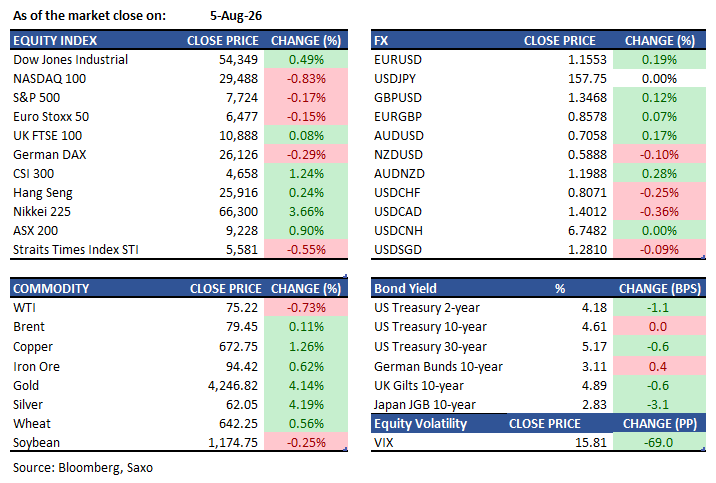
- US - US stocks closed near record highs Wednesday, supported by a better macro backdrop and strong earnings. The S&P 500 dipped 0.2% but stayed just below its record, while the Dow hit a fresh high, rising 263 points to 54,349. Crude oil extended losses after Iran and Oman agreed on a shipping route through the Strait of Hormuz and US officials reported progress on restoring regional trade, easing energy-inflation worries. Banks and other credit-sensitive sectors outperformed. Arista Networks gained 3.6% on a revenue beat, and Eli Lilly jumped 4.9% after topping estimates and raising guidance. The Nasdaq fell 0.8%, with SpaceX down 13.6% and AMD off 7% despite doubling data center revenue. Sandisk still fell 8% despite beat earnings and issuing strong forecasts this quarter.
- Europe - The Stoxx Europe 600 nudged to a fresh record close on Wednesday, though gains were capped by HSBC falling 4.7% after multiple broker downgrades and a report that China expanded personal income tax to include returns from Hong Kong insurance policies. Novo Nordisk also weighed on the index following soft Wegovy sales. The DAX slipped 0.3%, dragged by Infineon falling 5.7%. The FTSE 100 edged higher to 10,888, led by AstraZeneca (+2.5%) and Next (+5.7%), which raised its outlook for the third time this fiscal year. The SMI rose 0.6%, led by Roche and Sika.
- Asia - Asian equities are slipping Thursday morning as the AI-led rally on Wall Street pauses. The MSCI Asia Pacific Index is down 0.2%. The Nikkei 225 fell 1.4% to 65,363 in early Tokyo trade as AI and semiconductor stocks sold off following disappointing results from SanDisk and Western Digital, though the broader Topix edged up 0.3% to 4,056 supported by Honda and Shiseido earnings. The Kospi is down ~1% after surging 3.8% on Wednesday, led by SK Hynix (+5.8%). Fitch flagged that Korea equity volatility poses limited near-term credit risk. The Hang Seng is consolidating; analysts at Bloomberg Intelligence see it extending its Q3 outperformance on broader AI tech exposure. STI-listed DBS reported Q2 net income of S$3.1 billion, beating estimates, and raised its 2026 guidance.
Earnings this week:
- Thursday: Molson Coors, Monster Beverage, Warner Bros Discovery, Airbnb, SoftBank Group, DBS, Nintendo, Orix
- Friday: OCBC
FX:
- USDJPY steadied around 157.67 on Wednesday after the yen's post-intervention rally stalled. The US and Japan conducted a historic joint FX intervention last week, with Treasury Secretary Bessent warning of further coordinated action. Strategists at Morgan Stanley, JPMorgan and MUFG see limited scope for significant further yen gains given Fed rate-hike expectations underpinning the dollar.
- USD broadly softer, with the Bloomberg Dollar Spot Index extended its weekly decline on Wednesday, falling ~0.2%, as Hormuz deal optimism reduced inflation and Fed-tightening expectations.
- AUDUSD hovered near a seven‑week high on hopes of a US‑Iran understanding that could secure shipping through the Strait of Hormuz.
- Yuan steady despite softer dollar. USDCNH was little changed at 6.7482 on Wednesday even as the PBOC set a stronger daily fixing of 6.7889 per dollar. One-month implied volatility on USDCNH edged up to 1.94%.
Commodities:
- WTI settled near $75 a barrel on Wednesday — the lowest in almost a month — falling for a third straight session as Iran and Oman reached an agreement on a proposed Hormuz shipping route. Brent closed just above $79. Oil has lost approximately 11% over the week's first three sessions. A Houthi threat to attack Saudi oil tankers in the northern Red Sea briefly pushed Brent back above $80 intraday before the move faded.
- Copper futures on Comex climbed to a record high, up approximately 18% year-to-date, as traders positioned ahead of an expected US tariff decision on copper imports. The LME cash-to-3-month spread rose sharply, reaching its highest level since October 2025, reflecting tightening in the physical market as large volumes flow to US ports.
- Gold extended its strongest advance in six months as progress on reopening the Strait of Hormuz eased energy-driven pressure on the Fed; bullion rose up to 0.8% to about $4,280 after a 4.1% jump—the biggest since 3 Feb. Silver gained 0.3% to $62.23 after more than 4% the day before.
Fixed income:
- Cash Treasuries were steady, with the 10-year near 4.61% as the front end slightly outperformed. Treasury kept its issuance guidance—no change to note and bond auction sizes into 2027—softening wording to potential “changes” in coupon and FRN sales; next week’s refunding will sell $58bn 3s, $42bn 10s and $25bn 30s to raise about $28.7bn.
- The quarterly refunding announcement kept coupon auction sizes unchanged, with the Treasury signalling no change "for at least the next several quarters." The market showed no reaction to the announcement.
- The high-yield primary market reopened with four borrowers set to price approximately $2.7 billion in new bonds on Wednesday — the busiest session in nearly two weeks — as junk spreads tightened on Hormuz optimism.
For a global look at markets – go to Inspiration.
This content is marketing content and should not be considered investment advice. Trading financial instruments carries risks and historic performance is not a guarantee for future performance.
The instrument(s) mentioned in this content may be issued by a partner, from which Saxo receives promotion, payment or retrocessions. While Saxo receives compensation from these partnerships, all content is conducted with the intention of providing clients with valuable options and information.