
Access all our platforms from a single account.

Asia Market Quick Take – 04 September 2026

Key points:
- Macro: Waller pivots dovish ahead of NFP tonight and Aug CPI on 11 Sept
- Equities: Stock bounced on dovish Waller; Lululemon falls 18% after slashing forecast
- FX: Yen jumped 2% to 155.30 per dollar, its biggest daily gain in over a month
- Commodities: Spot gold jumped as much as 2.9%, topping $4,500
- Fixed income: Yields fell across the curve, with a bull-steepening bias
------------------------------------------------------------------
Disclaimer: Past performance does not indicate future performance.
Macro:
- Fed's Waller pivots dovish: Fed Governor Christopher Waller said his September rate decision will be "heavily influenced" by August CPI data due 11 September. He signalled willingness to hold rates steady if disinflation continues, prompting markets to price roughly even odds of a hike at the September meeting, down from near-certainty earlier in the week.
- US trade deficit widens sharply: The July goods and services trade gap expanded 24.4% month-on-month to $88.6 billion, the largest since early 2025, driven by an 11.4% surge in capital goods imports — primarily computers and semiconductors — reflecting the AI investment race.
- US labour market softening: ADP private payrolls rose just 38,000 in August, below the 47,000 consensus estimate and the smallest gain since early 2026, underscoring a gradual cooling in hiring. The August non-farm payrolls report is due today and is being closely watched ahead of the Fed's September meeting.
- US-Iran conflict ongoing: The US carried out a second round of strikes against Iran this week, keeping oil prices elevated and stoking inflation concerns. President Trump said renewed attacks would be "short-lived," offering some relief to markets mid-week.
- BOE's Pill flags prompt hike: Bank of England Chief Economist Huw Pill said a "prompt" rate increase would be appropriate to prevent the Iran energy shock from embedding inflation, though he stressed it need not be the start of a prolonged hiking cycle.
- Japan intervention risk elevated: Japan's top currency official Atsushi Mimura said he is "ready to continue the currency battle" following the yen's sharp rally. BOJ rate hike bets also rose, adding to yen strength.
- India rupee boosted by record diaspora inflows: India drew a record $127–136 billion through special central bank capital-raising programmes, far exceeding expectations and providing a significant buffer to defend the rupee.
Equities:
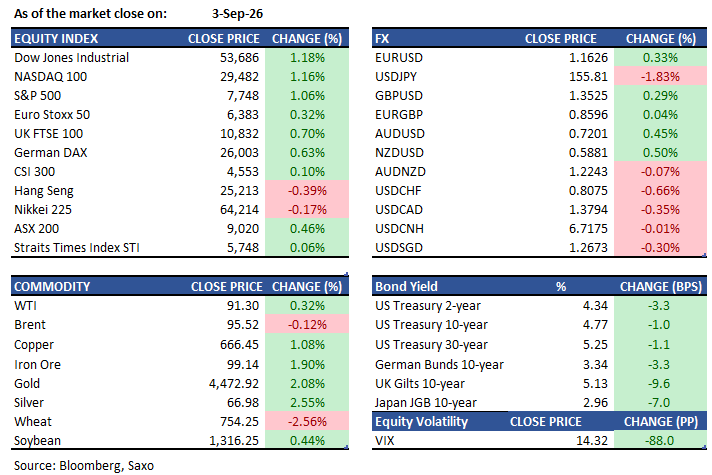
- US — S&P 500 rose 1.1% to 7,747.71 on Thursday, its best session in a month, as Fed Governor Waller's dovish-leaning remarks drove a broad rally. Nasdaq Composite gained 1.4% to 26,584.06 and the Dow added 1.2% to 53,686.11. All Magnificent Seven names closed higher; Microsoft led the S&P 500 with a 2.7% gain, while Nvidia rose 1.8% after announcing the acquisition of AI platform Hugging Face. Robinhood surged 16.6%, the index's largest single-stock move. In after-hours trading, Adobe slipped 1.4% after naming a new CEO; Oxford Industries tumbled 16% on a guidance cut; and Lululemon fell 18% after slashing full year forecast again, expecting it to decline 5-7%.
- EU — European equities tracked the global risk-on tone, supported by falling bond yields after Waller's remarks. Gilts and European bonds extended gains, with the German 10-year yield falling 3bps to 3.35% and the UK 10-year dropping 7bps to 5.16%. Ned Davis Research downgraded US stocks to underweight and upgraded Europe ex-UK to overweight, increasing its allocation to 15% from 12%, citing relative valuation and earnings optimism. Germany's ruling SPD backed EU tariffs on Chinese EVs, adding a trade policy overhang for the auto sector.
- Asia — Asian equity futures pointed higher heading into Friday's open, tracking Wall Street's gains as September Fed hike bets eased. Japan's Topix rose 3.8% in August as the market broadened beyond AI trades into fundamentals-driven sectors, though Kioxia has lost more than half its value from its late-June peak. Futures for Japan, South Korea and Australia all pointed higher overnight. However, caution is warranted: a sharp yen appreciation and more hawkish BOJ rate expectations may cap gains among Japan's export-oriented stocks. Morgan Stanley cut its targets for China and Hong Kong stocks, citing worsening macro data, tighter liquidity and regulatory concerns — lowering its CSI 300 target to 4,880 and Hang Seng China Enterprises Index target to 8,900. The Nasdaq Golden Dragon China Index fell 0.8% on Thursday. Chipmaker Longsys reportedly priced its Hong Kong listing at HK$236. ByteDance secured a $30 billion loan, Asia's second-largest this year. The STI and Kospi were also set to open higher, with MSCI ASEAN gaining 0.7% on Thursday.
FX:
- The yen surged ~2% against the dollar on Thursday to 155.81, its best single-day performance in over a month, as traders lifted BOJ rate hike bets and remained on alert for intervention. Japan's top currency official Atsushi Mimura said he is ready to "continue the battle" on FX. JPMorgan estimates a break below 155 could accelerate yen short covering, with a full unwind potentially pushing USDJPY to the 142–146 range.
- Global pension funds and insurers are reportedly hedging only 41% of their foreign-currency exposure — the lowest since at least 2015 — raising the risk of a sharper dollar selloff if sentiment turns.
- The onshore yuan edged to its strongest level since February 2023, with USDCNY touching 6.7179 after the PBOC set a stronger-than-expected daily fixing. The yuan's appeal as an alternative carry trade currency to the yen is growing, according to market commentary.
- The Singapore dollar's 120-day correlation with the US dollar has dropped to -0.94, the most inverse in Asia and the most negative since May 2024, positioning it as a key beneficiary of the dollar debasement trade, according to analysts.
- AUD steadies near a one-week high at 0.7202 as traders await the US nonfarm payrolls report, after touching 0.7208 overnight. NZD holds at 0.5882 following a 0.5% gain in the previous session.
Commodities:
- Spot gold surged as much as 2.9% on Thursday to top $4,500 per ounce, its biggest intraday jump since 19 August, driven by the dollar's decline and Waller's dovish remarks. The GLD ETF recorded its largest single-day inflow since 16 January at $1.41 billion. Central bank demand remains a structural tailwind, with the Dutch central bank having moved ~86 metric tons of gold from New York and Ottawa to London, citing "increasing geopolitical unrest."
- Crude fluctuated as Iran-related geopolitical tensions kept markets on edge, with the US-Iran conflict over the Strait of Hormuz continuing to drive supply risk. WTI had briefly surged above $90 earlier in the week before pulling back. Asian refiners have been buying more US crude as a rally in Abu Dhabi's Murban oil opened the arbitrage window. OPEC+ ministers meet Sunday to set production targets, a key near-term catalyst.
- Base metals broadly advanced alongside gold on Thursday as the dollar weakened.
Fixed income:
- Yields fell across the curve on Thursday following Waller's remarks, with the curve bull-steepening. The 2-year yield, which had topped 4.40% earlier this week for the first time since January 2025, fell ~5bps to 4.33%. The 10-year dipped to 4.768% and the 30-year to 5.248%. Treasury options saw an influx of weekly structures hedging event risk around Friday's August payrolls print.
- The US 30-year bond entered September having settled above 5% for 55 consecutive sessions, a stretch not seen since 2006, driven by a gaping fiscal deficit, heavy corporate issuance and Fed rate hike uncertainty. Schroders has been adding 10-year duration, calling yields "more attractive" after the recent selloff.
- UK gilts and European government bonds extended gains alongside Treasuries. The UK 10-year yield fell 7bps to 5.16% and the German 10-year fell 3bps to 3.35%. UK Prime Minister Andy Burnham pledged fiscal stability amid soaring gilt yields but declined to rule out further borrowing or tax rises. The China-US 10-year yield spread remains near record wides at ~312bps (US 4.77% vs China 1.69%), raising capital outflow risks for China.
For a global look at markets – go to Inspiration.
This content is marketing content and should not be considered investment advice. Trading financial instruments carries risks and historic performance is not a guarantee for future performance.
The instrument(s) mentioned in this content may be issued by a partner, from which Saxo receives promotion, payment or retrocessions. While Saxo receives compensation from these partnerships, all content is conducted with the intention of providing clients with valuable options and information.