
Access all our platforms from a single account.

Asia Market Quick Take – 25 August, 2026

Key points:
- Macro: US sanctions 60 Iran-linked entities. US plans 7.5% tariffs on Chinese goods.
- Equities: Stocks fall amid trade tensions, higher yields. BABA down 8.5%
- FX: USD remains weak; CAD slides on trade shock, while SGD strengthens below 1.27
- Commodities: US Treasuries rally, long-end leads
- Fixed income: Gold hits three-month high, rising for a fifth straight session
------------------------------------------------------------------
Disclaimer: Past performance does not indicate future performance.
Macro:
- The US Treasury sanctioned nearly 60 Iran-linked entities, individuals, and vessels tied to nuclear, missile, cyber, and oil networks, targeting five sectors—digital assets, technology, gold, aviation, and shipping—and a global network of brokers and shadow-fleet ships.
- US-Canada trade tensions escalated as Washington imposed 50% tariffs on Canadian goods, prompting Ottawa to vow equal retaliation. Trump said tariffs on autos, parts, and steel will rise to 50% from January 1, 2027. The US also widened secondary sanctions on entities doing business with Iran, with Bessent warning a major financial institution—possibly in China—could be targeted this week.
- The US is reportedly planning a 7.5% tariff on Chinese goods over alleged excess capacity ahead of a Trump–Xi summit next month, which would lift average second-term duties on China back to about 20%.
- The Chicago Fed National Activity Index fell to -0.08 in July from 0.06 in June, indicating slightly weaker activity. Three of four categories deteriorated, with personal consumption and housing turning sharply negative. The three-month average slipped to -0.04 from 0.01.
Equities:
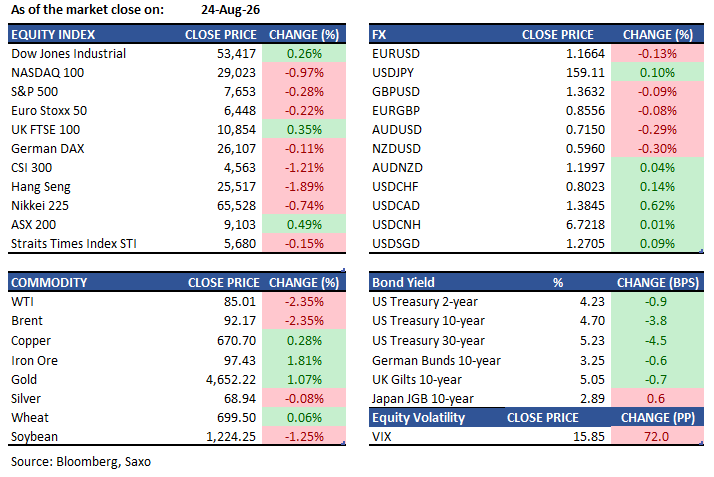
- US — US equities closed mixed on Monday. S&P 500 fell 0.3% to 7,652.86, the Nasdaq Composite dropped 0.8% to 25,980.19, while the Dow Jones Industrial Average edged up 0.3% to 53,417.16. Chipmakers led the decline, with Nvidia falling 2.9% for its seventh consecutive session of losses — its longest losing streak since 2022. Seagate Technology fell 6.5%, the largest single-stock drop in the S&P 500. The MSCI China Index fell 2.3% in US trading, with the Nasdaq Golden Dragon China Index down 1.7%. Alibaba fell 8.5% after announcing a $10.2 billion share sale. In after hours, PDD Holdings edged higher 1.5% after Q2 EPS beat, though revenue missed estimates.
- EU — European equities were broadly weaker on Monday, tracking the global risk-off tone driven by the US chip selloff and escalating geopolitical tensions around Iran and the US–Canada trade dispute. Materials and precious metals miners outperformed, benefiting from gold's continued advance. Canadian stocks bucked the trend, with the S&P/TSX Composite closing 0.3% higher, led by gains in gold miners offsetting declines in industrials and consumer discretionary.
- Asia — Asian equities are trading lower on Tuesday morning, following Wall Street's tech-led selloff. The MSCI Asia Pacific gauge slipped 0.4%. The Kospi opened sharply lower, falling around 3% to approximately 6,495 at the open, with Samsung Electronics and SK Hynix slipping in pre-market action after US memory stocks ranked among the S&P 500's worst performers. The Nikkei is also under pressure, tracking US tech weakness, with USD/JPY little changed at 159.08. China's broader market continues to struggle, having peaked in late June and weighed down by the global chip selloff and a deepening economic slowdown. The MSCI ASEAN index fell 0.3% to 829.41 on Monday. SoftBank is separately planning a record ¥1 trillion retail bond sale.
Earnings this week:
- Tuesday (25 Aug) — Intuit, Zoom
- Wednesday (26 Aug) — Nvidia, Salesforce, CrowdStrike, HP, Haidilao, Li Auto
- Thursday (27 Aug) — Marvell, IREN, Affirm
- Friday (28 Aug) — BYD, China Construction Bank, ICBC, Agricultural Bank of China, Bank of China
FX:
- The move extends broader USD weakness as hedge funds add bearish positions ahead of further detail on Treasury Secretary Bessent’s fiscal plan and his pledge to at least double long‑dated bond buybacks. Markets remain focused on Warsh's Jackson Hole speech on Friday.
- CAD remains under pressure after US‑Canada trade talks collapsed and Trump threatened to double auto tariffs, sending USDCAD as high as 1.3860 on Monday and giving the loonie its worst day since mid‑June.
- JPY held little changed at around 159.08 per dollar after Bessent refrained from further signals on US debt management. A former BOJ board member flagged a September rate hike as likely, which could provide yen support.
- GBP was a relative outperformer, slipping just 0.09% as gilts rallied with Treasuries on lower oil prices. The dollar’s move marked a partial recovery from three‑month lows hit Friday after Bessent’s bond‑buyback plans, even as hedge funds kept adding to structural USD shorts.
- AUD was the worst G10 performer on Monday, falling 0.17%, closing at 0.7149. Markets await RBA minutes from the August 11 meeting due Tuesday morning Sydney time, which will be parsed for signals on further tightening.
- USDSGD dips below 1.2700, hovering near multi‑month lows as MAS’s tight stance, stronger growth outlook and broader USD bearish positioning continue to support the Singapore dollar.
Commodities:
- Gold climbed for a fifth consecutive session, nearing $4,680 per ounce — its highest intraday level since mid-May — up more than 7% over four sessions since the Treasury's surprise ramp-up in long-dated bond buybacks. The debasement trade and dollar weakness continue to drive demand. Goldman Sachs flagged that surging call-option volumes could amplify two-sided volatility, while maintaining an end-2026 target of $4,900/oz.
- Oil falls on Iran sanctions: Brent crude hovered around $92 per barrel on Monday, declining after Bessent unveiled the Iran sanctions plan. Iran's oil shipments to Asia have already largely dried up, with cargo prices flipping from a discount to a premium of around $4 per barrel above global benchmarks. Front-month WTI declined more than 2.5% intraday before paring losses.
- Copper squeeze persists: Copper remains elevated near record levels, with the LME spot-to-three-month backwardation still very wide following last week's historic squeeze, which saw the spread reach as high as $545 per ton. Deliveries by traders including Trafigura helped ease the spread to around $248 per ton, though conditions remain tight. Copper is up approximately 16% year-to-date.
Fixed income:
- Treasuries gained across the curve, with the 10-year yield falling 3bps to 4.706% and the 30-year yield falling 4.1bps to 5.232%. The rally was initially driven by falling oil prices and gathered pace after CNBC reported the Treasury's General Account could be used to fund expanded buybacks. With the 10-year yield above 4.7%, Treasuries now out-yield nearly every S&P 500 stock, with only ~20 index members offering a higher dividend yield.
- US IG bond spreads widened 1bp to 80bps over Treasuries in the past week, while US HY spreads widened 3bps to 269bps, with CCC yields surging to a new two-year high.
- Asian issuers reportedly priced roughly $7 billion of dollar and euro bonds on Monday — the busiest day in almost two months — led by Japanese companies. SoftBank Group is separately planning a record ¥1 trillion ($6.3B) retail bond sale, the largest by any issuer in Japan. Two upcoming Japanese government bond auctions — a 10-year on September 1 and a 30-year on September 3 — are flagged by analysts as a potential fresh source of upward pressure on US Treasury yields if demand disappoints.
For a global look at markets – go to Inspiration.
This content is marketing content and should not be considered investment advice. Trading financial instruments carries risks and historic performance is not a guarantee for future performance.
The instrument(s) mentioned in this content may be issued by a partner, from which Saxo receives promotion, payment or retrocessions. While Saxo receives compensation from these partnerships, all content is conducted with the intention of providing clients with valuable options and information.