
Access all our platforms from a single account.

Asia Market Quick Take – 02 July, 2026

Key points:
- Macro: Warsh sees easing inflation. ADP below forecasts.
- Equities: Meta surged 9.7% after announcing cloud infrastructure business
- FX: Dollar edges higher after Warsh; euro weakens, yen steady near four-decade lows
- Commodities: WTI extended declines to $68, while gold holds above $4,000
- Fixed income: Treasury curve steepens, yields mixed
------------------------------------------------------------------
Disclaimer: Past performance does not indicate future performance.
Macro:
- Fed Chair Kevin Warsh said inflation expectations have eased, reducing the urgency to raise interest rates, but reaffirmed the Fed’s commitment to restoring price stability. Separate data Wednesday showed US private-sector hiring slowed more than expected last month.
- US private businesses added 98K jobs in June 2026, down from 122K in May and below forecasts of 113K. Education and health led gains, leisure and hospitality stayed weak, and mining lost jobs. Small firms added the most positions. ADP said the slowdown reflects both weaker demand and labor supply constraints. Annual pay rose 4.4% for job stayers and 6.6% for switchers.
- Euro-zone inflation undershoots: Euro-area CPI rose 2.8% year-on-year in June, below the 3% consensus estimate and down from 3.2% in May, aided by retreating oil prices. Core and services inflation also surprised to the downside. ECB policymakers at Sintra showed no consensus on the next rate move.
- The US ISM Manufacturing PMI fell to 53.3 in June 2026 from 54.0 in May, below expectations, signaling slower growth. Output and new orders cooled, employment stayed just in contraction, and the prices index dropped but remained high. Firms cited persistent inflation, geopolitical risks, higher-rate concerns, and trade policy uncertainty as headwinds.
Equities:
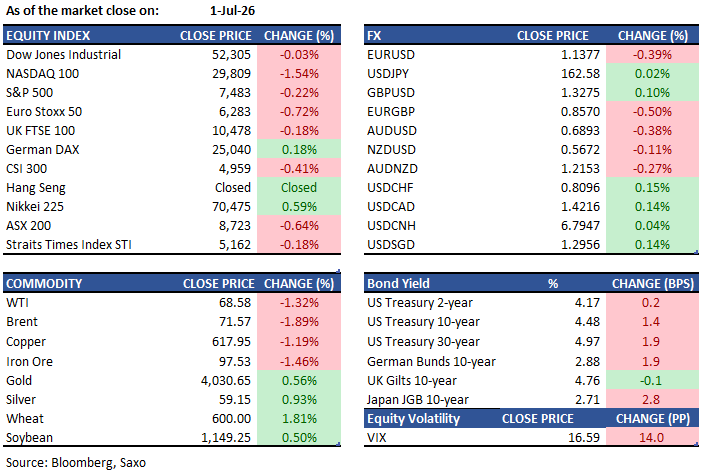
- US — S&P 500 closed down 0.2% at 7,483 on Wednesday, while the Nasdaq 100 fell 1.5% as a semiconductor selloff dominated. The Philadelphia Semiconductor Index sank 6.3%. Micron fell 10.6% and Corning dropped 13.6%, the two largest drags on the S&P 500. Meta surged ~9.7% after reports it is developing plans to sell excess AI compute capacity as a cloud-infrastructure business. The Dow Jones hit a record above 52,700, up 0.6%, lifted by financials, which gained 2.1%. Walmart fell 3.9% to its lowest close since November 2025, down ~19% from its May record high, after Cleveland Research flagged slowing quarter-to-date trends. After hours, Franklin Covey tumbled 24% after cutting its full-year revenue outlook and missing Q3 estimates. Greenbrier reported Q3 revenue of $576.5 million, missing the $612.7 million estimate.
- EU — European stocks edged lower on Wednesday, with the Stoxx 600 falling 0.4% to 639.31, pulling back from a record high hit the prior session after its best quarter since 2020. The Euro Stoxx 50 declined 0.72% to 6,282.50. The DAX bucked the trend, rising 0.2% to 25,040, with Rheinmetall surging 6.1% as European defence stocks extended their rally following the UK's £15 billion military spending commitment. ASML fell 4.6%, the largest drag on the Stoxx 600. The FTSE 100 slipped 0.2% to 10,478, weighed by AstraZeneca (-1.7%) and Associated British Foods (-3.2%). Galderma slumped after the FDA declined to review its Botox competitor Relfydess. Autos outperformed on bullish commentary ahead of Renault's earnings.
- Asia — Asian equities are under significant pressure this morning, led by a sharp selloff in South Korean chipmakers tracking Wednesday's US semiconductor rout. The Kospi is down as much as 6% in early trade, with SK Hynix, Samsung Electronics and Samsung Electro-Mechanics the largest drags; the index risks closing below the 8,000 level for the first time since June 11. The MSCI Asia Pacific Index is down approximately 0.9%. On Wednesday, the Nikkei 225 closed up 0.6% at 70,475, supported by AI and semiconductor-related names. Hong Kong markets were closed on Wednesday for a public holiday and reopen today. China's CSI 300 fell 0.4% on Wednesday, with energy inverter makers including Sungrow Power declining after reports the Trump administration is drafting a ban on imports. US equity futures are retreating 0.3% in Asian hours. Hanwha Aerospace rose 12% in Seoul on Wednesday, its largest gain in four months.
Events this week:
- Thursday – Non Farm Payroll for June
- Friday – US market closed
FX:
- The USD strengthened after comments from Fed Chair Kevin Warsh and other central bankers at the ECB’s Sintra forum. Warsh reiterated his preference to shrink the Fed’s bond portfolio, stressing any move would be preceded by significant public communication.
- EURUSD fell as much as 0.4% to 1.1376 after ECB President Lagarde said risks to euro-area inflation and growth are now less pronounced, and Governing Council member Kocher framed the next decisions as either further hikes or a pause.
- USDJPY was steady around 162.55 after recent gains pushed the yen to four-decade lows. Japan’s FX chief again underscored intervention as an effective tool and highlighted close coordination with the US, as data showed large-manufacturer sentiment at its strongest since 2018 and inflation expectations at a record high.
- AUDUSD slid 0.3% to 0.6896, while USDSEK rose 0.3% to 9.7293.
Commodities:
- WTI traded near $68 a barrel and Brent settled below $72, falling for a third consecutive session. Hormuz flows have surpassed 10 million barrels per day, the UAE restored exports to pre-war levels (~3.9 million bpd), and Goldman Sachs warned the global oil market is set to swing back into oversupply as the Iran war premium fades. Crude options implied volatility has fallen sharply, with WTI within reach of its pre-war range below $65.
- Gold rose as much as 2.7% as the dollar and bond yields pared gains following Warsh's remarks, with futures settling around $4,068 per ounce. The metal has stabilised above $4,000 after tumbling 13% in Q2 — its largest quarterly loss on record — as the "dollar debasement" trade unwound. ETFs added ~23,500 troy ounces to holdings in the latest session.
Fixed income:
- The 10-year Treasury yield rose 1.2bps to 4.479% and the 30-year rose 1.1bps to 4.966%, while the 1-year yield fell 0.9bps to 3.984%. The 2s-10s spread pushed above 30bps, a level that has repeatedly been tested since the June FOMC meeting. Month-end saw heavy liquidations in 5-year, 10-year and long-bond futures, with a large position build in 2-year note futures.
- Appetite for longer-dated Treasuries proved short-lived. Yields initially reversed gains after Warsh's Sintra remarks, but momentum faded as markets positioned cautiously ahead of Thursday's NFP release. Capital Economics warned the curve could re-invert if the Fed delivers three hikes in 2027.
- US junk bonds posted their best quarterly gains since Q3 2025, with yields dropping 24bps and risk premiums falling 47bps over Q2. Issuers have sold $219.2 billion of high-yield bonds year-to-date, up 43% versus the same period last year, with a fresh supply wave expected as spreads remain compressed. Goldman Sachs gained market share, rising to fourth in the league table.
For a global look at markets – go to Inspiration.
This content is marketing content and should not be considered investment advice. Trading financial instruments carries risks and historic performance is not a guarantee for future performance.
The instrument(s) mentioned in this content may be issued by a partner, from which Saxo receives promotion, payment or retrocessions. While Saxo receives compensation from these partnerships, all content is conducted with the intention of providing clients with valuable options and information.