Access all our platforms from a single account.

Asia Market Quick Take – 19 June, 2026
Key points:
- Macro: US-Iran deal signed; Straits of Hormuz reopened
- Equities: SOX up 6.4% to record; Intel rose 10.6% after Apple confirmed chip partnership
- FX: Dollar surges on hawkish Fed repricing; yen nears multi-decade intervention levels
- Commodities: Hormuz reopening pressures Brent lower; gold ETFs extend outflows
- Fixed income: Treasuries stage bull-flattening rebound as Hormuz deal tempers inflation concerns
------------------------------------------------------------------
Disclaimer: Past performance does not indicate future performance.
Macro:
- US-Iran Hormuz Deal: The US and Iran digitally signed a memorandum of understanding to reopen the Strait of Hormuz, with a 60-day clock now running to negotiate a permanent peace deal. Shipping has begun returning to the waterway, easing global energy supply concerns and lifting risk sentiment across assets.
- Fed — Warsh's Hawkish Debut: New Fed Chair Kevin Warsh held rates steady at 3.50%–3.75% at his first FOMC meeting but delivered a hawkish press conference, cutting the length of the policy statement and signalling a strong commitment to returning inflation to 2%. The dot plot pointed to growing support for a rate hike later this year, with markets now pricing a meaningful probability of a July move.
- Fed Rate Hike Risk: Goldman Sachs Vice Chairman Rob Kaplan said it would be "wise" for the Fed to act by September if inflation fails to cool. Veteran strategist Ed Yardeni echoed the view, saying a hike is possible if the Fed is serious about its 2% target. A record 500,000+ bond futures contracts changed hands on Thursday as traders positioned for a hike.
- US Jobless Claims: Initial claims fell 4,000 to 226,000 in the week ended June 13, broadly in line with the 225,000 consensus estimate, pointing to continued labour market resilience. Continuing claims, however, rose 24,000 to 1.81 million.
- Philadelphia Fed Manufacturing: The June Philly Fed general business conditions index rose to 10.3, above the prior month's -0.4 and slightly ahead of the 10.0 consensus. New orders surged to 27.3 from -1.7, though the prices paid component climbed to 53.2 from 47.9, reinforcing inflation concerns.
- Bank of England: The MPC voted 7-2 to hold rates at 3.75%, with two dissenters favouring a 25bp hike to 4.00%. The BoE noted the recent fall in oil prices was "encouraging" on inflation. UK unemployment came in at 4.9% for the three months to April, below the 5.0% consensus.
- Swiss National Bank: The SNB held rates unchanged. Switzerland's Federal Expert Group revised its 2026 GDP growth forecast down to 0.9% from 1.0%, citing higher energy price headwinds.
Equities:
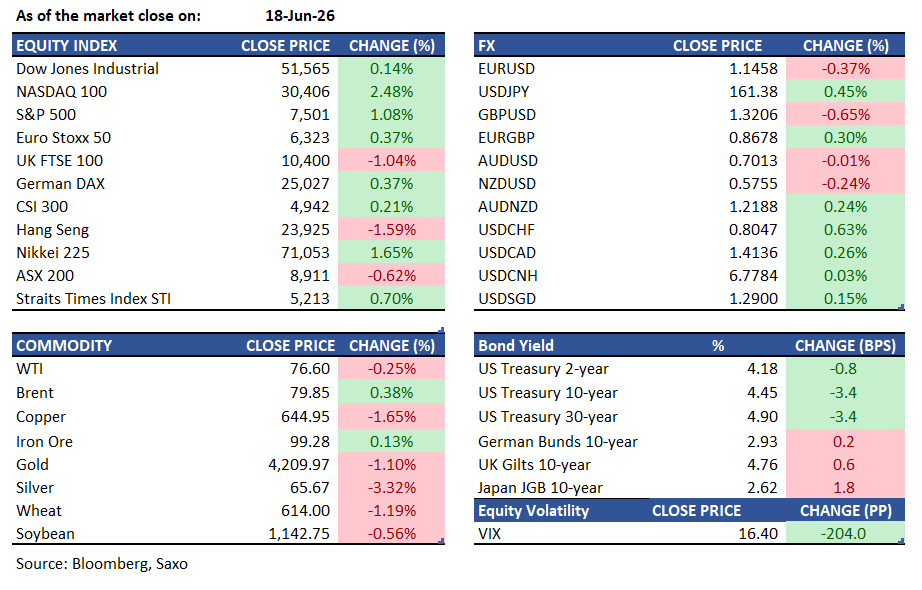
- US — The S&P 500 rose 1.1% to 7,500.58 on Thursday, with the Nasdaq 100 surging 2.5% and the Dow Jones gaining 0.1%, as chipmakers led a broad rally. The Philadelphia Semiconductor Index (SOX) advanced 6.4% to a record high. Nvidia (+3.0%) was the largest points contributor to the S&P 500. Intel soared 10.6% after President Trump announced a chip-making partnership with Apple. Sandisk (+11.5%) and Micron also hit record highs. Accenture tumbled a record ~20% after issuing a weak Q4 revenue outlook, citing AI disruption to its consulting business. Kroger fell ~8.6% on a downbeat Q2 EPS guide. In after-hours trading, Hyperscale Data (GPUS) fell ~22% after announcing it had established a new entity while SpaceX prepares to sell $20b in bonds.
- EU — European stocks closed mixed on Thursday. The Stoxx 600 fell 0.3%, snapping a five-day winning streak, while the Euro Stoxx 50 edged up 0.37% to a new record close. The DAX gained 0.4% to 25,026.80, and the CAC rose 0.4%, while the FTSE 100 fell 1.0% to 10,399.70 and the SMI declined 0.4%. Energy majors Shell, BP and TotalEnergies each fell more than 2.5% as Brent crude dropped below $78 on the Hormuz deal. Capgemini fell ~9% in sympathy with Accenture's warning. London Stock Exchange Group was the FTSE 100's largest decliner, falling 7.0%. Infineon rose 6.4%, leading the DAX higher on chip sector optimism. UBS and IAG hit 52-week highs.
- Asia — Asian markets were broadly higher on Thursday, buoyed by the US-Iran Hormuz deal and the Fed's decision to hold rates. The Nikkei 225 rallied 1.7%, closing above 70,000 for the first time ever, driven by energy and export-related optimism. The Kospi surged 2.3% to breach the 9,000 level for the first time in history, with Samsung Electronics gaining ~5% and SK Hynix rising ~7% on AI semiconductor momentum. The Hang Seng Index fell 1.6% to 23,924.81 — its biggest single-day drop since May 15 — as tech stocks sold off following China's release of draft rules regulating food delivery platform subsidies. Alibaba was the largest drag, falling 1.9%, while China Overseas Land & Investment fell 9.0%. HK property stocks also declined on rising Fed hike expectations. Mainland investors sold a net HK$6.79 billion of HK shares via Stock Connect. The HSCEI fell 2.1%. Note: Hong Kong markets are closed Friday for a public holiday.
Events this week:
- Friday: US Juneteenth holiday. China, Hong Kong and Taiwan observe Dragon Boat Festival. Markets closed.
FX:
- The USD extended a broad rally, with the Bloomberg Dollar Spot Index posting its largest two-day gain in three months (about 1%) as markets brought forward expectations for a potential Fed rate hike to as early as July after Chair Warsh’s hawkish first FOMC meeting.
- USDJPY rose 0.7% to 161.81 on Thursday before settling around 161.35, approaching the weakest level for the yen since December 1986. Traders remain on alert for potential Japanese intervention, with the next key level at 161.95.
- CAD weakened further, with USDCAD up 0.2% to 1.4129, approaching lows last seen in April 2025 as Fed–BoC divergence widens, implying more downside for CAD.
- GBP softened modestly after the Bank of England left rates unchanged at 3.75% in a 7–2 vote, offering little hawkish support.
- CHF’s carry appeal diminished as Nomura exited a long CHFJPY trade (roughly flat) following a lack of hawkish detail from the SNB.
Commodities:
- Oil lower on Hormuz reopening: Brent crude fell below $78 a barrel on Thursday following the signing of the US-Iran MOU to reopen the Strait of Hormuz. Energy majors across both the US and Europe sold off sharply. The reopening is expected to trigger a significant restart of Gulf oil field production, with the scale of the logistics exercise described as unprecedented.
- Gold ETF outflows continue: Gold ETFs recorded their eighth consecutive day of outflows on Thursday, bringing year-to-date net sales to 1.84 million troy ounces — the longest losing streak since March 24. The US 10-year real yield stood at 2.20%, up 28 basis points year-to-date, continuing to weigh on non-yielding bullion.
- Copper supply disruption resolved: Rio Tinto resumed copper concentrate exports from its Oyu Tolgoi mine in Mongolia after a brief road blockade by protesters was lifted. The mine is a key supplier of copper concentrate to China, and the disruption had briefly raised supply concerns.
Fixed income:
- Treasuries partially recover in bull flattening: After Wednesday's sharp post-Fed selloff, Treasuries rallied on Thursday as the Hormuz deal eased inflation fears. The 10-year yield fell ~3.5bps to 4.455% and the 30-year fell ~3bps to 4.904%, while the 2-year remained elevated near 4.20% — its highest since February 2025. The curve continued to flatten, with 2s10s tightening ~3bps on the day.
- 5-year TIPS auction at highest yield since December 2024: The $24 billion 5-year TIPS reopening was awarded at 1.955%, the highest-yielding auction of that tenor since December 2024, reflecting the post-Fed repricing of real rates. Indirect bidders took ~68.6% of the auction, with primary dealer awards among the lowest on record.
- Rate hike bets surge in futures market: A record 500,000+ Treasury futures contracts changed hands on Thursday as traders positioned for a potential Fed hike as early as July. The activity was roughly four times the 20-day average, underscoring the significant shift in rate expectations following Warsh's debut FOMC meeting.
For a global look at markets – go to Inspiration.
This content is marketing content and should not be considered investment advice. Trading financial instruments carries risks and historic performance is not a guarantee for future performance.
The instrument(s) mentioned in this content may be issued by a partner, from which Saxo receives promotion, payment or retrocessions. While Saxo receives compensation from these partnerships, all content is conducted with the intention of providing clients with valuable options and information.