
Access all our platforms from a single account.

Asia Market Quick Take – 18 June, 2026

Key points:
- Macro: Fed holds rates with hawkish tone; 9 members see a hike this year
- Equities: S&P 500 fell 1.2% after hawkish Fed; Kospi gains, led by SK Hynix +5.8%
- FX: Dollar strengthens on hawkish first Warsh Fed; NOK posts sharpest G10 loss
- Commodities: Oil down 1%; Brent below $80/bbl
- Fixed income: UST curve bear-flattened; 2Y +15 bps to 4.20%
------------------------------------------------------------------
Disclaimer: Past performance does not indicate future performance.
Macro:
- The Fed held rates at 3.50%–3.75% at Kevin Warsh’s first meeting but surprised hawkishly: 9 of 19 officials now see at least one hike this year, up from none in March, and Warsh scrapped traditional forward guidance while pledging to restore price stability.
- The Fed lifted its 2026 PCE forecast to 3.6% and core PCE to 3.3%, and markets now fully price a quarter‑point hike by year-end. Chair Warsh also launched five task forces on Fed communications, the balance sheet, and related issues.
- Markets now fully price a hike by October; Citi pushed its first-cut call to October. Warsh launched a review of the Fed’s $6.7 trillion balance sheet and enabled T‑bill purchases “when appropriate.” The 2026 median rate forecast stayed at 3.75%, but the dot plot turned meaningfully more hawkish.
- Trump says they have signed the memorandum of understanding with Iran.
- US retail sales rose 0.9% m/m in May 2026, beating forecasts (0.5%) and April’s revised 0.4%, signalling strong consEx-gas, sales climbed 0.7% with broad-based strength across online, autos, and discretionary categories; restaurants/bars and electronics/appliances declined. The core “control group” for GDP also rose 0.7%, after 0.5% in April.
- US pending home sales rose 3.8% m/m in May 2026, the largest gain since September 2024 and well above the 0.8% forecast. All regions saw increases, and sales were up 4.8% y/y. NAR’s Lawrence Yun said the jump reflects pent‑up demand and growing acceptance of >6% mortgage rates, while stressing the need for more housing supply.
Equities:
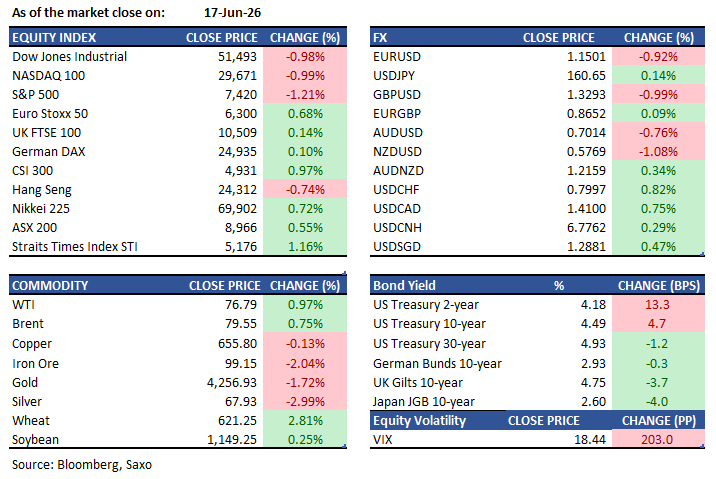
- US — US equities fell sharply on Wednesday after the hawkish Fed pivot. The S&P 500 dropped 1.2% to 7,420.10, closing near session lows, while the Nasdaq 100 shed 1.0% and the Dow Jones fell 1.0%. Every S&P 500 sector closed lower, led by communication services. Microsoft fell 3.8% and was the largest drag on the index; Carvana tumbled 10.3%; CarMax dropped ~7% after same-store sales disappointed for a fourth straight quarter; and Adobe slid 5.3% to its lowest level in more than eight years. On the upside, semiconductor names rebounded — Broadcom, Micron and Applied Materials were among the top S&P 500 gainers. Jabil surged as much as 14% after beating Q3 estimates and raising full-year guidance. In after-hours trade, Rumble edged up ~3.9% after announcing a restructuring into two core business units.
- EU — European equities closed at fresh record highs on Wednesday ahead of the Fed decision, with the Stoxx 600 rising 0.5% to 639.31 and the Euro Stoxx 50 gaining 0.68% to a new record close of 6,300.07. The DAX edged up 0.1% to 24,934.67, the FTSE 100 added 0.1% to 10,508.61, and the SMI rose 0.4%. Banking stocks gained for a fifth straight session to a new 2008-high. The standout mover was BMW, which slumped 8.3% to a 2020-low after slashing its profitability forecast on worsening China demand, dragging peers Volkswagen and Mercedes-Benz lower. Straumann jumped ~10.8% after raising its 2026 core EBIT margin expansion guidance materially above expectations. ASML rose 4.1%, contributing the most to the Stoxx 600 advance.
- Asia — Asian equities on Wednesday closed mostly higher for a fourth straight session, with the MSCI Asia Pacific Index rising 0.5%, as investors awaited the Fed decision. The Kospi outperformed, rising 1.6% to 8,864.24, led by SK Hynix which surged 5.8% to a record high on continued AI-driven semiconductor demand. The Straits Times Index rose approximately 1% to around 5,168. Japan's Nikkei had closed at a record high the prior session following the Bank of Japan's rate hike. Hong Kong-listed Chinese stocks faced pressure as global investors rotated toward AI supply chain names in North Asia, sidelining internet and consumer names that dominate the Hang Seng. Looking ahead to Thursday's open, equity futures for Japan, South Korea and Australia pointed lower following the hawkish Fed outcome, with the yen weakening past 160 per dollar raising intervention risk.
Events this week:
- Friday: US Juneteenth holiday. China, Hong Kong and Taiwan observe Dragon Boat Festival. Markets closed.
FX:
- USD surged broadly after a hawkish FOMC, Kevin Warsh’s first meeting as Chair, where rates were kept on hold but half of policymakers signalled at least one hike by year-end. The Bloomberg Dollar Spot Index jumped 0.7%, its biggest gain since early March. Hedge funds added to bullish dollar positioning via short-dated call options.
- NOK was the weakest G10 currency, sliding about 1.5% versus the dollar, while GBP, EUR, AUD, CAD and CNH all fell around 0.7–1.0%.
- USDJPY edged higher, with the yen at its weakest since mid‑2024 and intervention risk seen rising around the 160 level.
- EURUSD fell for the first time in three sessions, trading within Monday’s 1.1569–1.1622 band and hovering around its 21-day moving average near 1.1600, with initial support at the June 8 low of 1.15.
- CHF initially outperformed in Asia, up 0.37% by the Tokyo afternoon, but later surrendered those gains as post-FOMC dollar strength gathered pace.
- SEK held gains after the Riksbank kept its rate at 1.75% but struck a hawkish tone, explicitly stating the probability of a hike later this year has increased.
Commodities:
- Gold ETF holdings fell for a seventh consecutive day on Wednesday, the longest losing streak since March, with ETFs cutting 135,924 troy ounces — equivalent to approximately $588.7M — bringing year-to-date net sales to 1.84 million ounces. Gold holdings are at their lowest level since November 2025.
- Oil prices declined more than 1% in early Asian trading Thursday, extending recent weakness as the imminent signing of the US-Iran interim peace deal raises expectations of a Strait of Hormuz reopening and a surge in Middle East supply. Brent futures held below $80/bbl.
- Copper supply concerns emerged after protesters blockaded a key road at Rio Tinto's Oyu Tolgoi mine in Mongolia, threatening copper concentrate deliveries to China. Separately, Antofagasta approached Chinese smelters with a proposal to shift contractual ore pricing to spot-market indexes, signalling strain on the traditional fixed-price system.
Fixed income:
- The US Treasury curve bear-flattened sharply following the hawkish FOMC outcome. The 2-year yield surged 15 basis points to 4.20% — its highest level since February 2025 — while the 10-year yield rose 4.8 basis points to 4.49% and the 30-year yield was little changed at 4.93%.
- The 5-year/30-year yield spread compressed significantly to 66.9 basis points from 77.9 basis points at the prior close, reflecting aggressive front-end selling as markets priced in a full rate hike by October.
- The Bank of England is expected to hold rates at 3.75% at its Thursday decision; Japanese government bonds are expected to decline at Thursday's open, tracking the US Treasury selloff, with USD/JPY above 160 adding to pressure on the BoJ's policy stance
For a global look at markets – go to Inspiration.
This content is marketing content and should not be considered investment advice. Trading financial instruments carries risks and historic performance is not a guarantee for future performance.
The instrument(s) mentioned in this content may be issued by a partner, from which Saxo receives promotion, payment or retrocessions. While Saxo receives compensation from these partnerships, all content is conducted with the intention of providing clients with valuable options and information.