
Access all our platforms from a single account.

Asia Market Quick Take – 20 August, 2026

Asia Market Quick Take – 20 August, 2026
Key points:
- Macro: US Treasury doubles buybacks of 10 and 30 year bonds
- Equities: Moderna surged 177% after cancer vaccine shows promise in trial.
- FX: Dollar slumps on expanded Treasury buybacks; USDCHF leads G10 dollar weakness
- Commodities: Gold tops $4,500 - biggest 1-day gain in 6 months, highest since early June.
- Fixed income: Treasury curve twist-flattened; long end outperformed
------------------------------------------------------------------
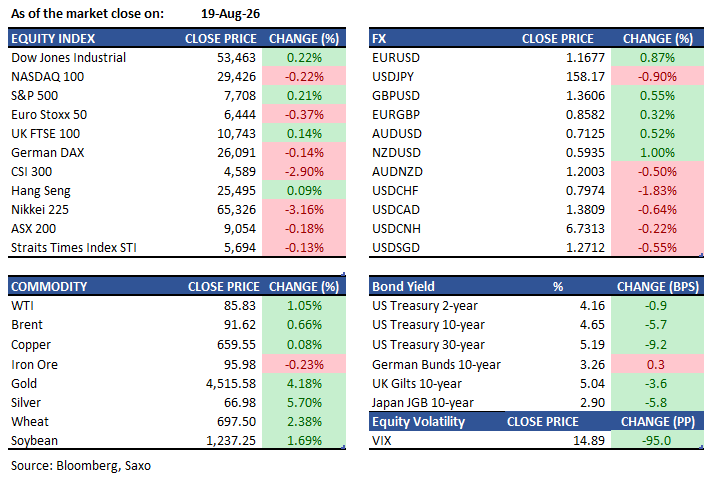
Disclaimer: Past performance does not indicate future performance.
Macro:
- Treasury will at least double buybacks of 10- to 30-year debt after 30-year yields hit their highest since 2007, aiming to support liquidity and stability. The move pushed the 30-year yield down about 9 bps to 5.19% and comes ahead of a $16 billion 20-year bond auction.
- July FOMC minutes showed most officials favored holding rates, though several wanted a hike and said more increases may be needed if inflation stays high. They noted tighter financial conditions, broad-based price gains, and an outlook of similar inflation but slightly weaker growth. Chair Warsh floated cutting to six meetings a year, with no change for 2026.
- Trump said oil is still flowing through the waterway and signaled openness to talks with Tehran “at some point.” Meanwhile, the UAE halted financial and economic transactions with Iran after accusing it of launching ballistic missiles at its territory.
Equities:
- US — S&P 500 gained 0.3% on Wednesday, snapping a three-session losing streak, as the Treasury buyback announcement lifted sentiment. The Dow Jones rose 0.2% while the Nasdaq 100 was little changed. Moderna surged 177% — the best performer in the S&P 500 — after its personalised cancer vaccine developed with Merck showed positive Phase 3 melanoma results; Merck rose 12%. Marvell jumped ~10% on a new custom AI chip agreement with Alphabet's Google, while Broadcom fell 4.1%. Banks underperformed, with the S&P 500 Banks index falling 2.1%. Chipmakers continued to lag, with Seagate falling 7.9%. Estée Lauder rose ~8% on an earnings beat. SK Hynix announced a 40 trillion won ($29 billion) share buyback, sending its shares opening higher but closed flat. Target rallied 4% after reporting earnings that beat estimates and raised full year sales growth forecast to 5%
- EU — European equities closed mixed on Wednesday amid elevated bond yields, inflation concerns, and a continued tech selloff. The Stoxx 600 fell 0.1% for a sixth consecutive session, its lowest close since July 31, with ASML declining 2.2% as the largest drag and Rockwool falling 5.0%. The DAX slipped 0.1% to its lowest since August 3, with Infineon down 4.0%. The FTSE 100 edged up 0.1% to 10,743, supported by AstraZeneca (+2.1%) and Fresnillo (+7.8%). The CAC gained 0.1% and the Swiss Market Index rose 0.5%. Smith & Nephew fell 3.7% after its CFO announced his departure.
- Asia — Asian markets are staging a sharp rebound on Thursday morning after Wednesday's steep selloff, which had seen the MSCI Asia Pacific drop 2.3%, the Kospi plunge 5.8%, and the Nikkei fall 3.2% — driven by a semiconductor rout and elevated bond yields. Today, the MSCI Asia Pacific is up approximately 1%, with the Kospi surging over 4% to around 6,732, led by memory chipmakers after SK Hynix announced a 40 trillion won buyback post-close. The Nikkei is up 1% to approximately 65,981, with Kansai Electric jumping 6.6% and Namura Shipbuilding rising 11%. The ASX 200 is up 0.5%. Hang Seng and broader China markets are opening into a positive backdrop, with the Nasdaq Golden Dragon China Index having risen 1.5% overnight. The STI is trading modestly higher in line with the regional tone. US equity futures are also advancing in early Asian trade.
Earnings this week:
- Thursday - Walmart, Deere & Co., Ross Stores, Alibaba, Ping An Insurance, Pop Mart
- Friday - BJ’s Wholesale Club
FX:
- USD slumped broadly after the Trump administration unexpectedly pledged to at least double long-end US Treasury buybacks, reversing a rout that had pushed 10–30Y yields to their highest since 2007. The Bloomberg Dollar Spot Index fell as much as 0.8% to its weakest since May 12, driving gains across G10 and EM FX.
- USDCHF stand out as the biggest G10 mover, dropping 1.83% in the Swiss franc’s sharpest one-day rally since July 15 and almost twice the size of the next-largest move.
- USDJPY is nudging back to 158.34 after its 0.9% drop, with a clear break below 158 eyed as a trigger for deeper carry unwinds and potential BOJ intervention chatter.
- EURUSD is holding around 1.1675 after yesterday’s 0.87% surge, with options skew showing this is still largely a September Fed repricing story rather than a strong euro conviction, especially as the Iran-driven energy shock caps eurozone upside.
- GBPUSD sits just above 1.36 and EUR, GBP, AUD risk reversals continue to trade as a unified dollar view, underlining that local narratives are secondary to the US rates theme.
Commodities:
- Gold surged more than 4% to above $4,500 per ounce, its largest single-day gain in six months and its highest level since early June. The move was driven by the sharp fall in the dollar and long-end Treasury yields following the buyback announcement, with analysts noting the rally also reflects a growing market premium on US institutional and policy volatility.
- Brent crude held above $91 per barrel in early Asian trade, extending a four-day run of gains of more than 5%, as President Trump announced sweeping new economic measures against Iran and the UAE cut trade and financial ties with Tehran. The US is reportedly running a stealth military shipping corridor through the Strait of Hormuz, with roughly 10 million barrels per day transiting via the Omani route.
- Copper's historic LME squeeze continued to ease, with the cash-to-three-month backwardation falling to around $248 per metric ton from a peak of $545 earlier in the week, after Trafigura and other traders made significant metal deliveries to the exchange. Copper traded below $14,000 per metric ton.
Fixed income:
- The Treasury curve twist-flattened, the long end outperforming on an off-cycle buyback that at least doubled 10–30Y operations, while the front end lagged amid T-bill supply concerns. The 30-year yield fell approximately 10 basis points to 5.18%, having hit its highest level since 2007 earlier in the week. The 10-year yield fell 5.8 basis points to 4.647%, while the 1-year yield was little changed at 3.982%. The 5s30s spread tightened by approximately 7 basis points on the day.
- The $16 billion 20-year bond auction cleared at a yield of 5.204% — the highest since the sector was reintroduced in May 2020.
- UK Gilts outperformed on Wednesday after UK CPI matched estimates, with traders paring Bank of England tightening bets. The 10-year Gilt yield fell 2 basis points to 5.07%. German Bunds lagged, with a €3.77 billion 10-year Bund auction clearing at the highest average yield since 2011. Bond traders are increasingly positioning for a Fed pivot to rate cuts in 2027, even as long-end yields remain at multi-decade highs.
For a global look at markets – go to Inspiration.
This content is marketing content and should not be considered investment advice. Trading financial instruments carries risks and historic performance is not a guarantee for future performance.
The instrument(s) mentioned in this content may be issued by a partner, from which Saxo receives promotion, payment or retrocessions. While Saxo receives compensation from these partnerships, all content is conducted with the intention of providing clients with valuable options and information.