
Access all our platforms from a single account.

Asia Market Quick Take – 16 July, 2026

Key points:
- Macro: US PPI declines 0.3% against expectations of 0%
- Equities: Apple surges 4% to new high as China approves Apple AI
- FX: Soft US inflation weakens dollar; sterling rallies to fresh two-month highs
- Commodities: WTI choppy around $80; gold steady near $4,060
- Fixed income: Treasuries up a second day; yields fall across the curve
------------------------------------------------------------------
Disclaimer: Past performance does not indicate future performance.
Macro:
- US producer prices fell 0.3% month-on-month in June 2026 (vs 0% expected), after a revised 0.6% rise in May—the first decline since August 2025. Goods prices dropped 1.4%, led by a 12% fall in gasoline, while services rose 0.2%. Year-on-year, PPI increased 5.5% (vs 6.2% expected), and core PPI rose 0.2% on the month, with the annual core rate at 4.7%.
- The New York Fed’s Empire State Manufacturing Index rose 10 points to 15.6 in July 2026, indicating stronger activity. New orders, shipments, employment, and the workweek increased, supply availability worsened, and price pressures remained elevated but eased slightly. Firms remained optimistic about the outlook.
- The Bank of Canada kept its overnight rate at 2.25% in July 2026 for a sixth straight meeting, as expected. The economy has improved despite the energy shock, but growth is expected to moderate, with GDP seen at 2.75% this year and 3.25% next year. Inflation is projected to ease from above 3% and converge toward the 2% target next year, supporting unchanged policy.
- Andy Burnham, expected to be confirmed as UK prime minister on Monday, is set to choose a fiscally conservative finance minister. Reports that Home Secretary Shabana Mahmood is the frontrunner for the Treasury have reassured markets, easing worries he might pick Ed Miliband, who is seen as more fiscally expansionary.
Equities:
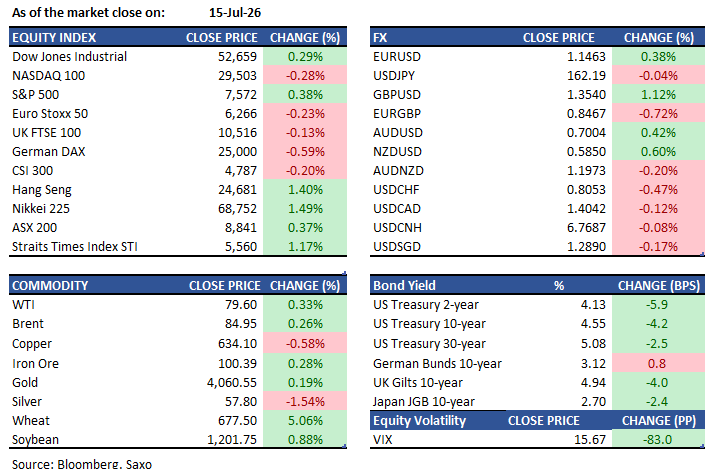
- US — US equities closed higher on Wednesday for a second consecutive session. The S&P 500 rose 0.4% to 7,572.40, the Dow gained 0.3% to 52,658.64, while the Nasdaq Composite added 0.6% to 26,269.23. The Nasdaq 100 fell 0.3%, dragged by memory chip names — Micron and AMD were notable laggards, while SanDisk sank 13%. Apple surged 4.0% to a new all-time high of $327.50, aided by China's Cyberspace Administration including Apple's generative AI in an approved list. PayPal soared 17.2% on reports that Stripe and Advent may make a takeover offer. The S&P 500 financials sector hit a record high on strong bank earnings. Pentair fell 15% to a two-year low.
- EU — European equities were broadly flat on Wednesday. The Stoxx 600 edged up 0.1% to 642.71, while the Euro Stoxx 50 fell 0.2% to 6,265.58. The DAX declined 0.6% to 24,999.53, with Infineon dropping 6.3% on chip sector weakness. The FTSE 100 slipped 0.1% to 10,515.92, with HSBC and Vodafone (-3.9%) leading declines. The standout mover was Richemont, which surged 6.7% after reporting first-quarter sales growth nearly twice as strong as expected, lifting the luxury sector gauge 3.2%. ASML initially rallied as much as 7.9% after raising its annual sales forecast for the second time this year, but gave back gains to close lower amid reports of pricing pushback from TSMC. SEB hit a record high after reporting record fee and commission income.
- Asia — Asian equities are under significant pressure this morning, led by a sharp selloff in semiconductor stocks. The MSCI Asia Pacific index fell 1.1% to 269.90. South Korea's Kospi opened down 4.4% to 6,960.50, with the Korea Exchange activating a sidecar to halt program selling — chip bellwether SK Hynix tumbled over 8.4%. Japan's Nikkei fell over 2% to 67,373.74, with the broader tech and chip complex dragging the index lower; Japanese banks are attracting interest as an alternative to crowded AI names. The Hang Seng and China markets are in focus as the Nasdaq Golden Dragon China Index rose 2.9% overnight, with Chinese smartphone and AI model makers in focus following Apple's China AI approval. Selling pressure in Asia is being driven by contagion from the US memory chip rout, with Micron's losses on the SOX gauge and SK Hynix ADRs falling 9% overnight setting the tone.
Earnings this week:
- Thursday: Netflix; GE Aerospace; Alcoa; UnitedHealth
FX:
- USD weakened broadly as back-to-back soft US inflation prints — first CPI and then a weaker-than-expected PPI — pushed the Bloomberg Dollar Spot Index down 0.3% to its lowest since June 17.
- Sterling led G10 gains, with GBPUSD up 1.12% to a two-month high on USD softness and UK political headlines, while AUDUSD climbed 0.42% to near a three-week high as traders pared Fed hike expectations.
- EURUSD rose 0.38%, though the euro remains 2.8% lower year-to-date amid French election risk, deteriorating terms of trade, and valuation concerns.
- USDCHF saw the sharpest dollar decline, falling 0.47%, whereas USDJPY barely moved (-0.04%), leaving the yen the weakest G10 performer despite the softer dollar, as structural headwinds from the BOJ’s shrinking balance sheet and ongoing depreciation persisted.
- USDCNH dipped modestly after the PBOC delivered its strongest daily fix since April and signalled comfort with current yuan levels and two-way flexibility.
Commodities:
- WTI crude is choppy around the $80/bbl level, while Brent extended gains as the US launched fresh strikes in the Middle East and reports emerged of a potential expansion of military operations against Iran. The Strait of Hormuz blockade risk continues to underpin prices, with the IEA flagging significant global economic risk if the disruption persists.
- Gold steadied near $4,060/oz in early Asian trading, after ending Wednesday up 0.2%. Softer US inflation data and a weaker dollar provided support, though escalating Middle East tensions and uncertainty over the Fed's rate path are keeping traders cautious on direction.
- Rio Tinto fell as much as 2.3% in London after reporting Q2 copper production that declined from the prior comparable period, with iron ore output also missing expectations — highlighting ongoing supply-side pressures in the base metals complex.
Fixed income:
- Treasuries rose for a second consecutive session following the soft June PPI print, with yields falling across the curve. The 2-year yield fell approximately 5bps to around 4.19%, the 10-year fell 4.9bps to 4.545%, and the 30-year fell 3bps to 5.077%. Short-end bonds outperformed as the market further priced out near-term Fed hike risk.
- The 5s30s spread widened to 82bps from 78.5bps, with a large block curve trade in 5-year notes and ultra-long bonds helping sustain the steepening move. The Empire State Manufacturing data added further evidence supporting the steepener thesis.
- Rising JGB yields to multi-decade highs are drawing Japanese capital home, with analysts flagging that a $100 billion reduction in Japanese Treasury holdings could push US 10-year yields materially higher on a sustained basis — a structural headwind for Treasuries that is being closely monitored.
For a global look at markets – go to Inspiration.
This content is marketing content and should not be considered investment advice. Trading financial instruments carries risks and historic performance is not a guarantee for future performance.
The instrument(s) mentioned in this content may be issued by a partner, from which Saxo receives promotion, payment or retrocessions. While Saxo receives compensation from these partnerships, all content is conducted with the intention of providing clients with valuable options and information.