Access all our platforms from a single account.

Asia Market Quick Take – 13 July, 2026
Asia Market Quick Take – 13 July, 2026
Key points:
- Macro: US and Iran exchange fresh strikes over the weekend
- Equities: SK Hynix ADR jumped 12.8% on record $26.5b debut
- FX: USD broadly strengthens on US–Iran tensions; JPY, AUD weaken
- Commodities: Brent crude surges 3% above $78 on Hormuz uncertainty
- Fixed income: 30Y auction clears at 5.058%, highest since 2007
------------------------------------------------------------------
Disclaimer: Past performance does not indicate future performance.
Macro:
- US and Iran traded new missile strikes amid rising Strait of Hormuz tensions. The US carried out a fourth strike in a week after Iran hit a Cyprus-flagged ship. Iran claimed it has closed the strait, which the US rejected, and says it won’t resume talks until the US honors past transit and oil-export commitments.
- Canada’s jobless rate edged down to 6.5% in June 2026 from 6.6%, beating expectations. Employment rose by 18,000, mainly in part-time jobs, and unemployment fell by 13,200. The job-finding rate reached 24.3%, while labor force participation held at 65.0% despite recent energy shocks and US tariff tensions.
- New Zealand’s BusinessNZ Performance of Composite Index rose to 53.6 in June 2026 from 49.9, marking the first private-sector expansion since January and the strongest since December 2025. Services returned to growth and manufacturing saw its fastest expansion since July 2021 despite high fuel costs, though activity/sales, stocks, and employment remained in mild contraction, suggesting a tentative recovery.
Equities:
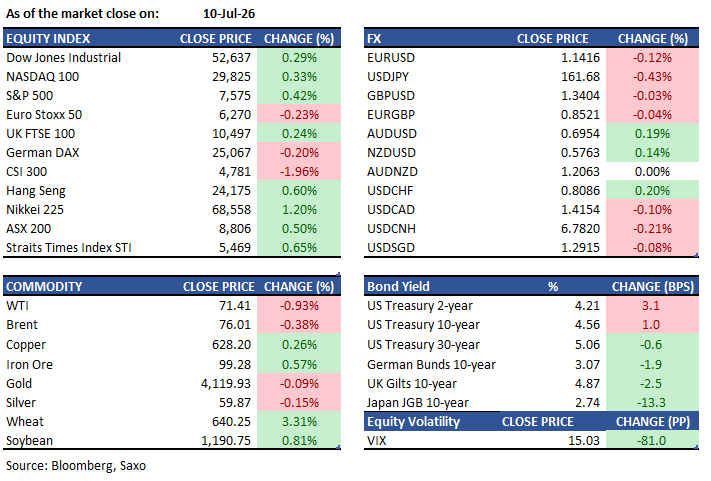
- US - Stocks rose Friday ahead of earnings: S&P 500 +0.4%, Nasdaq 100 +0.3%, Dow +150 pts. SK Hynix jumped 12.8% in its record $26.5 billion US debut. Nvidia gained 4%, AMD 2%, while Broadcom slipped 0.3% and Intel 2.4%. Meta rose 6% on a positive AI report. Financials and cyclicals firmed as oil’s rebound paused, easing Fed hike worries.
- Europe - European stocks ended mixed Friday after a volatile week. The Euro STOXX 50 slipped 0.3% and the STOXX 600 was flat as AI-related tech names retreated (ASML, Siemens Energy, Infineon all lower) despite strong SK Hynix demand. Banks rose about 1.5% (BBVA, Deutsche Bank, UniCredit) on firm Eurozone bonds and softer oil. Both key indices are now roughly 2% below last week’s record highs.
- Asia — Asian equities face a cautious open Monday with a stronger dollar and higher oil prices threatening to stall last week's recovery momentum. The Kospi enters the week having declined in five of the last six weeks, though it trades at a record-low forward P/E of just 6.4x despite an ~80% year-to-date rally driven by Samsung and SK Hynix earnings upgrades. The Hang Seng saw strong gains mid-week (8 July) as Chinese tech rallied — Alibaba surged 11% and Tencent added 3% — on reports local AI model makers are developing proprietary chips. Asian energy stocks may outperform Monday tracking Brent's move above $78. The Nikkei and STI are also expected to open cautiously given the geopolitical backdrop and sliding Treasury futures.
Earnings this week:
- Monday: Fastenal
- Tuesday: JPMorgan; Bank of America; Wells Fargo; Citigroup; Goldman Sachs
- Wednesday: Morgan Stanley; United Airlines; BlackRock, ASML
- Thursday: Netflix; GE Aerospace; Alcoa
FX:
- USD strengthened broadly against most G-10 and EM Asia currencies as risk-off sentiment picked up on renewed geopolitical tensions between the US and Iran.
- USDJPY climbed to 161.91, hovering near its 52-week highs, with the yen notably failing to attract its traditional safe-haven inflows despite the risk-averse environment.
- Commodity currencies underperformed, with AUDUSD slipping 0.09% to 0.6940 and NZDUSD easing 0.07% to 0.5760, reflecting sensitivity to global growth and risk sentiment.
- EURUSD held steady at 1.1400, showing relative resilience even as the broader dollar gained ground.
- The largest mover was USDCHF, which rose 0.22% to 0.8100, suggesting that investors are currently favoring the USD over the Swiss franc as their safe-haven of choice.
Commodities:
- Brent crude surges above $78 on Hormuz uncertainty. Brent rose more than 3% to $78.40 a barrel in early Monday trading after the US launched fresh strikes on Iran and Tehran declared the Strait of Hormuz closed "until further notice." US Central Command disputed the closure claim. WTI traded near $74. European natural gas added as much as 2.7%. Brent had already gained 5.4% last week.
- Precious metals eased in early Monday trading despite the geopolitical escalation, as the stronger dollar weighed. Gold had been trading around $4,000/oz in recent sessions, having declined roughly 7% year-to-date as the Iran war-driven commodity shock faded earlier in the quarter.
Fixed income:
- Treasury yields rise for a second straight week. Yields across maturities ended the week of 10 July seven to eight basis points higher, with five- to 30-year tenors up 18 to 20 basis points over the past two weeks. The move was driven by the resumption of Middle East hostilities and the associated oil price rebound stoking inflation concerns. Treasury futures are sliding further in early Monday Asia trading, pointing to additional yield pressure.
- The $22 billion 30-year bond reopening on 9 July drew a yield of 5.058%, the highest since 2007, but stopped 0.3 basis points through the when-issued yield, signalling demand exceeded expectations. Indirect bidders took 77.7% of the auction — among the highest on record — with primary dealers awarded just 10%, the lowest since March.
For a global look at markets – go to Inspiration.
This content is marketing content and should not be considered investment advice. Trading financial instruments carries risks and historic performance is not a guarantee for future performance.
The instrument(s) mentioned in this content may be issued by a partner, from which Saxo receives promotion, payment or retrocessions. While Saxo receives compensation from these partnerships, all content is conducted with the intention of providing clients with valuable options and information.