Outrageous Predictions
Carry trade unwind brings USD/JPY to 100 and Japan’s next asset bubble
Charu Chanana
Chief Investment Strategist
A Trump-driven Fed pivot crashes the carry trade, hurling USD/JPY to 100 and unleashing Japan’s wild...



Silver has broken out of a multi-week holding pattern, with the move above $82.20–82.70 appearing to trigger momentum and technical buying.
The metal is behaving less like a pure haven and more like a risk-on hedge: inflation protection, industrial demand and copper strength are all supporting the move.
The opportunity is tactical, but the risk is speed. Silver can reward momentum, but it can also reverse sharply when leveraged positioning gets crowded.
Silver has surged to two-month highs after a sharp rally that pushed it back above $85 for the first time in around two months. The break above the $82.20–82.70 zone appears to have shifted the market from hesitation to momentum, with leveraged accounts that had been sitting on the sidelines now being pulled back in.
The move is not happening in isolation. Copper has also strengthened after breaking key resistance, giving silver an additional industrial-metals tailwind. That matters because silver is not just a precious metal. It is also tied to solar, electronics, autos, electrification and broader industrial demand.
That makes silver’s current setup cleaner than gold in some ways. Gold remains vulnerable to higher real yields because it has no yield. Silver has that problem too, but it also carries a growth and industrial-demand story. When investors want inflation protection without fully abandoning risk appetite, silver can outperform gold.
The big question for traders now is whether this is the start of a larger breakout, or whether the move has already pulled in too much fast money.
| Level | Why it matters |
|---|---|
| $82.20–82.70 | Key breakout zone. This is now the first major support area and the line that keeps the bullish structure intact. |
| $85 | Psychological and tactical pivot. Holding above this level suggests buyers remain in control. |
| $87–88 | Near-term momentum zone. A pause here would be normal after the sharp move. |
| $90–91.50 | Next major upside test. A break could extend the momentum trade. |
| $95–97 | Higher resistance zone where profit-taking risk may rise. |
| $100+ | Psychological squeeze zone, but also where volatility and margin risk may increase sharply. |
| Below $82 | Breakout failure risk. A move below here could pull silver back into its old range quickly. |
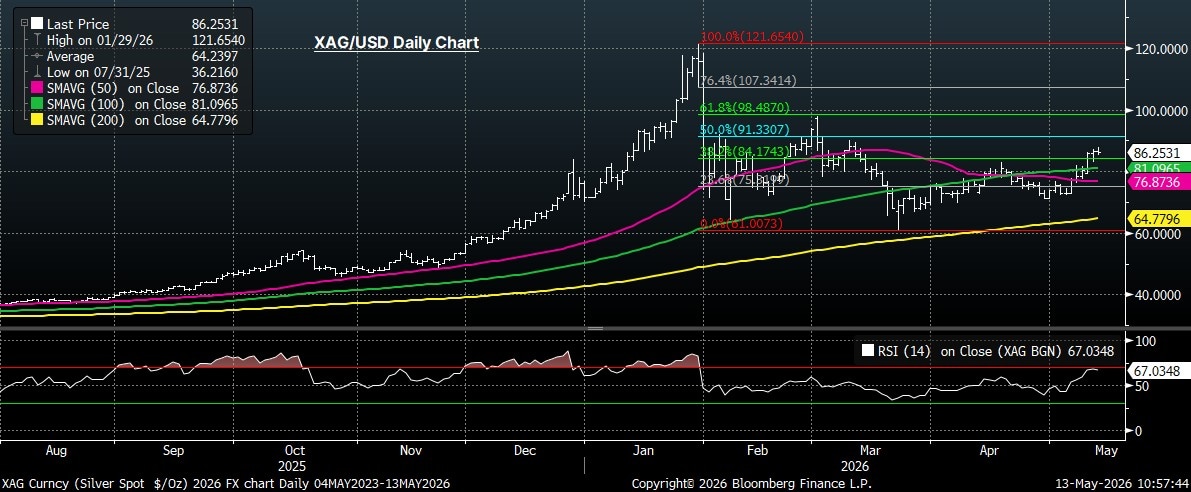
Hold above: $85
Upside trigger: $87–88
First target zone: $90–91.50
Extension zone: $95–97
Squeeze risk: $100+
The bullish case is that silver has moved from range-bound to trend-following. The break above $82.20–82.70 is important because it likely forced momentum buyers and sidelined leveraged accounts back into the market. As long as silver holds above $85, the market may continue to treat dips as buying opportunities.
Copper strength adds to this view. If industrial metals remain bid, silver has a cleaner narrative than gold: it can act as both a hedge and a growth-sensitive metal.
Copper continues to hold above its own breakout levels.
Real yields stop rising or the US dollar softens.
Gold remains capped, allowing silver to outperform on a relative basis.
Leveraged accounts add exposure instead of fading the move.
Inflation concerns remain alive, but growth expectations do not collapse.
Traders already long may look to stay with the trend while silver holds above $85.
New entries may be cleaner on shallow pullbacks rather than after another vertical spike.
A pullback toward $85, followed by a strong rebound, could confirm that buyers are defending the breakout.
Options traders may prefer call spreads over outright calls if volatility has already risen.
For relative-value traders, long silver versus gold may remain attractive while industrial metals are firm and the gold-silver ratio is falling.
The move has been fast, and fast rallies attract late buyers.
A reversal in copper could weaken the industrial-demand story.
A sharp rise in real yields could hit both gold and silver.
If silver fails near $90–91.50, profit-taking could become aggressive.
First support: $85
Major retest zone: $82.20–82.70
Bullish structure at risk: sustained break below $82
Upside reset level: reclaim of $87–88
After a strong multi-session rally and a sharp daily jump, a pullback would not be surprising. In fact, it may be healthier than another immediate spike. The cleaner question is not whether silver pulls back, but whether buyers defend the old breakout zone.
A retest of $82.20–82.70 would be important. If silver holds that area, the market can argue that former resistance has turned into support. That would keep the broader bullish structure intact.
Short-term profit-taking after a large move.
Copper pauses but does not break down.
The dollar firms temporarily.
Real yields rise modestly but not enough to break the metals bid.
Traders reduce leverage before key macro data or central-bank events.
This may be the cleaner setup for traders who missed the first move.
A dip toward $85 could be watched for signs of demand returning.
A deeper pullback toward $82.20–82.70 may offer a better-defined risk-reward area, provided price action stabilises.
Confirmation matters: a quick reclaim of $85 after a dip would be more constructive than simply catching a falling candle.
Traders may consider scaling rather than entering all at once, given silver’s volatility.
If silver cuts straight through $82.20–82.70, the breakout may have been more positioning-driven than fundamental.
A deeper pullback could trigger stops from late longs.
If copper also reverses, silver may lose one of its strongest supporting narratives.
Warning level: below $85
Breakout failure: below $82.20–82.70
Next downside zone: $78–80
Deeper reset: $75–76 if liquidation accelerates
The bearish case is that silver’s move has been too fast and too dependent on technical buying. If the rally was driven mainly by leveraged accounts chasing the breakout, the same accounts could become forced sellers if the market turns.
Silver remains vulnerable to the same macro headwinds as gold: higher real yields, a stronger dollar and tighter financial conditions. The difference is that silver also carries growth sensitivity. If the market shifts from “inflation with growth” to “inflation with growth fear,” silver could lose its advantage over gold.
Copper reverses sharply.
US real yields rise and the dollar strengthens.
Risk appetite weakens across equities and industrial commodities.
Traders unwind crowded long positions.
Margin pressure or volatility controls force position reduction.
Traders may consider reducing long exposure if silver closes back below $82.20–82.70.
A break below $82 would suggest the breakout has failed and that price may rotate back toward the old range.
Short-term traders may look for rallies back toward $82.70–85 to fade, but only if price fails to reclaim those levels.
For hedging, put spreads may be more efficient than outright puts if implied volatility is already elevated.
False breakdowns are common in silver.
A quick reclaim of $85 after a dip below support could trap shorts and restart the squeeze.
Any renewed inflation or geopolitical hedge demand could bring buyers back quickly.
Silver support: $85
Momentum confirmation: break above $90–91.50
Relative signal: falling gold-silver ratio
Risk signal: gold-silver ratio rebounds sharply
This may be the most important lens for traders. Silver is not simply following gold. It is behaving like the cleaner risk-on hedge.
Gold usually performs best when investors want safety, lower real yields or protection from currency debasement. Silver can benefit from those same forces, but it also responds to industrial demand. That gives silver an edge when investors want inflation protection but are not ready to give up on growth.
If copper remains strong, equities stay supported and the dollar does not squeeze higher, silver can continue to outperform gold.
Industrial metals continue to strengthen.
Inflation hedging remains relevant.
Growth expectations stay firm.
Real yields remain contained.
Gold is capped by yield pressure, while silver benefits from industrial flows.
Traders may favour silver exposure over gold when the market is in a risk-on but inflation-aware regime.
Relative-value traders may monitor long silver versus gold structures.
The trade is strongest when copper is rising, equities are stable and the dollar is not breaking higher.
A falling gold-silver ratio would confirm that silver is leading, not just tagging along.
If risk appetite deteriorates sharply, gold may regain leadership.
If real yields rise aggressively, both metals may struggle.
If industrial metals reverse, silver may lose its relative advantage.
Silver’s breakout looks technically meaningful while it holds above $82.20–82.70, with $85 now the key tactical pivot. Above that level, traders may continue to treat pullbacks as opportunities, with $90–91.50 the next major upside test and $95–97 as the higher resistance zone.
The strongest argument for silver is not just that precious metals are bid. It is that silver currently sits at the intersection of three themes: inflation protection, industrial demand and momentum positioning.
That combination can be powerful, but it also comes with sharp reversal risk. The cleaner approach is to respect the breakout, avoid chasing stretched candles, and use the $82.20–82.70 zone as the key line between a healthy pullback and a failed breakout.
Outrageous Predictions
Chief Investment Strategist
Outrageous Predictions
Chief Investment Strategist
Outrageous Predictions
Chief Investment Strategist
Outrageous Predictions
Chief Investment Strategist
Outrageous Predictions
Global Head of Investment Strategy
Outrageous Predictions
Investor Content Strategist
Outrageous Predictions
Global Head of Macro Strategy
Outrageous Predictions
Global Head of Macro Strategy
Outrageous Predictions
Saxo Group
Outrageous Predictions
Global Head of Macro Strategy