You can access all of our platforms from a single Saxo account.

Q2 Outlook for Traders: The Iran War and its Risks
Quarterly Outlook 10 minutes to read

The outbreak of war in Iran has set the market focus on spiking oil and gas prices as the most important immediate risk factor clouding the outlook. As of the mid-March time frame of the writing of this outlook, the market has “under-reacted” to the gravity of risks and is pricing that oil and gas flows will resume quickly and fully. We should all hope that the market is right. This outlook considers two scenarios stemming from the immediate risks of the war in Iran as well as how the war is a chapter in the ongoing rivalry between the US and China and what to look for next.
We are writing this outlook in the teeth of the most significant disruption to the flow of global oil supplies since the 1970s as the US and Israeli attacks on Iran have interrupted export flows through the world’s most important fossil fuel export artery, the Strait of Hormuz. As of this writing on March 17, best estimates are that at most, about half of the normal rate of approximately 20M barrels per day is being delivered for export, whether through the strait itself or via alternative routes. That’s according to noted energy industry analyst Javier Blas of Bloomberg, who also made the point that most of the flow rate is in crude oil, which leaves the world very short of key refined products that were increasingly coming from the Gulf countries in recent years.
And it’s not just about oil: Qatar quickly halted all liquefied natural gas (“LNG”) production with the outbreak of the war at the end of Feb, leaving the world short of 20% of global LNG exports. As well, Qatar doesn’t just produce natural gas, but also key products downstream of its gas processing like sulfur and many fertilizers. Qatar’s exports of both are a third or more of global exports in key categories. Officials there say it can take from “weeks to months” to get LNG flows restarted, with the availability and especially the cost of fertilizer supplies already a concern for the upcoming growing seasons in the Northern and Southern hemispheres. Sulfur is critical for both some fertilizers and for mining and other applications when converted into sulfuric acid. Helium is also a byproduct of Qatari natural gas processing and has represented as much as a third of global supplies in recent years. It is key in the semiconductor sector and many other industries.
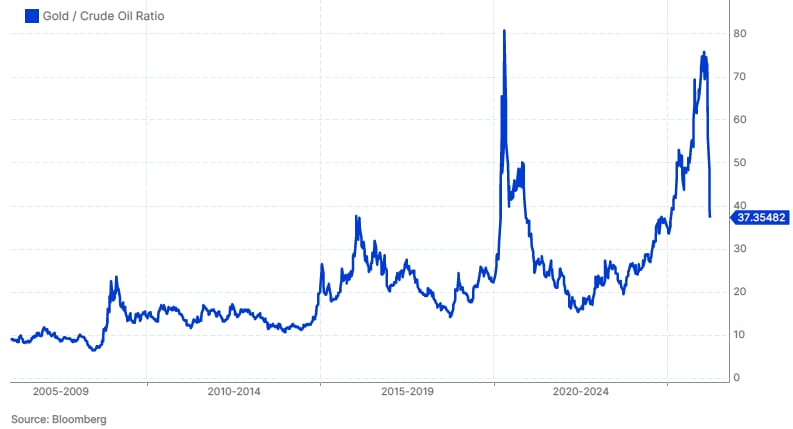
Chart: Gold/Oil ratio. The chart below shows the number of barrels of Brent crude a single ounce of gold can buy. It is interesting to note that the significant spike in crude oil prices in the wake of the outbreak of war in Iran failed to see gold spiking higher in sympathy on the risks to inflation – quite the contrary as gold prices even pushed lower after an initial jump after the outbreak of hostilities. Does this suggest that the market thinks the economy is far less vulnerable to energy spikes that can drive inflation?
While energy-intensity of GDP is lower and the percentage of energy coming directly from crude oil is far lower than was the case in the last major oil crisis in the 1970s, oil remains a vital input for economic activity. The gold market shrugging off this spike in energy prices probably indicates the market belief that this energy price spike will recede quickly as the market has “learned” that this is what “always” happens. After all, every prior jump in oil prices has eventually faded: the huge run-ups in 2007-08 and 2011-14, both of which were powered in part by a very weak US dollar, eventually faded, as did the most recent traumatic spike in 2022 on Russia’s invasion of Ukraine. Let’s see if this attitude ages well. Meanwhile, gold has likely been rising over the last couple of years more due to the world’s demand for a new portfolio asset that is resilient to fears of fiat currency devaluations as many see bonds as no longer providing a safe haven.
Key for Q2: Get crude flowing through Hormuz Strait or else.
An important overall disclaimer for this outlook: rapidly shifting dynamics in the Iran war and its impacts might completely alter global market sentiment and the forward outlook for both the economy and markets – for the better or for the worse. There are endless scenarios for how the situation can develop, but to focus attention on the risks we’ll crystallize two general scenarios from what should really be seen as a massive sliding scale from 1) clarity begins to emerge immediately and Hormuz strait oil and gas flows resume as quickly as can be expected given known difficulties in re-stablishing those flows to 2) profound economic and market dislocations.
- Scenario One (the baseline assumption): A slightly worse than expected scenario as of mid-March in which only about 75% or so of Hormuz Strait flows, both oil and gas, resume before May 1, with flows rapidly improving.
- Scenario Two (Probability: quite low?): Significant disruptions to oil and/or gas flows remain beyond May 1 with significant damage to production or processing infrastructure that prevents rapid normalization in coming months.
Scenario One: How much of the fallout is in price, is there a return to normalization?
Energy prices as the key input
As of this writing, prompt Brent trades around USD 102 per barrel and six-month forward Brent trades around USD 85 per barrel. Is that cheap or expensive? It’s probably expensive if all uncertainty evaporates in the days after making this observation. But especially the forward price looks quite cheap relative to any scenario in which there is an extension of supply uncertainty. For perspective: as of mid-March we already have more than two weeks of profound supply disruption and even if stability could be achieved in an instant, the resumption of normal flows would take at least a month to two months and reserves would need rebuilding on top of the base level demand for oil. In short, the market is pricing a very benign scenario, one that needs to be well on the way to significant improvement before this outlook hits your eyes around April 1 to be justified. Let’s hope that is what we get, in which case we can bring forward the more positive longer-term outlook for global growth and market outcomes outlined below.
Scenario One possible outcomes
Oil and gas: In our base case, the uncertainty lingers somewhat longer into the end of Q1 and even the first weeks of Q2 and all of the supply chain backups mean that the prompt price for crude oil and gas could stay at the high end of the recent price range for several more weeks, while the longer term price could slowly rise to the 80-100 dollar range for Brent rather than a sub-80 dollar range the market predicts, as the market understands the scale and duration of the disruption. Gas disruptions take slightly longer to clear, with some sustained higher prices for key markets relying on significant LNG, affecting inflation.
Global equities: In this scenario, global equities chop around in correction or near correction mode amid concerns for a profit and economic slowdown. Still, the damage is contained on the view that policymakers will continue the “run it hot” playbook (ongoing fiscal and monetary policy aimed at keeping nominal economy running hot, especially for strategically critical supply chains). In short, growth outcomes weaken, but fiscal and monetary policy remains pro-cyclical relative to the backdrop and central banks fail to put up much of a fight against rising inflation. A significant bottom in most equity markets is in Q2 with a recovery later in the year for Europe and Japan and other Developed Markets ex-US. Emerging markets might suffer more of a headwind to growth from higher energy prices and from general market volatility, especially given US dollar resilience, but this only looks to be a significant speed bump in a longer term EM-positive story, as EM economies are less debt-addled and have greater growth potential and align with our long-term USD bearish stance.
US equities – the AI angle: The US market has the greatest tech- and AI-overlay because of the huge weight of not just Mag7 mega-caps stocks, but many other infotech and software companies in the US indices. As discussed in our Investor Outlook for Q2, the AI space is going in many different directions, with some companies enjoying rising margins and absorbing the huge spending, while those doing the spending must prove they can maintain profitability and software companies must prove they can avoid disruption from AI. Still, there is an overall sideways to negative risk for the market-cap weighted US indices even after the five months sideways US equity market performance since October of last year. The most negative wildcard would be significant reductions to future capex plans for AI data centers, possibly using the excuse that energy prices have spiked too high to continue buildouts at previously planned rates. The rest of the US stock market, infotech aside, might enjoy a strong recovery from wherever it finds support in Q2. It’s worth noting that the equal weight S&P 500 Index rose to an all time high the very day before the Iran War broke out.
Rates, precious metals and FX: Japan shows the way? The US dollar saw a significant rally in Q1 after the market was caught off-guard by the Iran War and market participants squared heavy USD-short positions on the uncertainty. The reaction makes sense in that a huge spike in energy prices would be the worst for EM, Japan (very reliant on GCC-sourced crude oil) and Europe, with the US almost invulnerable to these disruptions, especially in natural gas. US Treasury yields and global bond yields have backed up on the assumption that higher oil prices would mean higher inflation and less dovish and even more hawkish central banks. Looking forward to Q2, the market is more likely to move away from any view, minor exceptions aside, that central banks will provide any meaningful pushback if inflation rises again. Rather, policymakers are likely to generally pursue the “run it hot” strategy of funneling support to strategically critical areas of the economy, especially defense, rare-earth, industrial and possibly even home-building supply chains in the US to support affordable housing. The advent of a super-majority empowered PM Takaichi in Japan and her fiscal expansion and pro-growth agenda shows the way for the rest of the world.
The US is likely to follow Takaichi’s lead this year once Fed Chair Powell is swept aside in May. This yields to a Bessent-Fed Chair Warsh duo looking to support credit expansion for key industries and overall non-restrictive policies for the broader economy. In this scenario, the USD peaks early in Q2 and rolls over to weakness on the expansive policy that imitates what the market is pricing for Takaichi’s Japan, while most other currencies firm against the greenback. Japan will need to encourage repatriation of investment to firm its currency versus a weak greenback and the yen may outperform European peers. Europe is always slow to move but will more likely eventually get on the same page with the rest of the world, so euro strength may become an issue that requires a pushback later in the year. EM currencies in this scenario find a low in the quarter and begin rising again as a function of renewed USD weakness. Gold and silver find solid ground at still quite high levels, possibly taking a breather before strength later this year.
Scenario Two: Lower odds, could trigger a significant deleveraging event.
In Scenario Two, the Iranian regime remains in place and continues its ability to lob enough drones and missiles in the region to disrupt perhaps a third or more of Hormuz Strait throughput (including emergency workarounds like the Saudi East-West pipeline) deep into Q2. Other possible disruptions include Houthi proxies in Yemen harassing Red Sea oil shipments and/or Iran significantly damaging key pipelines or other production facilities in Saudi, UAE, Iraq, Kuwait or Qatar that require many months of further disruption before visibility for the resumption of oil or gas supplies is found. It’s not a scenario we care to entertain, but we should all keep an open mind to the unknown non-zero degree of risk that it is possible.
Scenario Two possible outcomes: in short, a big deleveraging risk. Scenario Two presents some similarities but important differences to the problem set of the last major disaster – the outbreak of the Covid pandemic. The scenario would presumably see a huge and sustained spike to USD 150 per barrel in crude oil, but besides the price, there is the fact that actual supply shortfalls would shut down some significant percentage of economic activity, even despite huge draws on strategic reserves. Global equity markets would have to price a sharp global recession risk and the fiscal and monetary response challenge is far different from the Covid pandemic. Back then, central banks and treasuries printed money to rescue the economy from cratering demand. The “free” income then spiked inflation because the supply chains partially shut down by the pandemic couldn’t respond.
But this time, central banks and treasuries would likely be far more concerned with preserving solvency than boosting demand and can’t print barrels of oil or natural gas. A similar policy response to the pandemic in Scenario Two could create an even more unproductive inflationary spike than the last one. There would of course still be a policy response, but one aimed more at keeping mortgage markets and debt markets stable and people housed and fed and less geared to stimulating broad demand. Only more strategically critical industries and supply chains would continue to see isolated and robust support. We would presume a broad market recession on cratering growth, with some pockets of disaster in leveraged and opaque debt markets like private credit, a huge slowdown in data center spending and other areas. This could provide an attractive starting point for longer term expected returns, but the damage to confidence could prove significant and take all of this year and some of next year to dig ourselves out of. In this scenario, a significant spike in the US dollar and enormous volatility for less liquid assets, from EM bonds and stocks to high yield bonds, is a prominent risk before things begin to recover, presuming energy flows normalize.
Chart: The US golden goose became its Achilles heel over the last two quarters. (For easy comparison, the chart below sets the indices to 100 on September 1, 2025, after the market had recovered from Trump’s “Liberation Day” tariff threats.) The US market responded less negatively than global markets to the outbreak of war in Iran at the end of February. That’s in part as the US economy is profoundly more insulated from global oil and gas price shocks than any other major economy as it sources most of its supplies domestically and from the Americas. But let’s wind back to the pre-Iran War environment, in which the major US indices were under-performing other major equity markets, whether in EM broadly, Japan or Europe. That underperformance was linked to the dual concern that a) many of the largest and most profitable US companies that dominate the US market-cap are making titanic investments in AI infrastructure that may not pay off to shareholders at the same profit levels as their legacy business model and b) the market fears that the very large second and third tier US software-as-a-service names might see their asset-light, profit heavy businesses disrupted by generative and agentic AI. The largest US companies aside, many other US industrial-, logistics- and other companies were performing strongly and in line with global peers – this is visible in the Equal Weight S&P 500 Index strongly outperforming the market-cap weighted S&P 500 and looking more similar to global peers.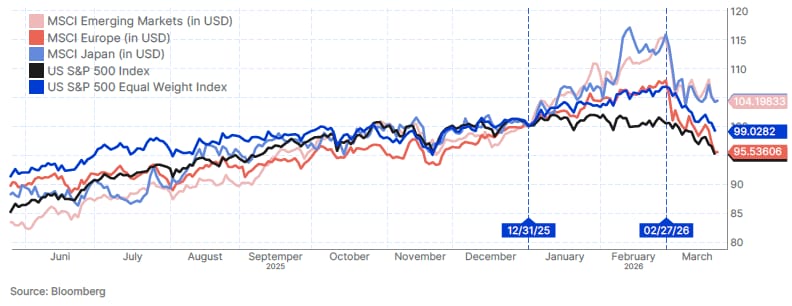
The bigger question: Is the Iran War really about US-China relations?
While we await the hoped for normalization of flows of crude oil, LNG and other supplies through the Hormuz Strait, it’s important to stop and consider why the US chose to pursue this war as a part of a wider geo-strategic initiative. Some argue that the US agreeing to team up with Israel to go after Iran’s regime had nothing to do with the specific threats Iran was making to allies in the Middle East and was really something completely different: the logical second move after the decapitation of Venezuela’s regime and redirection of that country’s energy output to go after suppliers of cheap energy to China. After all, China was the chief buyer at steep discounts of Iran’s heavily sanctioned crude.
The deeper strategic logic, if there is one, is that the United States may feel increasingly backed into a corner. Washington cannot be comfortable with a world in which China holds coercive leverage over the US economy, and potentially over the American military-industrial base itself, through its dominance in manufacturing, rare earths, and, in an extreme Taiwan invasion scenario, access to leading-edge semiconductors. From that vantage point, the US has an existential incentive to develop counter-leverage against one of China’s own core vulnerabilities: its dependence on imported energy.
Seen through that lens, a more assertive US posture in the Middle East would amount to more than regional crisis management. It would represent a longer-term power play to gain greater influence over global oil and gas flows, and thereby offset China’s strategic advantages elsewhere in the supply chain. If that was indeed part of the thinking, Washington may have believed that events could move quickly—perhaps quickly enough to reshape the regional balance before the Trump-Xi summit originally expected around April 1. A sharp interruption to major crude suppliers serving China, alongside a firmer alignment between Washington and key Middle Eastern powers, may have been viewed as a way to improve US leverage ahead of a broader negotiation with Beijing.
But this remains highly speculative. It is unclear whether the US is truly thinking at this level of strategic integration, and even less clear how China will respond. As of this writing, Trump has asked Xi to postpone the summit by one month. We all hope that the situation moves toward a grand bargain or “deal” in which both sides effectively agree not to weaponize access to critical resources. The risk, of course, is that it leads instead to renewed trade hostility and a sharper strategic confrontation, an outcome that would darken the global outlook considerably.
This content is marketing material and should not be considered investment advice. Trading financial instruments carries risks and historic performance is not a guarantee for future performance.
The instrument(s) mentioned in this content may be issued by a partner, from which Saxo receives promotion, payment or retrocessions. While Saxo receives compensation from these partnerships, all content is conducted with the intention of providing clients with valuable options and information.
The instrument(s) mentioned in this content may be issued by a partner, from which Saxo receives promotion, payment or retrocessions. While Saxo receives compensation from these partnerships, all content is conducted with the intention of providing clients with valuable options and information.