
Access both platforms from your single Saxo account.

Asia Market Quick Take – December 18, 2025

Asia Market Quick Take – December 18, 2025
Key points:
- Macro: UK inflation falls to 8-month low at 3.2%
- Equities: Tech led declines with Oracle down 5.4% after data centre deal stall
- FX: JPY weakens 0.6% before BoJ on Friday
- Commodities: Silver another record high while Gold approaching new highs
- Fixed income: Long end cheapens after lacklustre 20-year auction
------------------------------------------------------------------
Disclaimer: Past performance does not indicate future performance.
Macro:
- UK inflation fell to 3.2% in November 2025, its lowest in eight months. Significant price drops occurred in food, especially bread and cereals, while alcohol and tobacco reached their lowest since December 2022. Transport, housing, and utility costs decreased, and services inflation eased. Clothing prices fell, leading to a 0.2% month-on-month CPI decrease.
- New Zealand's economy grew 1.1% in Q3 2025, recovering from a 1% contraction and exceeding forecasts. Business services and manufacturing expanded, while information media and telecommunications declined. Exports and investments rose, with household spending up slightly. GDP increased 1.3% year-on-year after a Q2 drop.
- Euro Area's annual core inflation held at 2.4% in November 2025, consistent with estimates and unchanged for three months. Since May's near four-year low of 2.3%, it has stabilized, suggesting no further ECB rate cuts. Monthly core prices decreased by 0.5%.
- Fed's Waller sees a "very soft" labor market but is optimistic about 2026. Inflation expectations are stable, with rates above target but expected to decrease. He sees no rush to cut rates, despite being 50-100bps over neutral. Fed's Bostic expects solid GDP growth next year, with employment trends uncertain.
Equities:
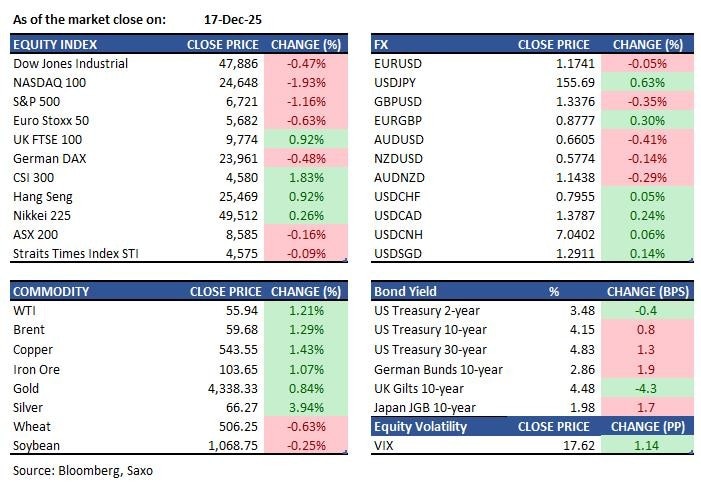
- US - U.S. stocks fell sharply Wednesday, with the S&P 500 down 1.2% and the Nasdaq off 1.8%, marking a fourth straight loss. The Dow dropped 228 points. Tech led declines amid concerns over AI valuations: Oracle plunged 5.4% after reports its key data center partner rejected a $10B project, while Nvidia (-3.8%), Broadcom (-4.5%), and AMD (-5.3%) also slid. Amazon eased 0.6% despite talks to invest $10B in OpenAI. Energy outperformed as oil rose following Trump’s order to block Venezuelan tankers. Netflix added 0.2%, trimming earlier gains after reports Warner Bros.’ board may favor its buyout bid.
- EU - European stocks mostly fell Wednesday, reversing early gains for a second straight session. The STOXX 50 dropped 0.7%, while the STOXX 600 was flat. ASML slid 4% after reports that a Shenzhen team built an EUV prototype, potentially reducing China’s reliance on ASML. Siemens (-2%) and Schneider Electric (-2.9%) also weakened. Defense stocks rebounded as Germany approved over €50B in defense contracts, lifting Rheinmetall (+1.7%) and Safran (+0.5%). Energy gained with BP (+0.9%), Shell (+1.4%), and Eni (+0.5%). Investors now await key policy decisions: the ECB is expected to hold rates, while the BoE is likely to resume cuts.
- HK - Hang Seng rose 233 points (0.9%) to 25,469 on Wednesday, snapping two days of steep losses as bargain hunting lifted all sectors. Mainland markets also rebounded, led by tech strength. Goldman Sachs projected Chinese equities could climb 30% by end-2027, citing pro-market policies and improving earnings. The Hang Seng Tech Index gained 1%, boosted by MetaX Integrated Circuits’ IPO debut, which surged 755% after raising about USD 586 million. Pop Mart jumped 3.7%, Trip.com added 2.6%, while SMIC and Meituan rose 2.4% each. Gains were capped by caution ahead of Hong Kong’s November inflation data due next week.
Earnings this week:
- Thursday: Accenture, Nike, Cintas, FedEx
FX:
- The dollar trimmed gains after Fed Governor Christopher Waller—seen as a potential chair—reiterated dovish rate views. Sterling lagged after inflation hit an eight‑month low, cementing expectations of a BoE cut; GBPUSD fell 0.3% to 1.3379 after 1.3312.
- USDJPY rose 0.6% to 155.70 ahead of the 19 December BoJ decision, making the yen the G‑10 laggard; EURUSD was steady near 1.1743 and EURGBP up 0.3% to 0.8777, while Sweden and Norway are expected to hold rates, the NZD extended losses despite stronger 3Q GDP, and Australian 10‑year bonds edged higher after lower issuance was flagged for next year.
Commodities:
- Gold held near record highs as investors tracked Venezuela tensions and awaited US inflation data, hovering around $4,340 an ounce—up 0.8% in the prior session and just over $40 below October’s peak—and little changed at $4,338.20 in early Asia; silver was flat at $66.24 after a record $66.8932 on Wednesday, platinum steady after its highest since 2008, while palladium fell.
- Oil extended its rebound from a four‑and‑a‑half‑year low, with WTI just below $57 after Wednesday’s 1.2% rise and Brent just under $60, as markets weighed US plans for fresh Russia sanctions and a blockade of Venezuelan exports—heightening supply risks—against a still‑bearish backdrop.
Fixed income:
- US Treasuries ended narrowly mixed, with the long end cheaper after a lacklustre 20‑year auction; yields peaked as crude jumped then eased as the rally faded and Fed Governor Waller said policy is 50–100bp above neutral, supporting the front end; Singapore sovereigns have largely decoupled as sensitivity and correlation near zero amid a shift from dollar assets, with fiscal discipline boosting AAA paper; and Australian 10‑year bonds firmed after the AOFM cut projected issuance to A$125bn from A$150bn for the year to June 2026.
For a global look at markets – go to Inspiration.
This content is marketing content and should not be considered investment advice. Trading financial instruments carries risks and historic performance is not a guarantee for future performance.The instrument(s) mentioned in this content may be issued by a partner, from which Saxo receives promotion, payment or retrocessions. While Saxo receives compensation from these partnerships, all content is conducted with the intention of providing clients with valuable options and information.