
Un seul compte Saxo suffit pour accéder à nos plateformes.

Small move, big night: how the options market prices Apple earnings
Options 10 minutes to read

Résumé: The options market wants half the premium for Apple that it asked for Meta, yet more than Apple shares have moved on any earnings night this year. One of those yardsticks has to give.
When one yardstick says the implied move is cheap and another says it is rich, choosing the yardstick is the real trade.
Apple (AAPL) closed at $336.91 on 27 July, in record territory after a 3.5% jump the previous Friday returned it to the top of the market-cap table (Source: Saxo platform and Bloomberg, 27 July 2026 close). The company is scheduled to report fiscal Q3 2026 results on Thursday 30 July after the US close, around 22:00 CET (Source: Apple Investor Relations). Consensus sits near $108.8-109 billion in revenue and $1.88-1.89 in earnings per share, close to 20% EPS growth year over year (Source: Bloomberg consensus, July 2026).
The quarter carries an unusual narrative load: it is Tim Cook’s final scheduled earnings call as CEO ahead of the announced handover to John Ternus (Source: company announcements), and it lands after a re-rating that, in our view, reflects investor enthusiasm for Apple’s capital-light, on-device AI approach. A loaded agenda, a stock at highs, and an options market that, at first glance, appears remarkably calm about all of it.
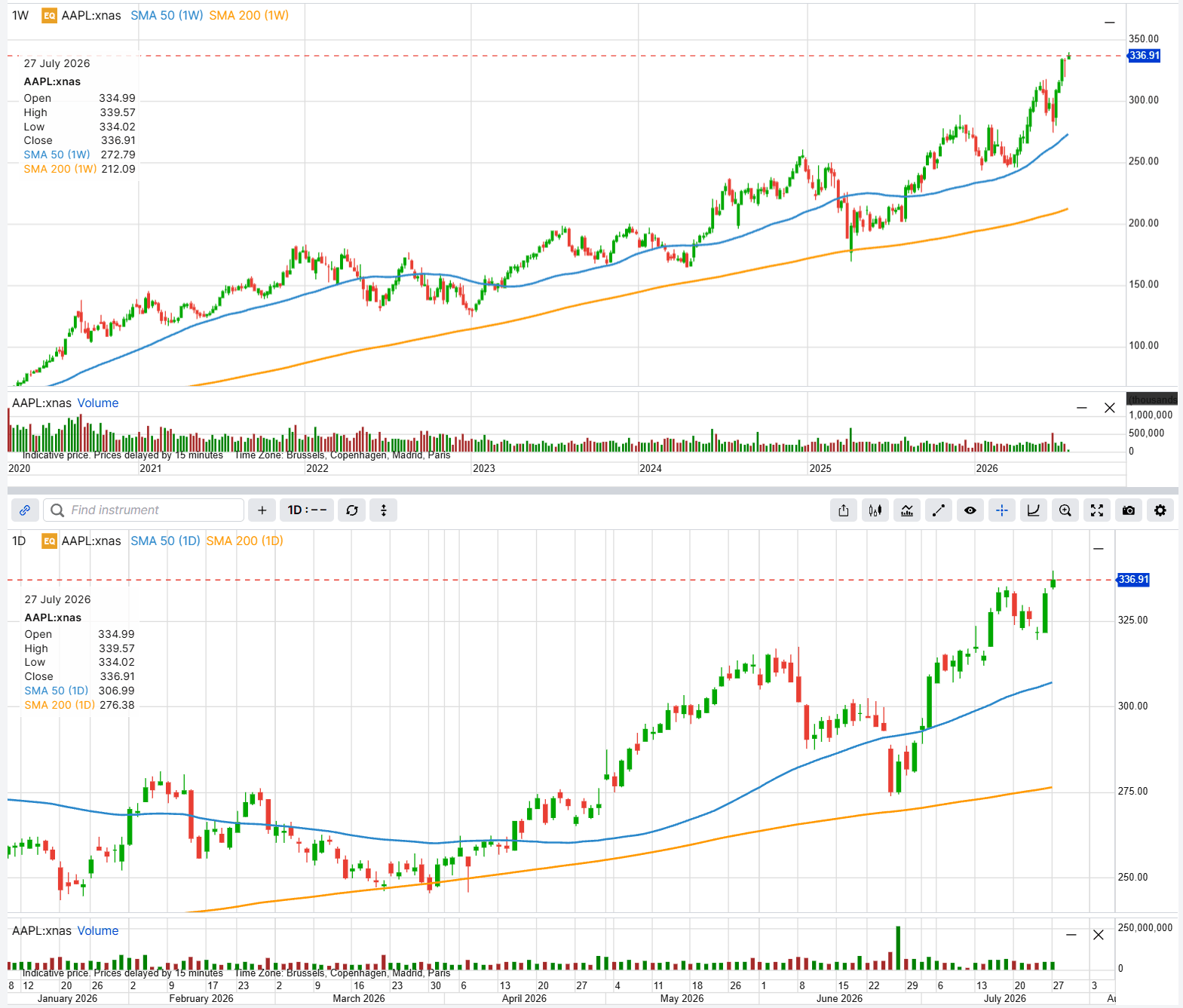 Apple enters earnings week at record highs, above both moving averages. Past performance is not indicative of future results; the chart is illustrative and educational, not predictive. Source: SaxoTrader
What 4% actually means here
A common way to estimate the market-implied move is to add the at-the-money call and put premiums for the expiry that captures the event. On the 31 July expiry, the 337.5 call trades near $6.45 and the 337.5 put near $6.95: a straddle of about $13.40, roughly 4.0% of the share price (Source: Saxo platform, indicative pre-open quotes, 28 July 2026). These figures move constantly and should be repriced from the live chain before any decision.
Two comparisons frame that number. Meta’s chain priced an implied move above 8% into its 29 July report (Source: Saxo platform, 27 July 2026), so Apple trades at roughly half the event premium of its mega-cap peer. Pull the other way and the picture flips: Apple’s last four post-earnings sessions moved 2.5%, 0.4%, 0.5% and 3.2%, an average of about 1.7%, so none of them reached the move now being priced (Source: Saxo price history, July 2025 to April 2026). Past performance is not indicative of future results. Option buyers are paying up by Apple’s own standards.
The term structure repeats the message. At-the-money implied volatility sits near 52% on the 31 July expiry against 31% for 21 August (Source: Saxo platform, 28 July 2026). That 21-point gap is the event premium, and most of it may evaporate from the weekly options once the report is out, the mechanism usually described as IV crush.
Important note: The strategies and examples provided in this article are purely for educational purposes. They are intended to assist in shaping your thought process and should not be replicated or implemented without careful consideration. Every investor or trader must conduct their own due diligence and take into account their unique financial situation, risk tolerance, and investment objectives before making any decisions. Remember, investing in the stock market carries risk, and it’s crucial to make informed decisions.
Volatility view: the narrative beats the history
If the CEO handover and the AI re-rating make this quarter more binary than Apple’s recent past, 4% may be too little. The direction-neutral expression is buying the move: a long straddle on the expiry that captures the print. The position needs Apple to move more than the options market expects, in either direction, and quickly, because IV crush works against every long option held through the report. Options carry a high risk of rapid loss and are not suitable for every investor.
Example structure (illustrative only - not a trade recommendation)
- Buy 1 AAPL 31 July 2026 337.5 call (about $6.45)
- Buy 1 AAPL 31 July 2026 337.5 put (about $6.95)
- Net debit: approximately $13.40 = $6.45 for the call plus $6.95 for the put
- Maximum risk: approximately $1,340 per contract pair, with the worst outcome at expiry if AAPL closes at or near the 337.5 strike
- Break-evens at expiry: approximately $324.10 and $350.90 (a move of about 3.8% down or 4.2% up)
All figures are hypothetical and for education only.
The structure profits at expiry only outside the break-evens, and the maximum loss, the full $13.40 paid, applies if the shares sit at the strike on the 31 July close. History leans against the buyer: none of the last four post-earnings moves reached 4%, so this position would have lost money on each of those nights. It only makes sense for someone who believes this specific quarter breaks the pattern.
Strategy insight - paying for convexity. A long straddle’s risk is fully known while its reward is open-ended in both directions, which is why it appears expensive precisely when events look binary; the cost of that convexity is the certainty of losing the entire debit if the underlying fails to move. See Saxo pricing for costs and applicable charges.
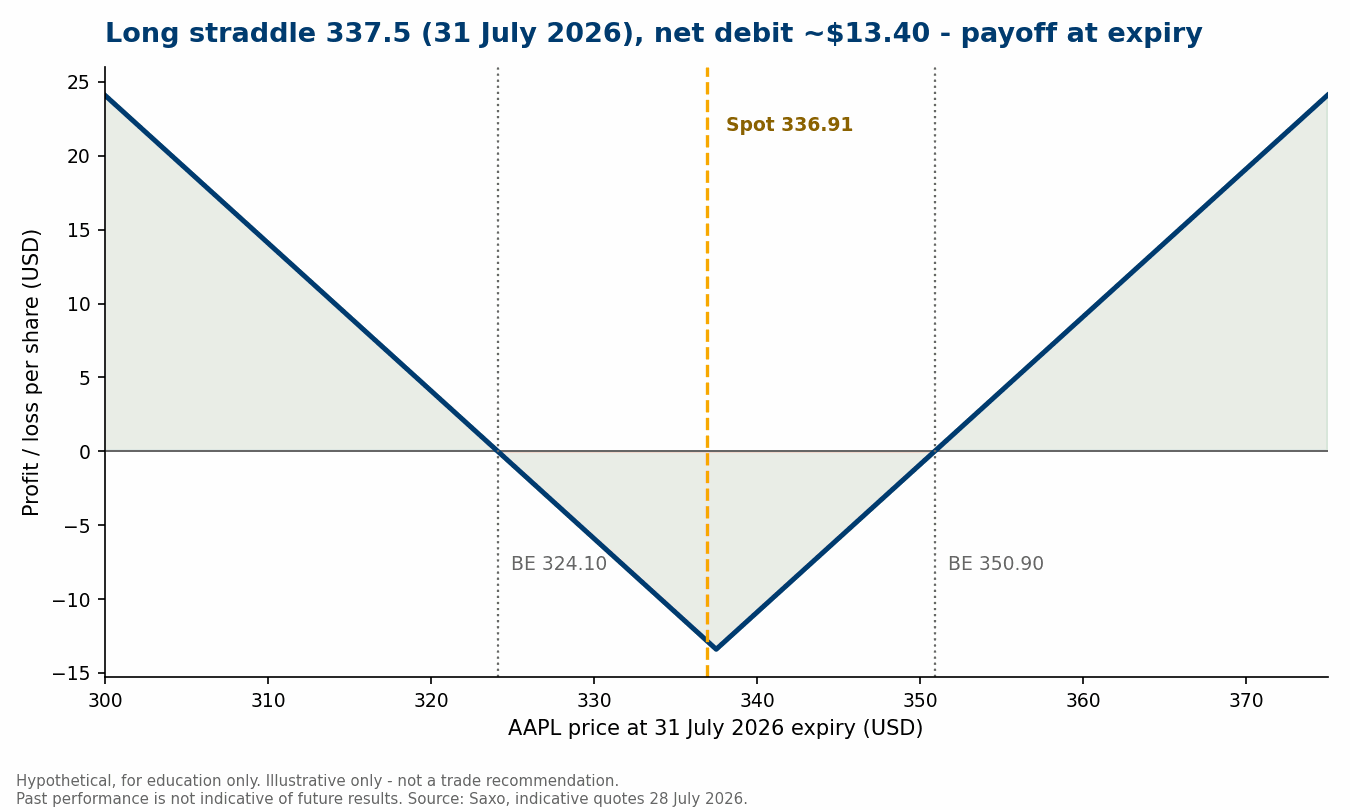 Long straddle payoff at expiry. Hypothetical, for education only. Illustrative only - not a trade recommendation. Past performance is not indicative of future results; figures are illustrative and not predictive. Source: Saxo
Bullish view: continuation, without paying the event premium
A trader who leans bullish faces a practical problem: the weekly options carry 52% implied volatility, so directional exposure bought there pays the full event surcharge. One alternative is the 21 August expiry, where implied volatility near 31% is materially cheaper, with cost capped through a vertical spread. The trade-off cuts both ways: the maximum loss is limited to the debit paid, and the maximum gain is capped above the short strike no matter how far the shares run. Options carry a high risk of rapid loss and are not suitable for every investor.
Example structure (illustrative only - not a trade recommendation)
- Buy 1 AAPL 21 August 2026 340 call (about $9.38)
- Sell 1 AAPL 21 August 2026 360 call (about $2.86)
- Net debit: approximately $6.52 = $9.38 paid for the long call, less $2.86 taken in on the short call
- Maximum risk: approximately $652 per spread, lost in full if AAPL closes below 340 at expiry
- Maximum profit: approximately $1,348 per spread, reached at or above 360 at expiry
- Break-even at expiry: approximately $346.52, about 2.9% above the 27 July close
All figures are hypothetical and for education only.
The long 340 call provides the upside exposure; the short 360 call finances part of it and caps the gain above 360. The expiries deliberately differ from the expected-move calculation: the 4% figure comes from the 31 July chain because that expiry captures the event most directly, while the 21 August spread gives a post-earnings thesis three additional weeks to develop. Traders should price the spread from the 21 August chain rather than assuming the weekly implied move applies to it unchanged.
Strategy insight - buying the back month into an event. Longer-dated options carry less event premium per day, so they lose less to the post-earnings volatility reset, but they still lose: 21 August implied volatility may also drop once the report is out, and the spread structure is what keeps that vega exposure modest. See Saxo pricing for costs and applicable charges.
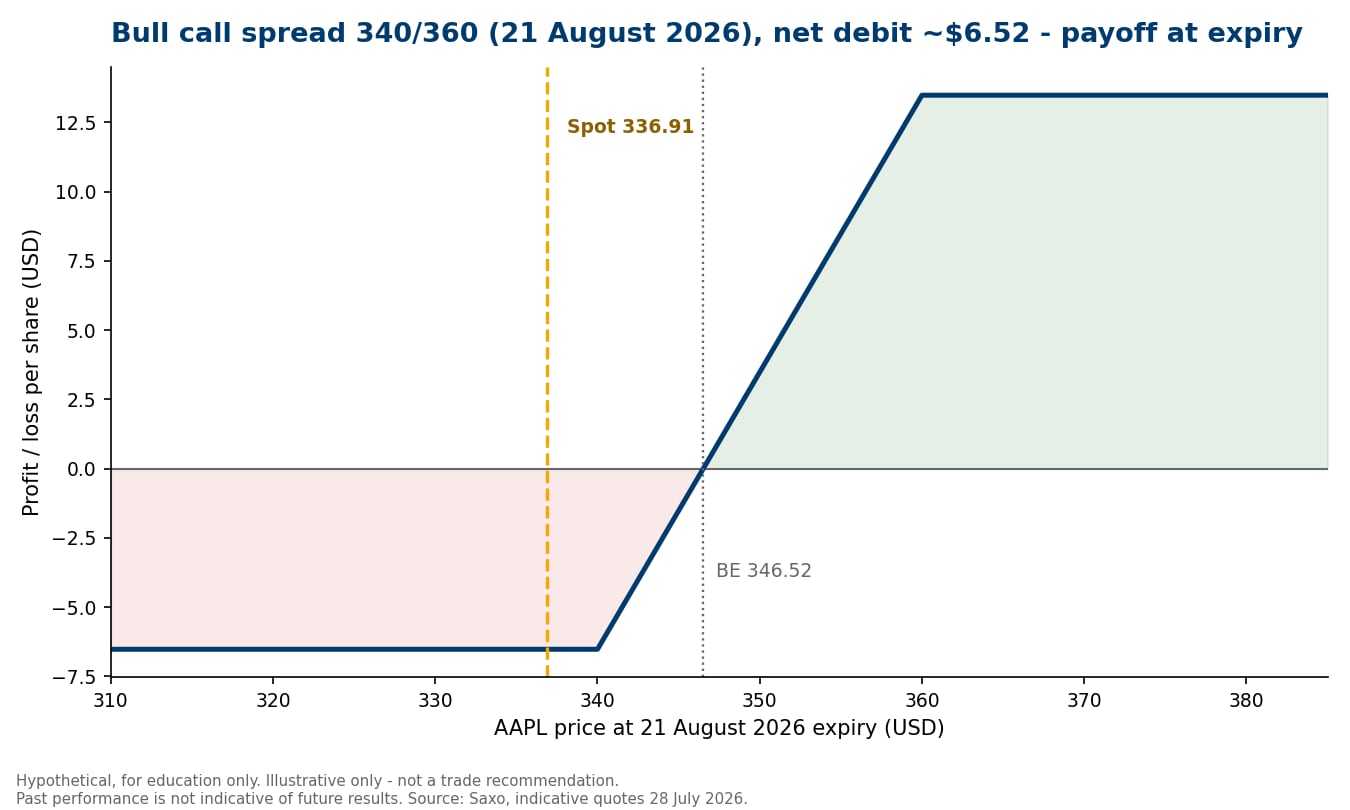 Bull call spread payoff at expiry. Hypothetical, for education only. Illustrative only - not a trade recommendation. Past performance is not indicative of future results; figures are illustrative and not predictive. Source: Saxo
Range view: Apple’s own history wins again
The third reading trusts the price history: with the past four reactions averaging about 1.7% and none reaching 4%, the implied move appears richly priced, in our view. The matching structure is a short iron condor on the weekly expiry: the credit received is the maximum profit, kept only if the shares finish between the short strikes on 31 July, while the maximum loss, the wing width minus that credit, applies beyond either long strike and is nearly three times the credit here. Options carry a high risk of rapid loss and are not suitable for every investor.
Example structure (illustrative only - not a trade recommendation)
- Sell 1 AAPL 31 July 2026 322.5 put (about $1.80)
- Buy 1 AAPL 31 July 2026 312.5 put (about $0.61)
- Sell 1 AAPL 31 July 2026 350 call (about $2.06)
- Buy 1 AAPL 31 July 2026 360 call (about $0.67)
- Net credit: approximately $2.58 = $1.19 from the put side ($1.80 less $0.61) plus $1.39 from the call side ($2.06 less $0.67)
- Maximum profit: approximately $258 per condor, kept if AAPL closes between 322.5 and 350 at expiry
- Maximum risk: approximately $742 per condor (the $10 wing width less the $2.58 credit), if AAPL closes below 312.5 or above 360
- Break-evens at expiry: approximately $319.92 and $352.58
All figures are hypothetical and for education only.
The short strikes sit near the edges of the option-implied range, making this roughly the mirror image of the straddle: it wins where the straddle loses. A single outsized move would cost the condor seller nearly three times what a quiet night earns, so sizing for the maximum loss rather than the credit is what keeps the structure survivable.
Strategy insight - selling a rich move is still short volatility. The condor’s edge, if there is one, comes entirely from the gap between the 4% implied and the roughly 1.7% average realized move, and that gap is not a guarantee; it is four quarters of history against a quarter with a CEO transition attached. See Saxo pricing for costs and applicable charges.
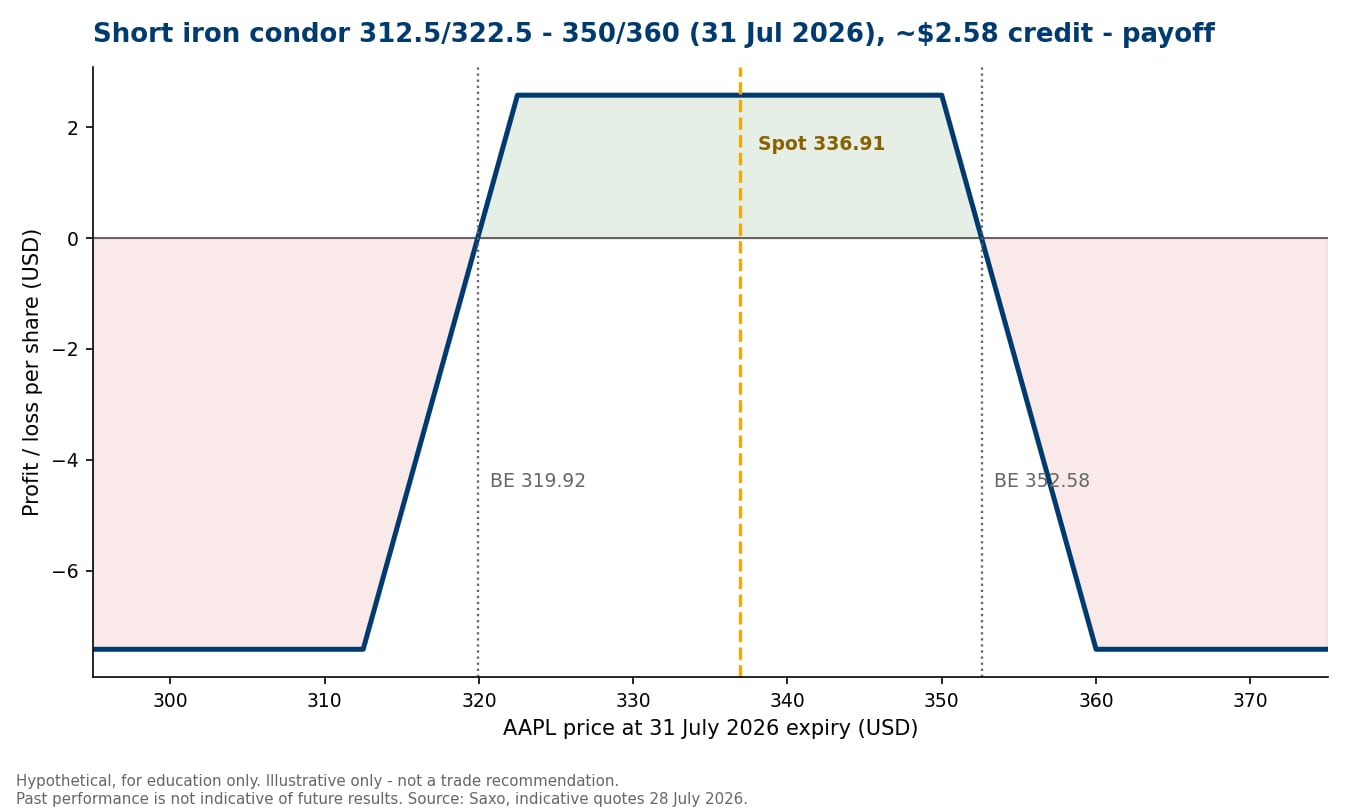 Short iron condor payoff at expiry. Hypothetical, for education only. Illustrative only - not a trade recommendation. Past performance is not indicative of future results; figures are illustrative and not predictive. Source: Saxo
Before placing any trade, check:
- Bid/ask spreads, wide spreads can eliminate the theoretical edge at entry
- Volume and open interest at the selected strikes, especially in the weekly expiry
- Confirmation of the report timing, currently expected after the US close on 30 July
- IV relative to realised volatility, is the market pricing more than the stock typically moves
- Exit plan, defined before entry, especially for the multi-leg structures
- Assignment risk on short legs (see note below)
Assignment risk note: Because AAPL options are American-style, short legs (the 360 call in the spread, the short strikes in the condor) can be assigned before expiry if they move in the money, particularly near expiration or ex-dividend dates. Traders should monitor short options and understand the platform’s assignment process before entering the trade.
Final thought
Apple’s setup this quarter shows why an implied move settles nothing on its own. Measured against Meta’s 8%, the 4% looks small; measured against Apple’s own quiet year, it looks generous. The options market appears to be averaging two regimes: a company that rarely moves on results, and a quarter carrying a CEO handover and an AI narrative that could break the pattern.
The three structures are three answers to one question: which history repeats on 30 July. A trader who cannot answer it has no edge in any of them, and standing aside, with the event premium left for someone else, remains a position too.
This content is marketing material and should not be regarded as investment advice. Trading financial instruments carries risks and historic performance is not a guarantee of future results.
The Author is permitted to wait at least 24 hours from the time of the publication before they trade the instruments themselves.
The instrument(s) referenced in this content may be issued by a partner, from whom Saxo receives promotional fees, payment or retrocessions. While Saxo may receive compensation from these partnerships, all content is created with the aim of providing clients with valuable information and options.
This content will not be changed or subject to review after publication.
The author holds no position in Apple at the time of writing.
| Related articles/content |
|---|
| What IV crush really means in practice reviewed version | 9 April 2026 Trading earnings with defined | 31 Mar 2026 Where the strikes go a Meta earnings case study | 28 July 2026 Amazon into earnings choosing a structure when the move is already priced | 28 July 2026 Hedging a portfolio near the highs four ways to buy insurance while it is cheap | 17 July 2026 Before Alphabet reports reading the expected move and structuring three views | 16 July 2026 How to trade an earnings event with options a Netflix case study | 15 July 2026 ASML how to position with options ahead of Q2 earnings | 13 July 2026 Seoul halts index vol holds - Options Brief - 28 July 2026 Chips slide index shrugs - Options Brief - 27 July 2026 |
| More from the author |
|---|