options31024x768 M

What are my options for protection?

In this short refresher we revisit some of the options strategies investors may consider when seeking protection from adverse market moves.
   
Exchange-listed options can be used in a variety of ways. Investors often use options to construct a defined risk strategy; to put less capital at risk versus buying the underlying asset; harnessing leverage; and to use options as protection against adverse market moves.

Buy an at-the-money put

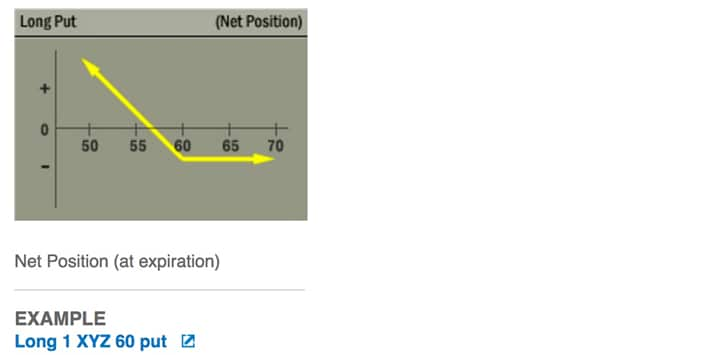
Buying an at-the-money put, i.e. with an exercise price at or near the current market price of the underlying stock is a straightforward strategy. 

If the price of the underlying stock declines below the exercise price, the profit on the purchased put option will offset some or all of the losses on the underlying stock held. See more details here.

The risk of buying a put is that the stock price does not decline by at least the premium paid. If the stock price remained at the same level as when the put option was bought, then the premium paid (plus fees) would represent a loss.

Buy an out-of-the-money put

This strategy is similar to the at-the-money put, but with a strike price below the current market price for the underlying asset. This means no revenue is earned until the stock price moves below the exercise price.

It also means that the option is cheaper to buy, as it is delivering less cover. Many websites, such as Saxo’s trading platform or the delayed information-only prices on the Options Industry Council website, enable investors to compare the costs of options with varying degrees of "out-of-the-moneyness". 

Some investors see this as similar to an excess on an insurance policy. Out-of-the money options can offer a way of reducing the cost of protection by adjusting the amount of cover. The risk is the same as for buying an at-the-money put: that the stock price does not decline and that the premium paid (plus fees) could represent a total loss.

Buy a bear put spread

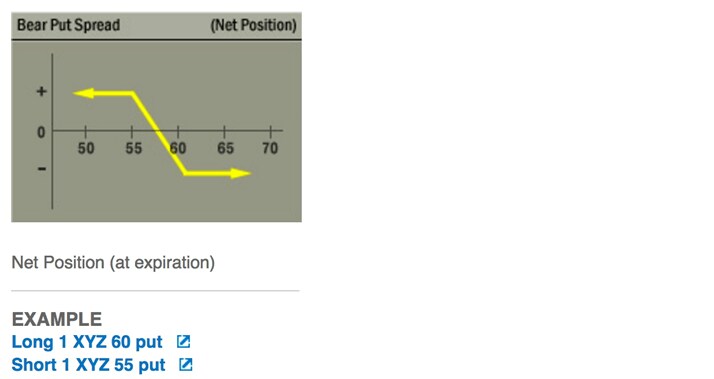
A bear put spread is another way to reduce the cost of protection. It is constructed by buying a put at a higher exercise price and then defraying the cost by selling another put at a lower exercise price. Both options have the same expiration. 

The combined position still gives protection between the higher and lower exercise prices. The cover afforded is limited by the exercise price of the put option sold. To read more on this strategy go to the OIC strategy page.

The risk for the bear put spread is that the underlying stock price moves beyond the lower strike price, where the buyer of the bear put spread has no protection. In this example, the protection is only between 55 and 60. The strategy involves buying and selling options, so there is also the risk of early assignment, which will disrupt the strategy.


Buy a collar

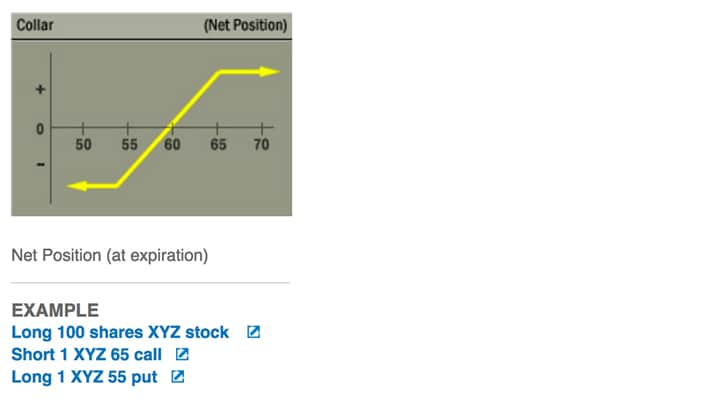
A collar places two options around an underlying stock position. A put is purchased with an out-of-the-money exercise price – an exercise price below that of the underlying stock price – to give protection should the market move lower. At the same time an out-of-the-money call option is sold – this time with an exercise price above the underlying stock price, which puts a limit on the upside potential. 

The underlying stock is thus collared between the long put on the downside and the call on the upside. The income generated by the sale of the call helps offset the cost of the put. As with any combined position, the exercise prices selected have an impact on the cover purchased and the cost incurred. You can read more about collars here.

The risk when buying a collar is twofold. The short call has been sold to help finance the long put. If the underlying stock rises beyond the exercise price of the call sold, then the call writer will not be able to participate in any gains above that level, meaning that he will in effect sell the underlying stock position at that price. 

As for the long put purchased, if the underlying stock price does not fall below the exercise price of the long put, then the premium has been paid for nothing. The potential profit and loss of this hedging strategy are limited, with the investor seeking to balance the cost of cover with the level of cover. 

Since the strategy involves buying and selling options, there is also the risk of early assignment on the put sold, which will disrupt the strategy.


Collar study

Investors considering a collar strategy may be interested in a collar study commissioned by OIC in 2011. Edward Szado and Thomas Schneeweis from the Isenberg School of Management at the University of Massachusetts updated the data in their original modified collar study to include September 30, 2010. 

The research found that a long protective collar strategy using six-month put purchases and consecutive one-month call writes earned superior returns compared to a simple buy-and-hold strategy while reducing risk by almost 65%. You can read a summary here.

Conclusion

Exchange-listed options offer many possibilities to investors wishing to establish some protection. Cost and cover can be adjusted according to investor taste. We have profiled some of the more popular strategies, but more complicated strategies are also available. The strategy section on the OIC website is a useful resource, as are Saxo's trading platform and OIC’s delayed information-only prices.

Saxo Bank’s extensive educational initiatives can be found here. 


Disclaimer

Confidentiality and Usage:
You may not reproduce, distribute, or transmit this material or any portion thereof without prior written permission from Saxo.

Nature of Information:
The information provided herein is based on current market conditions and analysts' opinions, which may reflect personal views of the author, and are subject to change without notice. This material does not include a record of any trading prices, or an offer of, or solicitation for, or endorsement to enter into any transaction in any investment product. Any forecast on the economy, markets and economic trends of the markets provided is not necessarily indicative of the future or likely performance of the investment product subject of this material.

Responsibility and Liability:
Saxo accepts no liability for any use that may be made of these comments or for any consequences that arise from such use. Saxo does not guarantee the accuracy or completeness of any information provided and assumes no liability for any errors, omissions, losses, or damages resulting from the use of this information.

The information provided in this material is solely for information only. It is intended for general circulation and does not take into account the specific investment objectives, financial situation or particular needs of any particular person. Accordingly, it should not be relied on or treated as a substitute for specific advice concerning specific situations of any person. Please seek advice from a financial adviser regarding the suitability of any investment product taking into account your specific investment objectives, financial situation or particular needs before you make a commitment to purchase an investment product. In the event that you choose not to seek advice from a financial adviser, you should consider whether any investment product mentioned in this publication is suitable for you.

Notwithstanding the above, insofar as any information provided herein contains research analyses or reports concerning any investment product authored by any foreign research house and is issued or promulgated to a person in Singapore who is not an accredited investor, expert investor, and/or institutional investor, Saxo Capital Market Pte. Ltd. accepts legal responsibility for the contents of this material to the extent required by law. Recipients of such material are to contact Saxo Capital Markets Pte. Ltd. in respect of any matters arising from, or in connection with, this material.

Risk Disclosure:
Trading in investment products involve significant risk, including the risk of losing your entire investment. Historical returns are not a guarantee of future returns. Prices can both rise and fall, and there is a risk that you will not get back the money you invested.

Conflicts of interest:
The author may hold positions in the investment products mentioned. The author does not own positions in the underlying investment product exceeding 0.5% of its market capitalisation, save as otherwise declared. The author is not permitted to trade the mentioned investment products within the first 24 hours after the publication of this article.

Saxo maintains partnerships with companies that compensate Saxo for promotional activities conducted on its platform. Additionally, Saxo has agreements with certain partners who provide retrocession contingent upon clients purchasing specific investment products offered by these partners. While Saxo receives compensation from these partnerships, all content is conducted with the intention of providing clients with valuable options and information.

Publication details:
If any listed companies are the subject of the material, the content has not been submitted to the companies in question prior to publication.

Please refer to our full disclaimer and notification on non-independent investment research for more details.

Saxo Markets
88 Market Street
CapitaSpring #31-01
Singapore 048948

Contact Saxo

Singapore
Singapore

Saxo Capital Markets Pte Ltd ('Saxo Markets') is a company authorised and regulated by the Monetary Authority of Singapore (MAS) [Co. Reg. No.: 200601141M ] and is a wholly owned subsidiary of Saxo Bank A/S, headquartered in Denmark. Please refer to our General Business Terms & Risk Warning to consider whether acquiring or continuing to hold financial products is suitable for you, prior to opening an account and investing in a financial product.

Saxo is part of the J. Safra Sarasin Group.

Trading in financial instruments carries various risks, and is not suitable for all investors. Please seek expert advice, and always ensure that you fully understand these risks before trading. Trading in leveraged products such as Margin FX products may result in your losses exceeding your initial deposits. Saxo Markets does not provide financial advice, any information available on this website is ‘general’ in nature and for informational purposes only. Saxo Markets does not take into account an individual’s needs, objectives or financial situation.

The Saxo trading platform has received numerous awards and recognition. For details of these awards and information on awards visit www.home.saxo/en-sg/about-us/awards.

The information or the products and services referred to on this website may be accessed worldwide, however is only intended for distribution to and use by recipients located in countries where such use does not constitute a violation of applicable legislation or regulations. Products and Services offered on this website are not intended for residents of the United States, Malaysia and Japan. Please click here to view our full disclaimer.

This advertisement has not been reviewed by the Monetary Authority of Singapore.

Apple and the Apple logo are trademarks of Apple Inc, registered in the US and other countries and regions. App Store is a service mark of Apple Inc. Google Play and the Google Play logo are trademarks of Google LLC.