
Access all our platforms from a single account.

Disney: high rank, cheap event

Summary: Disney’s options screen as expensive, with a volatility rank in the seventies going into the 5 August print. Its own earnings days keep moving further than that premium pays for.
A volatility rank tells you how options are priced against their own history. It says nothing about how the share price actually behaves.
The Walt Disney Company (DIS) reports fiscal third-quarter results on 5 August 2026, before the US market opens (Source: Disney investor relations). The shares closed at 96.16 on 30 July, down 2.36%, leaving them 19.6% below the 52-week high and beneath both the 50-day moving average at 99.27 and the 200-day at 104.76 (Source: Saxo, 30 July 2026 close).
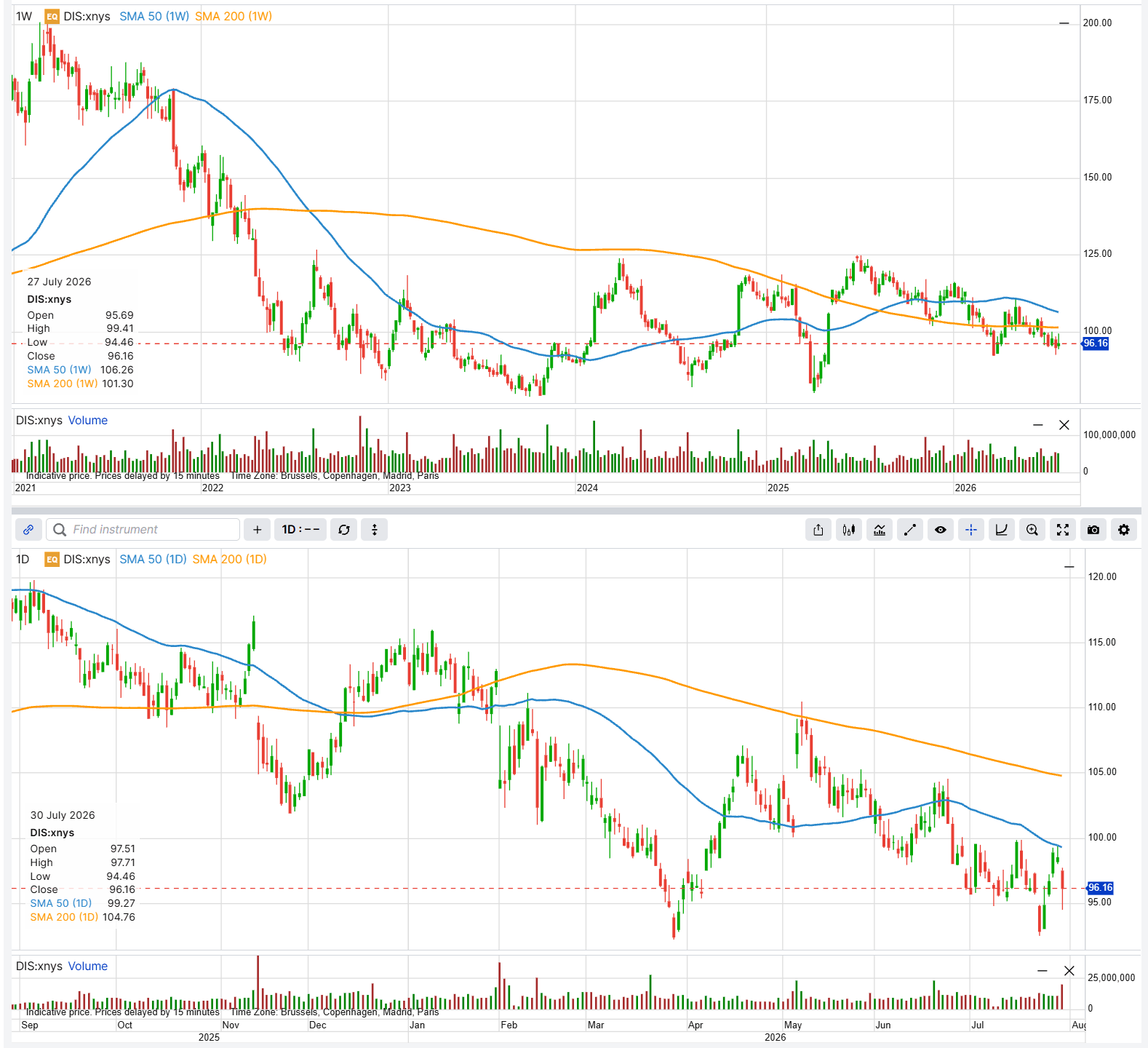 Disney weekly and daily, with price below the 50 and 200 period averages on both timeframes. Source: SaxoTrader. Past performance is not indicative of future results; figures are illustrative and not predictive.
Thirty-day implied volatility reads 34.4%, an implied volatility rank of 72.3 (Source: Saxo, 31 July 2026). A rank in the seventies is usually where a premium seller starts looking. In our view that may mislead here, because rank compares implied volatility only against its own twelve-month range, not against the way the underlying moves.
What the options market is pricing
A common way to estimate the market-implied move is to add the at-the-money call premium and the at-the-money put premium for the expiry that captures the event. The combined straddle price is a rough proxy for how much movement option buyers are paying for.
The 7 August 2026 expiry is the first spanning the release. At the 96 strike the call was quoted around 3.29 and the put around 3.10, a straddle of roughly 6.39, or about 6.65% of the share price (Source: Saxo option chain, 31 July 2026, indicative pre-open). The premium sits almost entirely on that expiry.
- 7 August 2026, 7 days: at-the-money implied volatility 56% to 59%
- 14 August 2026, 14 days: 43% to 45%
- 21 August 2026, 21 days: 37% to 41%
- 18 September 2026, 49 days: about 31%
Source: Saxo option chain, 31 July 2026, indicative pre-open.
Set that against how Disney trades. Realised volatility is 28.7% over the past 30 sessions, 27.1% over 90 and 25.7% over the past year (Source: Saxo price history, 30 July 2026). Between events this is a quiet share price. Its earnings days are not.
- 6 May 2026, Q2 FY26: +7.54%
- 2 February 2026, Q1 FY26: -7.40%
- 13 November 2025, Q4 FY25: -7.75%
- 6 August 2025, Q3 FY25: -2.66%
- 7 May 2025, Q2 FY25: +10.76%
- 5 February 2025, Q1 FY25: -2.44%
Source: Saxo price history, close to close on each report date. Past performance is not indicative of future results; figures are illustrative and not predictive.
The average absolute move across those six reports is 6.42% and the median 7.47%, against 6.65% implied today. Four of the six exceeded what is currently priced, and the three most recent each moved 7.4% or more. In our view that reconciles the two readings. The rank may read high because Disney’s baseline is unusually low, rather than because its event premium is rich.
Important note: The strategies and examples provided in this article are purely for educational purposes. They are intended to assist in shaping your thought process and should not be replicated or implemented without careful consideration. Every investor or trader must conduct their own due diligence and take into account their unique financial situation, risk tolerance, and investment objectives before making any decisions. Remember, investing in the stock market carries risk, and it’s crucial to make informed decisions.
Volatility view: buying the move rather than selling it
A trader who finds that persuasive needs no direction, only enough travel either way. A reverse iron condor buys a put and a call either side of the money and sells a further put and call to cut the cost, so the long options carry the exposure and the short options cap the payoff.
The following examples are hypothetical and for educational use only; they are not advice or trade recommendations.
Example structure (illustrative only - not a trade recommendation)
- Buy 1 7 August 2026 95 put (about 2.75)
- Buy 1 7 August 2026 97 call (about 2.70)
- Sell 1 7 August 2026 89 put (about 0.77)
- Sell 1 7 August 2026 105 call (about 0.70)
- Net debit: approximately 4.05 per spread, or 405 USD, against a quoted mid of 3.98 = 2.75 paid for the 95 put, plus 2.70 paid for the 97 call, less 0.77 taken in on the 89 put, less 0.70 taken in on the 105 call
- Maximum risk: 405 USD, if Disney settles between 95 and 97 on 7 August
- Maximum profit: 395 USD above 105, or 195 USD below 89
- Break-even at expiry: approximately 90.95 and 101.05
All figures are hypothetical and for education only. Risk: the maximum loss is the net debit paid, 405 USD, and short legs carry early-assignment risk. Costs and charges apply to each leg; see Saxo pricing for full details.
The whole 405 USD debit is lost if Disney does very little, and that buys break-evens at -5.42% and +5.09%, both inside the 6.65% being priced, so the position may profit if the move merely matches what is implied. The wings are uneven, 6 points on the put side against 8, which is why the upside pays 395 USD and the downside 195 USD.
Strategy insight – paying for movement. Implied volatility collapses once a result is public, so a modest move can leave a long-premium structure worth less than it cost even when the direction was right; against that, the position may benefit if Disney travels beyond either break-even, with loss capped at the debit paid. Options carry a high risk of rapid loss and are not suitable for every investor. See Saxo’s pricing overview for costs and applicable charges.
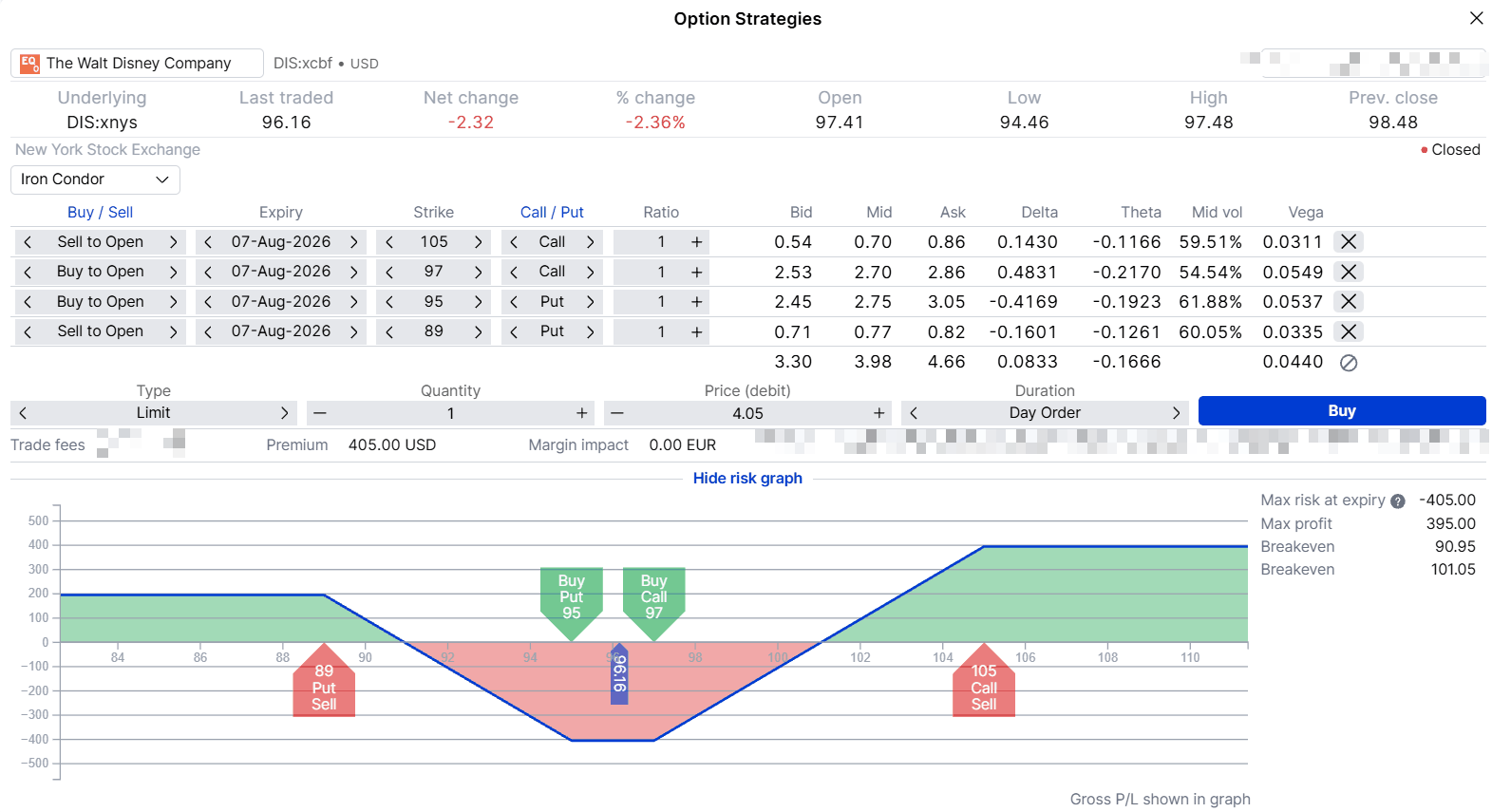 Reverse iron condor on the 7 August expiry. Illustrative only, not a trade recommendation. Source: SaxoTrader. Past performance is not indicative of future results; figures are illustrative and not predictive.
The opposite case: selling the event premium instead
The argument can be wrong. Six reports is a small sample, two of them moved less than 3%, and a share price 19.6% off its high has arguably priced in much disappointment.
That side can be taken against a longer-dated option rather than outright. A call calendar sells the 100 call expiring 7 August and buys the 100 call expiring 18 September. The short leg carries roughly 55% implied volatility because it contains the print, the long leg about 31%, and that 24-point gap is the idea.
Example structure (illustrative only - not a trade recommendation)
- Sell 1 7 August 2026 100 call (about 1.62)
- Buy 1 18 September 2026 100 call (about 3.03)
- Net debit: approximately 1.50 per spread, or 150 USD, against a quoted mid of 1.41 = 3.03 paid for the September call, less 1.62 taken in on the August call
- Maximum risk: 150 USD, the debit paid
- Estimated profit zone: approximately 94.34 to 107.09 at the 7 August expiry, modelled with September implied volatility falling to 27%
- Estimated peak value: around 232 USD near the 100 strike on the same assumption
All figures are hypothetical and for education only. Risk: the maximum loss is the net debit paid, 150 USD, profit and break-even are model-dependent, and the short leg carries early-assignment risk. Costs and charges apply to each leg; see Saxo pricing for full details.
The 150 USD debit is lost if Disney moves far from 100 either way, and in exchange the position may gain if the share price finishes near the strike. None of those profit figures is fixed at entry, because the front-expiry value depends on what the back-month option is worth that day.
Strategy insight – two expiries and two volatilities. A long calendar is net long vega, so the September leg may lose value if implied volatility falls across the curve after the result, even while decay on the short leg works in the position’s favour; the reward for that second exposure is a defined 150 USD risk instead of the open-ended risk of a naked short call. Options carry a high risk of rapid loss and are not suitable for every investor. See Saxo’s pricing overview for costs and applicable charges.
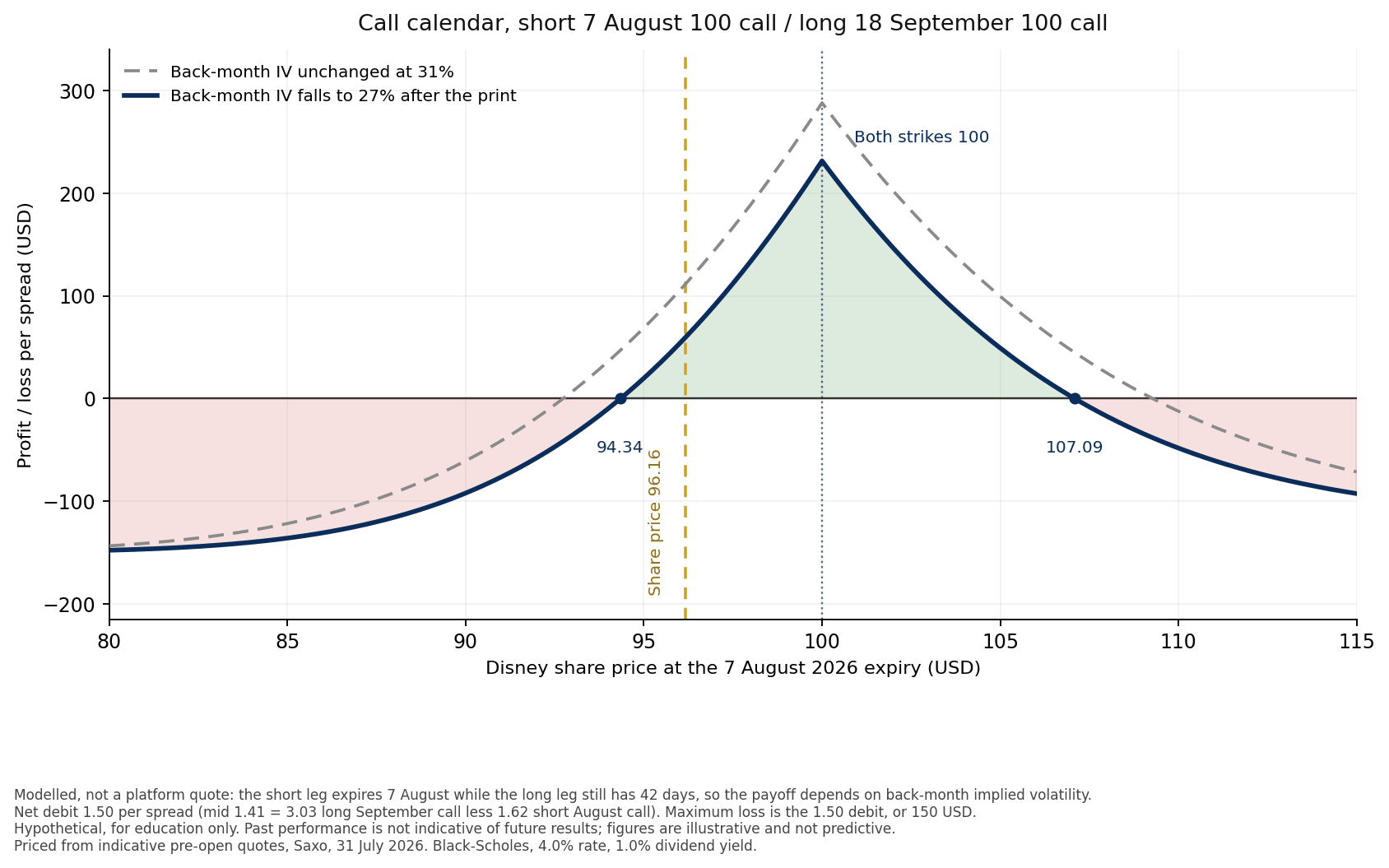 Call calendar modelled at the 7 August expiry under two back-month volatility assumptions. Modelled, not a platform quote. Illustrative only, not a trade recommendation. Past performance is not indicative of future results; figures are illustrative and not predictive.
Directional view: a move larger than the one priced
The third route takes a side. Consensus looks for adjusted earnings near 1.86 US dollars per share on revenue of 25.4 billion US dollars (Source: Bloomberg, 30 July 2026), and the shares have underperformed the S&P 500 by roughly 12.5 percentage points since the May report.
A bull call spread buys the 97 call and sells the 105 call, so the long call carries the upside while the short call cuts the cost and caps the gain. The strike choice matters. The 6.65% implied move puts Disney near 102.55, so a short strike at 105 means full value requires a larger move than the one priced.
Example structure (illustrative only - not a trade recommendation)
- Buy 1 7 August 2026 97 call (about 2.70)
- Sell 1 7 August 2026 105 call (about 0.70)
- Net debit: approximately 2.21 per spread, or 221 USD, against a quoted mid of 2.00 = 2.70 paid for the 97 call, less 0.70 taken in on the 105 call
- Maximum risk: 221 USD
- Maximum profit: 579 USD, at 105 or above
- Break-even at expiry: approximately 99.21
All figures are hypothetical and for education only. Risk: the maximum loss is the net debit paid, 221 USD, and the short leg carries early-assignment risk. Costs and charges apply to each leg; see Saxo pricing for full details.
The 221 USD debit is lost in full if Disney closes at or below 97 on 7 August, and against that the structure may return up to 579 USD if the shares reach 105. Break-even at 99.21 needs a rise of 3.17%, calculated as (99.21 minus 96.16) divided by 96.16; maximum value needs 9.19%, exceeded only by the May 2025 report in two years.
Strategy insight – cheap is not the same as likely. A payoff of roughly 2.6 to one is available because the market assigns a low probability to the outcome that pays it, and the whole debit is at risk in every other case, including a rally that stops short of the break-even. Options carry a high risk of rapid loss and are not suitable for every investor. See Saxo’s pricing overview for costs and applicable charges.
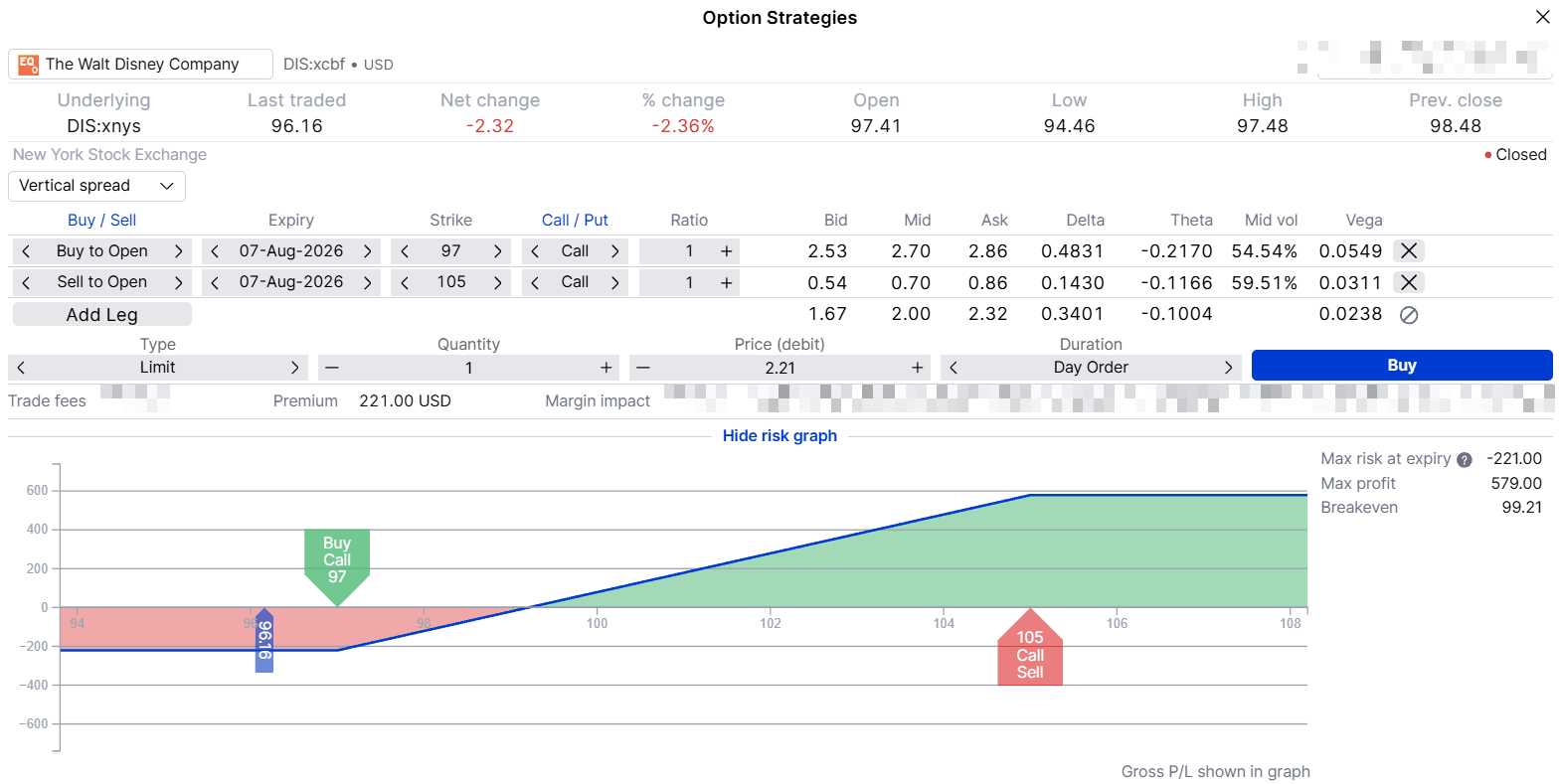 Bull call spread on the 7 August expiry. Illustrative only, not a trade recommendation. Source: SaxoTrader. Past performance is not indicative of future results; figures are illustrative and not predictive.
Before placing the trade, check:
- Bid and ask spreads. Every figure above is a mid price from indicative pre-open quotes on 31 July 2026, and several of these strikes quote wide enough to change the economics at entry. Reprice from the live chain.
- Volume and open interest at the specific strikes, particularly in the 7 August weekly.
- That Disney reports before the US open on 5 August, so the reaction falls in that session rather than overnight after it.
- Implied volatility against realised volatility, which is the question this article puts.
- An exit plan defined before entry, especially for the calendar, where value at the front expiry is not fixed.
- Assignment risk on every short leg.
Assignment risk note: Because Disney options are American-style, short legs can be assigned before expiry if they move into the money, particularly near expiry or an ex-dividend date. Traders should monitor short options and understand the platform’s assignment process before entering a position.
Final thoughts
Volatility rank is a useful screen and a poor conclusion. It answers whether options are expensive against their own history, not how much the underlying actually moves. On Disney those answers diverge, and in our view the divergence appears to favour the buyer of the event rather than the seller.
None of which makes the move happen. Each of the three structures carries a defined maximum loss that is also its single most likely outcome. What the options market offers before a result is not a forecast but a price on a range of outcomes, and the useful response is to judge whether it looks fair, then structure the position so being wrong costs a known amount. Options carry a high risk of rapid loss and are not suitable for every investor, and future outcomes are uncertain and may result in losses.
The author does not hold positions in any of the instruments mentioned in this article.
This content is marketing material and should not be regarded as investment advice. Trading financial instruments carries risks and historic performance is not a guarantee of future results.
The Author is permitted to wait at least 24 hours from the time of the publication before they trade the instruments themselves.
The instrument(s) referenced in this content may be issued by a partner, from whom Saxo receives promotional fees, payment or retrocessions. While Saxo may receive compensation from these partnerships, all content is created with the aim of providing clients with valuable information and options.
This content will not be changed or subject to review after publication.
| Related articles/content |
|---|
| What IV crush really means in practice reviewed version | 9 April 2026 Trading earnings with defined | 31 Mar 2026 SpaceX earnings pricing a first print with no history | 30 July 2026 Small move big night how the options market prices Apple earnings | 29 July 2026 Where the strikes go a Meta earnings case study | 28 July 2026 Amazon into earnings choosing a structure when the move is already priced | 28 July 2026 Hedging a portfolio near the highs four ways to buy insurance while it is cheap | 17 July 2026 Before Alphabet reports reading the expected move and structuring three views | 16 July 2026 How to trade an earnings event with options a Netflix case study | 15 July 2026 ASML how to position with options ahead of Q2 earnings | 13 July 2026 Fed day Friday gets pricier - Options Brief - 29 July 2026 Seoul halts index vol holds - Options Brief - 28 July 2026 |
| More from the author |
|---|