
Access all our platforms from a single account.

Global Market Quick Take: Asia – March 6, 2025

Key points:
- Macro: US services growth accelerates and Trump exempts Mexico and Canada from auto tariffs for a month
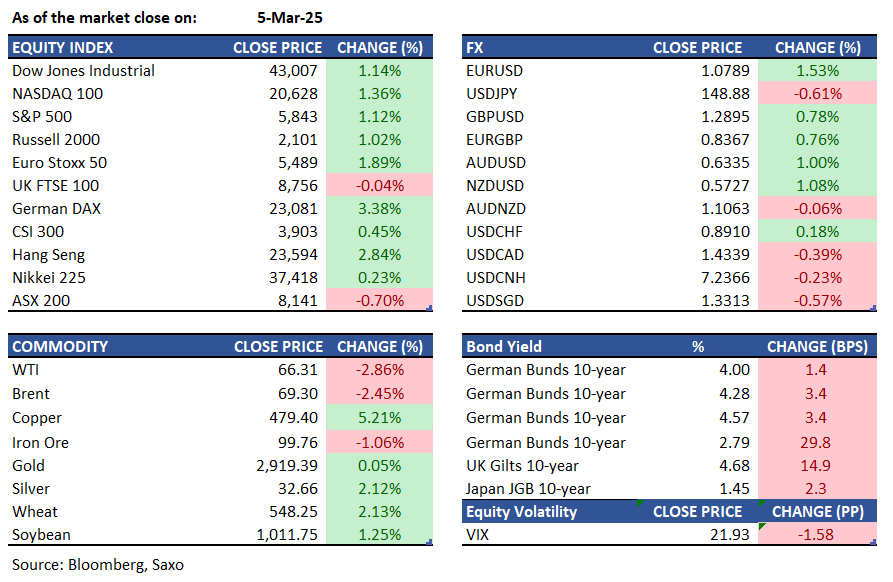
- Equities: US equities broke two-day losing streak. Nasdaq 100 up 1.4%.
- FX: Dollar index dropped 1% to 104.5; EUR neared 1.08 level
- Commodities: Copper rallies to $4.80 after Trump announces tariffs on imports
- Fixed income: The German bond market saw its worst selloff in years
------------------------------------------------------------------
Disclaimer: Past performance does not indicate future performance.
Macro:
- The White House announced that Trump granted a one-month delay on new tariffs for U.S. automakers complying with USMCA regarding Mexico and Canada.
- US private businesses (ADP) added 77K workers, the smallest increase in seven months and below the 140K forecast. The service sector gained 36K jobs, with losses in trade/transportation/utilities (-33K) and education/health (-28K). The goods sector added 42K jobs, mainly in construction (26K) and manufacturing (18K), while natural resources/mining lost 2K jobs.
- US ISM Services PMI rose to 53.5 in February 2025 from 52.8 in January, exceeding the 52.6 forecast. This marks faster growth in the services sector, with business activity, new orders, employment, and supplier deliveries expanding for the third consecutive month. Inventories and backlog of orders rebounded, while price pressures increased.
- Germany's CDU/CSU and SPD will relax borrowing rules to increase defence spending and create a €500 billion fund for infrastructure. The EU's defence plans could mobilize nearly €800 billion, according to Ursula von der Leyen.
Equities:
- US - US stocks broke a two-day losing streak on Wednesday after President Trump announced a one-month exemption on auto tariffs for Mexico and Canada. The S&P 500 rose 1.2%, the Nasdaq 100 climbed 1.4%, and the Dow Jones added 485 points. The White House confirmed a tariff delay for General Motors (+7.2%), Ford (+5.7%), and Stellantis (+9.2%), easing economic concerns and sparking a market rebound. Meanwhile, strong services sector data supported the market, though weak private payroll growth suggested slowing economic momentum. Microsoft, Oracle, and Amazon were among the top gainers, each rising over 2%, while energy stocks struggled as oil prices fell.
- EU - STOXX 50 surged 2.2%, rebounding from their worst day in over six months. Expectations of increased defense spending and borrowing to revive the Eurozone economy boosted sentiment. Germany's CDU/CSU and SPD agreed to relax borrowing rules and create a €500 billion fund for infrastructure projects. Defense stocks rallied, with Rheinmetall, BAE Systems, Leonardo, and Thales seeing gains. Investor sentiment also improved on hopes of US tariff relief. However, Adidas shares fell 2.4% due to lower-than-expected revenue growth projections.
- HK – HSI jumped 2.8% to 23,594 on Wednesday, bouncing back from the previous day's dip. This broad-based sector gain was driven by improved sentiment after China set a GDP growth target of around 5% for 2025, matching 2024's pace despite US trade tensions. Beijing also promised new support for domestic consumption and the tech industry while reducing its inflation target to 2% for the first time in over 20 years from the previous 3%. Additionally, CK Hutchison shares jumped 25% after agreeing to sell its Panama Canal ports to a US-led consortium under pressure from President Trump.
Earnings this week:
- Thursday: Broadcom, Costco, BJ’s Wholesale Club, JD.com, Gap
- Friday: No notable earnings
FX:
- Dollar index (DXY) fell over 1% to 104.5, its lowest in nearly four months, due to new US tariffs and weak economic data showed a disappointing ADP report but a stronger-than-expected ISM Services index.
- EUR approached the 1.08 mark, continuing its upward trend after Germany's recent spending and debt brake reform announcement. Germany's 10-year yields experienced their largest intraday increase since the 1990s.
- GBP climbed steadily, testing the 1.29 level, despite comments from BoE officials having little impact.
- JPY fell below 149.00 against the USD, with gains in the Japanese currency being more modest due to reduced haven demand amid positive risk sentiment.
- CAD traded around 1.44 against the USD, rebounding from a one-month low. Despite global trade disruptions, easing US tariffs on Canadian imports could boost exports. Canada imposed 25% tariffs on US imports, with more tariffs possible. Prolonged trade wars could cut Canadian output by 3%.
- Major economic data: EU Deposit Facility Rate, ECB Interest Rate Decision, Canada Balance of Trade, ECB Press Conference, CA Ivey PMI
Commodities:
- WTI crude fell to $66.50 per barrel, marking a third decline due to OPEC+ supply increases and trade tensions. Prices briefly hit multi-year lows before slight recovery on US tariff relief hints. US crude stockpiles surged by 3.6 million barrels, and OPEC+ plans to boost production, raising oversupply concerns.
- Gold trades near $2,900 per ounce, supported by a weaker US dollar and safe-haven demand amid US tariffs and escalating trade tensions.
- Copper futures surged to $4.80 per pound after President Trump announced tariffs on copper imports, contradicting earlier pledges to investigate levies. This move could increase reliance on limited domestic capacity, as the US imports nearly half of its copper.
Fixed income:
- Treasury futures fluctuated, with yields nearing session highs as investors awaited a $26 billion Mars deal. Oil price reductions and stock gains pressured yields, while the German bond market faced its largest selloff in years. Weaker-than-expected employment data initially boosted gains. US 10-year yields ended at 4.3%, after dipping to 4.18%. German bonds dropped due to spending plans, affecting core European rates. The Mars deal increased duration, raising yields before pricing.
For a global look at markets – go to Inspiration.