
Access all our platforms from a single account.

Global Market Quick Take: Asia – January 22, 2025

Key points:
- Macro: Trump announced 25% tariffs on Canada and Mexico, 10% on China.
- Equities: Oracle jumped 7.2% after announcing JV with OpenAI and Softbank
- FX: Trump's proposed tariffs significantly weaken CAD and MXN against USD
- Commodities: Gold climbs to its highest level since early November 2024
- Fixed income: Treasuries rose, leading to a flattening of the yield curve
------------------------------------------------------------------
Disclaimer: Past performance does not indicate future performance.
Macro:
- Although President Trump did not announce any tariffs during his inauguration speech, he revealed plans in the early Asia session yesterday to potentially impose 25% tariffs on Mexico and Canada by February 1st and announced this morning that his team is still thinking of an additional 10% tariff on China.
Equities:
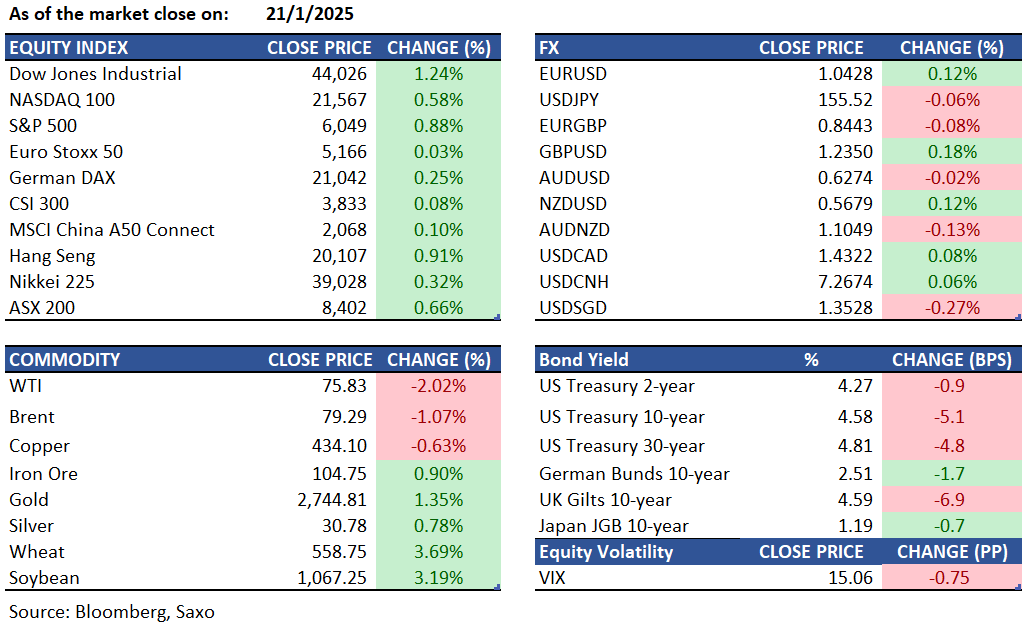
- US – U.S. stocks rose on Tuesday, with the S&P 500 up 0.9%, the Nasdaq 0.6%, and the Dow climbing 538 points. This increase was driven by relief over President Trump's milder-than-expected trade measures, as he avoided universal tariffs and was more targeted at some trading partners like Mexico and Canada. This suggested a more cautious approach than his campaign rhetoric indicated.
- Oracle's stock jumped 7.2% following a CBS report that President Trump is poised to announce a multi-billion-dollar private sector investment to establish AI infrastructure in the US, with OpenAI, Softbank (SFTBY), and Oracle (ORCL) planning to form a joint venture. Softbank is up 7.5% in early Tokyo trading.
- Netflix gained 14.8% post market after adding record 19m subscribers in Q4, almost double the street’s estimates. Revenue in Q4 was $16b, up 16% yoy.
- Europe - FTSE 100 and DAX reached record highs, driven by a weaker pound, strong banking sector, and traders evaluating Trump's second-term actions.
- Hong Kong - HSI rose 0.7% to a three-week high, driven by Trump's non-targeting of China, Xi Jinping's call for proactive policies, and strong property and tech sectors. Country Garden surged 20%, and PBoC maintained low lending rates.
- Earning for this week – P&G, Johnson & Johnson, Abbott, Texas Instruments, American Airlines, American Express, and Verizon.
FX:
- USD ended the session unchanged after initially gaining on reports that President Trump is considering 25% tariffs on Mexico and Canada, with implementation planned for February 1st. The Dollar's strength faded, with the DXY index falling to around 108.10 from an earlier high of 108.79. CAD weakened towards 1.44 against USD, nearing a nine-year low. MXN weakened past 20.7 against USD, nearing a three-year low.
- JPY's earlier gains were pared despite expectations of a BoJ rate hike, with USDJPY around 155.60 and an 86% chance of a hike.
- EURUSD recovered losses despite Germany's ZEW sentiment drop, attributed to weak household spending and construction demand. ECB's Villeroy suggested reaching a 2% neutral rate by summer, while Kazimir indicated a likely rate cut next week with more to follow. GBPUSD remained steady around 1.23 as wage growth and unemployment met expectations, with two 25bps BoE rate cuts now anticipated by August.
- President Trump considered a 10% tariff on China, causing the CNH to trade lower at 7.27 against the USD and leading to losses in the risk-sensitive NZD, following his comments on retaliating against fentanyl flows from China.
Commodities:
- Oil prices fell after President Trump's tariff threats on China, Canada, and Mexico, potentially raising gasoline and energy costs in the U.S. Despite recent declines, crude prices are still up this year due to U.S. sanctions on Russia.
- Gold prices climbed after President Trump's tariff announcements, causing market uncertainty and increasing futures premiums in New York due to possible tariffs on silver and gold imports. Investors are also evaluating inflation prospects and their effects on monetary policy, which could influence gold prices.
Fixed income:
- Treasuries gained, flattening the yield curve due to President Trump's tariff comments and a drop in oil prices, with most movement before U.S. markets reopened. Gains were trimmed during a quiet session, with options leaning towards higher yields. Intermediate and long-term yields fell by 3 to 6 basis points. Australian bonds declined amid global equity gains, while New Zealand bonds rose slightly as non-tradable inflation hit a three-year low.
For a global look at markets – go to Inspiration.