
Access all our platforms from a single account.

Global Market Quick Take: Asia – January 13, 2025

Key points:
- Macro: Dec NFP came in strong at 256K, with unemployment falling to 4.1%
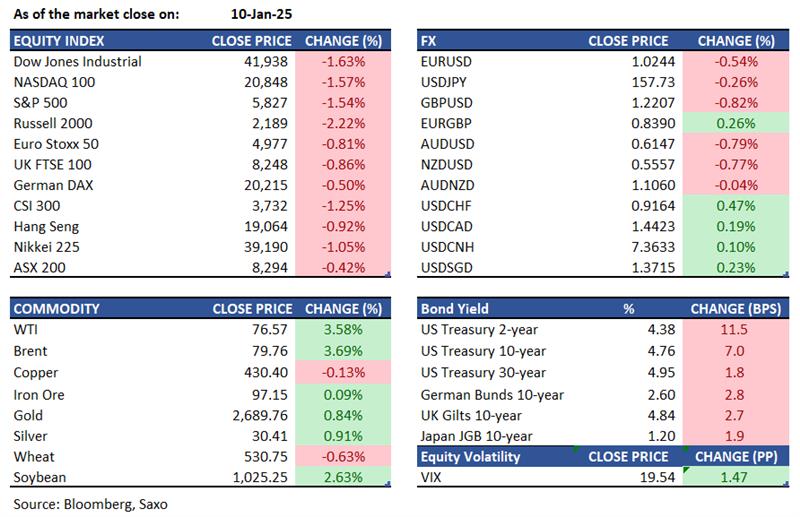
- Equities: S&P 500 and Nasdaq 100 fell 1.2% after the strong job numbers
- FX: Aussie dollar fell to its weakest level since April 2020
- Commodities: Oil rose over 4% on impending U.S. sanctions
- Fixed income: 30-year bond's yield has risen above 5% for the first time in over a year
------------------------------------------------------------------
<Table with Source>
Disclaimer: Past performance does not indicate future performance.
Macro:
- The December NFP report indicated a strong labor market, with 256,000 new jobs (vs 160,000 est) created and a drop in the unemployment rate to 4.1% (vs 4.2% est). This sparked worries that the Federal Reserve might maintain higher interest rates for an extended duration.
- The University of Michigan's inflation report for January revealed a mixed economic outlook, with current economic conditions improving slightly to 77.9 from 75.1, while expectations declined to 70.2 from 73.3. Notably, there was a sharp increase in both 1-year and 5-year inflation expectations to 3.3%, from 2.8% and 3.0% in December 2024, indicating growing consumer anxiety about future price pressures, particularly among lower-income groups.
- Canada finished 2024 with its strongest job gains in two years, right before a potential tariff conflict with the US. Employment rose by 91,000 in December, the largest increase since January 2023, lowering the unemployment rate by 0.1 percentage points to 6.7%.
Equities:
- US - The S&P 500 and Nasdaq 100 each declined by 1.2%. The Dow Jones fell by 600 points, having initially plummeted over 800 points earlier in the session. Among sectors, technology, real estate, and financials were the poorest performers, while energy stood out with better performance. In corporate news, Delta Air Lines shares surged 8% following earnings and revenue that exceeded expectations. Additionally, Walgreens Boots Alliance saw a 21% spike as its earnings surpassed estimates and the company upheld its guidance.
- Hong Kong – HSI fell 0.9% to 19,064, its lowest in over six weeks, due to broad sector losses following the People’s Bank of China’s announcement to temporarily halt government bond purchases due to a supply shortage. The index dropped 3.4% for the week, amid concerns of nearing bear-market territory.
- Earnings to watch this week: Citigroup, Goldman Sachs, JPMorgan Chase, Morgan Stanley, and Bank of America
FX:
- USD strengthened significantly following a strong US jobs report, with the currency rising to 109.97 from 109.12. High beta currencies underperformed, with the GBPUSD reaching a 12-month low at 1.2193, and NZDUSD falling to 0.5544.
- AUDUSD fell as much as 0.9% to a daily low of 0.6140 against the USD, its weakest level since April 2020.
- EURUSD dropped up to 0.8% to a session low of 1.0215, marking a new two-year low, before paring losses.
- USDCAD rose 0.3% to 1.4430, with the Canadian dollar outperforming most G-10 currencies after a strong Canadian jobs report prompted traders to reduce expectations of BOC easing.
- USDJPY fell 0.2% to 157.82, as the yen led G-10 currencies, shrugging off US data amid rising oil futures and declining US stocks in a risk-off market environment.
Commodities:
- WTI crude oil rose 3.6% to $76.57 per barrel due to U.S. sanctions on Russia, raising supply concerns. Colder U.S. weather increased heating fuel demand. Analysts foresee fluctuating oil prices amid supply constraints and economic slowdown. Brent crude oil futures jumped 3.7% to $79.6 per barrel on Friday.
- US natural gas futures surged over 6% to above $3.9/MMBtu due to forecasts of colder weather and increased heating demand. LNG exports hit record levels, while production stabilized. Prices rose over 17% for the week, recovering from declines.
Fixed income:
- Treasuries faced notable curve-flattening losses as Fed-dated OIS contracts adjusted to expect just one 25 basis point rate cut this year, driven by strong December employment data. 2 to 5 year yields hit new highs, each rising by at least 13 basis points. Major banks revised their Fed forecasts, with Bank of America no longer expecting any cuts. For the first time in over a year, 30-year bond yield has exceeded 5% but 5s30s curve flattened by nearly 10 basis points, marking the largest drop since October.
For a global look at markets – go to Inspiration.