
Access all our platforms from a single account.

Global Market Quick Take: Asia – February 27, 2025

Key points:
- Macro: Single family home sales drop 10.5%
- Equities: Nvidia's revenue and forecast beat expectations; 78% increase to $39.3B
- FX: AUDUSD dropped to 0.63 level due to disappointing data
- Commodities: Oil prices hit a new low for the year
- Fixed income: Two-year Treasury yield fell to the lowest since 24 October
------------------------------------------------------------------
Disclaimer: Past performance does not indicate future performance.
Macro:
- Sales of new single-family homes in the US fell 10.5% in January 2025 to an annual rate of 657,000, below expectations of 680,000. This was the lowest in three months, with high mortgage rates and severe weather, especially in the South, reducing demand.
- The average interest rate for 30-year fixed-rate mortgages in the US fell to 6.88% in the week ending February 21st, 2025, the lowest since December 2024, down from 6.93% the previous week, according to the Mortgage Bankers Association.
- Germany’s GfK Consumer Climate Indicator fell to -24.7 for March 2025 from -22.6, below forecasts of -21.4, marking a second consecutive decline and the lowest since last April. This highlights challenges for the new government, such as ongoing cost pressures, political uncertainty, and rising corporate bankruptcies.
Equities:
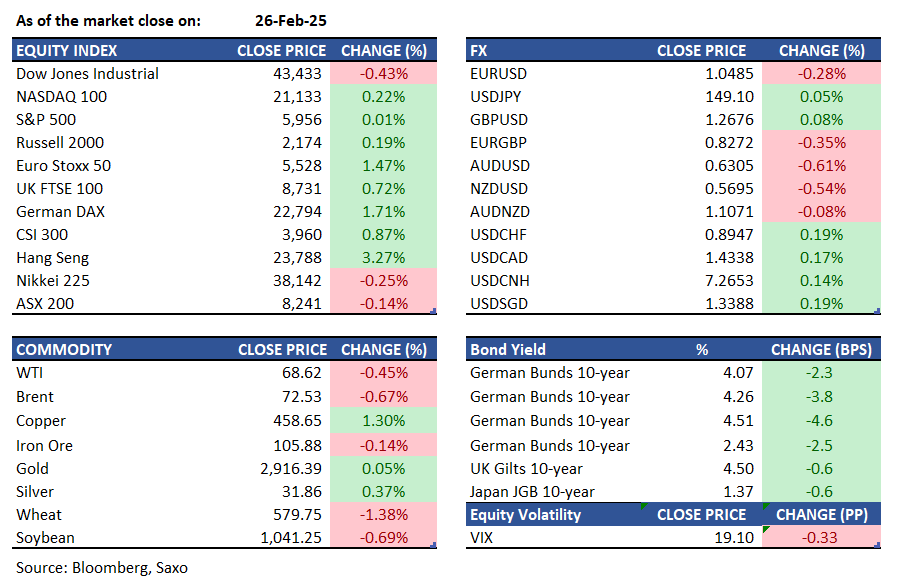
- US - The S&P 500 ended its losing streak with a slight gain, and the Nasdaq 100 rose 0.2%, while the Dow Jones fell 186 points due to tariff concerns. Lowe's gained 2% with a 0.2% rise in same-store sales, and General Motors jumped 3.7% after boosting its quarterly dividend by 25%.
- Nvidia reported fourth-quarter earnings after Wednesday's market close, with revenue rising 78% to $39.3 billion, surpassing estimates of $38.04 billion. The company's first-quarter revenue forecast also exceeded market expectations. Despite this, Nvidia's shares remained relatively stable in volatile after-hours trading.
- HK - HSI jumped 3.3%, to a three-year high of 23,788 on Wednesday. The rally was spurred by Hong Kong's 2024-25 budget plans to curb spending and boost revenues, including tax waivers. Chinese lawmakers' review of a bill for new safeguards also lifted sentiment. Tech stocks surged over 4% amid AI optimism, with financials rising after Morgan Stanley's price target upgrades. Alibaba rose 3.8% with AI model plans, while Meituan, Li Auto, and Semiconductor Manufacturing were other top gainers.
- Germany - DAX rose by 1.7% to close at 22,794.1 on Wednesday, extending its post-election rally and outperforming peers. Investors focused on strong corporate earnings and were optimistic about a potential Ukraine-US minerals deal.
- UK - FTSE 100 rose 0.7%, driven by gains in banking and mining stocks. Copper price increases boosted Antofagasta, Anglo American, Fresnillo, and Glencore. Banks advanced, with Lloyds Banking up 4.6% after a broker upgrade, and Barclays, Standard Chartered, and NatWest also rising. Convatec Group shares jumped 5.2% on strong annual results.
Earnings this week:
- Thursday: Vistra Energy, Norwegian Cruise Line, Dell, Viatris, Clover
- Friday: FuboTV, Terawulf, Chart Industries, AES, Frontline
FX:
- USD strengthened as Trump suggested an April 2nd start for tariffs on Canada and Mexico. Commerce Secretary Lutnick noted that if Trump is satisfied by the March 4th deadline on fentanyl and border security, those tariffs might be paused, but global tariffs would still begin on April 2nd. USDCAD traded above 1.4330 level.
- EUR slightly weakened in volatile trading, dropping below the 1.05 level. President Trump announced impending tariffs on the EU, suggesting a 25% tariff on autos and other goods, and mentioned that the EU might retaliate.
- JPY hit a YTD low of 148.66, while GBP peaked at 1.2715. BoE's Dhingra stated that monetary policy alone can't address price shocks in energy and food sectors, and the impact of US tariffs on UK inflation may be offset by reduced global price pressures.
- Australia's Construction Work data, which contributes to GDP, disappointed, alongside an in-line monthly CPI. As a result, AUDUSD dropped to 0.63, barely holding that level, while NZDUSD fell to 0.5689.
- Major economic data: US durable goods orders, US GDP growth rate, US intial jobless claims, Eurozone economic sentiment
Commodities:
- Oil prices reached a new yearly low as US President Donald Trump's conflicting trade announcements unsettled markets. WTI dropped below $69 a barrel, marking the year's lowest close amid volatile, thin trading. Trump issued contradictory statements about tariffs on Canada, Mexico, and the EU.
- Gold traded narrowly after a 1.3% drop, with bullion around $2,915 an ounce, $40 below Monday's high. It was supported by weak US data suggesting a potential Federal Reserve rate cut and increased haven demand from Trump's tariff threats.
Fixed income:
- Treasuries rose, hitting new YTD yield lows due to strong demand for the last coupon auction until 11 March. Options buying surged to lower the 10-year yield below 4%, as Morgan Stanley suggested. Two-year Treasury yield closed at 4.071%, its lowest point since 24 October and demand for the 7-year note auction was key.
For a global look at markets – go to Inspiration.