
Access all our platforms from a single account.

Global Market Quick Take: Asia – December 13, 2024

Key points:
- Macro: ECB cuts 25, SNB cuts 50; Fed and BOJ on tap next week
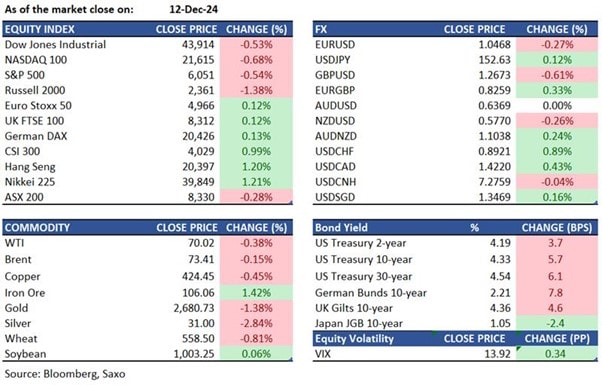
- Equities: US indexes lower, but Broadcom up 15% in after hours.
- FX: USD bid after ECB and SNB rate cuts
- Commodities: Gold declines ending four-day rally
- Fixed income: 10-year yield climbed to nearly 4.33%, highest since November 25.
------------------------------------------------------------------
Disclaimer: Past performance does not indicate future performance.
Macro:
- US PPI was hotter-than-expected with headline up 0.4% MoM vs. 0.2% expected and the prior revised upwards to 0.3% (prev. 0.2%), while the yearly figure rose 3.0% (exp. 2.6%, prev. 2.4%, rev. 2.6%). For core, M/M increased by 0.2%, in line with expectations whereas the Y/Y was 3.4% (exp. 3.2%). However, the components that feed into the Fed’s preferred PCE index were universally weak and, together with the CPI data released yesterday, point to a muted 0.03% m/m increase in the core PCE index. Initial jobless claims hit a 2-month high, with continuing claims rising. Money markets continue to highly favour a 25bps rate cut in the Fed's December meeting, with a ~ 97% chance.
- The ECB delivered a 25bps cut to the deposit rate to 3.0%. Lagarde was dovish, she noted that a 50bps cut was discussed but it failed to gain traction. Following the meeting and Lagarde's press conference, Reuters sources noted that a handful of policymakers were initially in favour of a 50bps cut and some argued that the ECB is overestimating growth, which could be below 1% next year under Trump tariffs. While not declaring victory on inflation, the President noted that direction of travel is clear, signalling further rate cuts. Market expected 120bps of rate cuts from the ECB next year, compared to only 50bps of cuts from the Fed.
- The SNB unexpectedly cut rates by 50bps to 0.50%, sparking immediate downside in the Franc, which enlarged as the session progressed. SNB's Chair Schlegel maintained the rhetoric of willingness to intervene as necessary, adding, that the SNB still has room for further interest rate moves, albeit, said they don't like negative rates, but will use them again if required.
Equities:
- US - The S&P 500 and Nasdaq both ended Thursday down by 0.6% due to the higher Nov PPI of 0.4% vs a forecast of 0.2%, indicating slow progress towards the Fed’s goal of 2% inflation. The Dow fell by 234 points, largely due to a 3.3% drop in UnitedHealth Group, whose shares have fallen by 14% following the death of its healthcare unit CEO.
- Broadcom is up 15% in after-hours trading following the earnings call which revealed that the company is collaborating with three major cloud service providers to assist in designing AI chips, a venture that is highly profitable for the firm.
- Germany - DAX edged slightly higher to 20,429 reaching a new record amid cautious European sentiment following the ECB's monetary policy decision. The central bank cut interest rates by 25bps and revised its GDP growth and inflation forecasts downward. This move was expected, with traders only slightly increasing bets on further easing by March.
- Australia - ASX 200 fell 0.28% its third decline in a row, as stronger jobs data reduced expectations for an early interest rate cut. Australia's unemployment rate dropped to 3.9% in November, with employment rising by 35,600 jobs, surpassing forecasts. The chance of a Reserve Bank rate cut in February fell to 50% from 68%.
FX:
- The US dollar was bid on the back of weakness in CHF as the SNB cut rates by 50bps in a surprise move. ECB’s 25bps rate cut also came with a dovish tilt.
- EURUSD found support at 1.0464, the first major area of support above the 1.0424 area. The ECB's statement saw the removal of the reference to “keep policy rates sufficiently restrictive for as long as necessary”, signalling a clear dovish shift as growth pressures mount.
- EURCHF rallied to 0.9340 from 0.9280 and faces resistance with 50DMA at 0.9356, but ECB rate cuts are likely to outpace SNB’s in 2025 with limited further room available for the Swiss central bank.
- AUD outperformed peers with minimal weakness as the economy added more jobs than forecasted (35.6k vs exp. 25k) as well as the Unemployment Rate unexpectedly falling to 3.9% from 4.1% (exp. 4.2%), though the participation rate did trickle lower. AUDUSD rose to 0.6420+ but could not sustain gains and returned to 0.6380 on dollar strength.
- USDCAD returned to trade at 4.5-year highs, weighed on by dollar strength in addition to Bloomberg reports that Canada is weighing export taxes on uranium and oil if Trump adds tariffs.
Commodities:
- Oil is poised for a weekly rise as potential US sanctions on Iran and Russia offset surplus concerns. West Texas Intermediate neared $70 a barrel, up 4%, while Brent topped $73. Oil’s implied volatility also increased.
- Gold dropped as mixed US data spurred profit-taking after a four-day rally. US wholesale inflation rose unexpectedly in November due to egg prices, while unemployment claims hit a two-month high. Gold fell up to 1.4%, its largest intraday drop in over two weeks.
Fixed income:
- Treasury prices declined for the fourth straight day, with the yield curve steepening further. The 30-year bond auction saw weak demand despite cheaper prices near the deadline. The 5s30s spread widened to its highest in over a month. The 10-year yield increased to nearly 4.33%, its highest since November 25, peaking post-auction.
- Italy's yield premium over Germany saw its largest rise since June after ECB President Christine Lagarde paired a dovish rate cut with an inflation risk warning.
For a global look at markets – go to Inspiration.