
Access all our platforms from a single account.

Asia Market Quick Take – September 25, 2025

Asia Market Quick Take – September 25, 2025
Key points:
- Macro: US new home sales rises 20.5% in August
- Equities: US equities pulled back for 2nd day; Alibaba ADR up 8.2% on AI boost
- FX: USD strengthens to highest level since 11th September
- Commodities: Copper jumps after Freeport-Mcmoran declares force majeure on Grasberg
- Fixed income: Oracle sold $18bn in US IG bonds, the year’s second‑largest deal
------------------------------------------------------------------
Disclaimer: Past performance does not indicate future performance.
Macro:
- U.S. single-family home sales surged 20.5% in August 2025 to an annual rate of 800K units, the highest since January 2022, surpassing July's revised 664K and forecasts of 650K.
- Germany's Ifo Business Climate Index dropped to 87.7 in September 2025, the lowest since May, missing market expectations and reflecting growing pessimism. Both expectations and current conditions worsened amid uncertainty over US tariff policy.
- The average 30-year fixed mortgage rate in the U.S. dropped to 6.34% in the week ending September 19, 2025, the lowest since September 2024, following a fourth consecutive weekly decline. This decrease aligns with lower Treasury yields after the Fed cut rates by 25bps and indicated further cuts.
Equities:
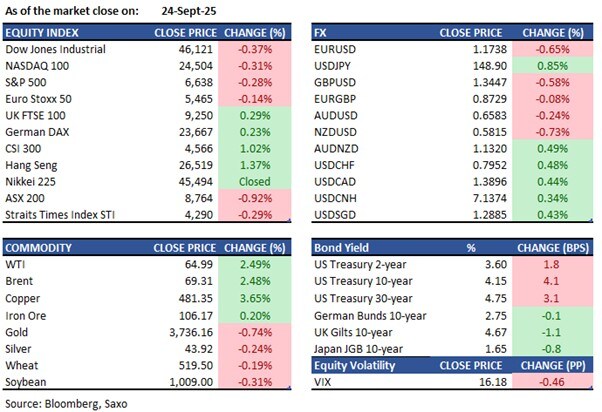
- US - US equities fell for a second day on Wednesday as investors weighed AI sector pressure, mixed Fed signals, and profit-taking near record highs. The S&P 500 slipped 0.3%, while the Nasdaq 100 and Dow each lost 0.4%, extending Tuesday’s pullback. Nvidia dropped nearly 1% after announcing a $100bn OpenAI partnership; Oracle fell 1.7%, and Micron slid 2.9% despite strong earnings. Alibaba ADR jumped 8.2% on plans to boost AI spending beyond $50bn. Sentiment remained cautious as Fed Chair Powell warned of persistent inflation and stretched valuations. A surprise surge in August new home sales offered a rare bright spot amid growth concerns.
- EU - European stocks ended flat on Wednesday, extending the week’s muted trend as luxury weakness offset sector gains. The Eurozone’s STOXX 50 and pan-European STOXX 600 were unchanged. Luxury names reversed Tuesday’s rally, with LVMH, Hermes, Ferrari, L’Oréal, and EssilorLuxottica falling 1.5%–3%. Energy stocks outperformed as oil prices rebounded, lifting ENI and TotalEnergies by 2%. Defence shares surged after US President Trump suggested Ukraine could reclaim lost territory, with Leonardo, Thales, SAAB, and Rheinmetall jumping 3%–6%. Overall sentiment remained cautious amid sector rotation and geopolitical headlines.
- HK - Hang Seng rose 1.4% to 26,519 on Wednesday, snapping a two-day decline as consumer and tech stocks rallied. Sentiment improved after reports that China plans rules to boost food delivery competition, including capping fees and improving transparency. Meituan gained 0.9%, JD.com jumped 3.6%, and Alibaba surged nearly 10% after pledging over USD 53bn in AI investment and unveiling a new model. SMIC climbed 5.8% on AI optimism, while China Vanke added 1.1% amid debt talks. Gains were capped by Typhoon Ragasa concerns, with Cathay Pacific cancelling 500+ flights and planning gradual resumption from Thursday.
Earnings this week:
- Thursday: Oracle Japan, Fonterra, Costco, Accenture, H&M, Jabil, LPP
- Friday: New World, DCM Holdings, Danieli, Crediabank
FX:
- The dollar rose to its highest since 11 Sept, with all G10 currencies weaker; the Bloomberg Dollar Spot Index gained 0.6%. US new‑home sales unexpectedly jumped to the fastest since early 2022, while Evercore said the BLS may delay the September payrolls release if a shutdown runs past 3 Oct.
- EURUSD fell 0.7% to 1.1737, the lowest since 22 Sept, as German business confidence slipped; hedge funds were said to be fading the dip to the 7% area, adding directional exposure.
- USDJPY climbed 0.8% to 148.84, a high since 3 Sept, despite Sanae Takaichi’s softer stance on BoJ policy;
- USDCAD rose 0.5% to 1.3905 as Canada’s population was little changed for a second quarter.
- AUDUSD eased 0.3% to 0.6581 amid an acceleration in monthly inflation to the top of the RBA’s target.
- NZDUSD fell 0.8% to 0.5811, the lowest since 22 Aug, after Anna Breman was named RBNZ Governor from 1 Dec.
Commodities:
- Copper jumped after Freeport‑McMoRan declared force majeure on contracted supplies from Indonesia’s Grasberg, the world’s second‑largest copper mine. The company cut quarterly copper and gold sales guidance amid the search for five missing workers after an accident two weeks ago; two fatalities have been confirmed after about 800,000 metric tonnes of mud flooded underground levels.
- Oil steadied after its biggest jump since July as Trump’s hawkish Russia remarks lifted geopolitical risk. WTI held above $64 and Brent above $69, with investors paring bearish bets.
- Gold hovered near a record around $3,745, less than $50 below Tuesday’s peak, as strong US data and mixed Fed views clouded rate‑cut prospects. Wednesday’s new‑home sales surge and a stronger dollar added pressure.
Fixed income:
- Treasuries softened as corporate supply swelled ahead the $70bn 5‑year sale; losses extended after Oracle launched an $18bn six‑tranche deal, and the auction tailed slightly. Yields were 3–4bp higher across the curve, with the 10‑year near 4.145% and close to session highs, while spreads stayed within 1bp of Tuesday’s close. Yields ground higher as the calendar stacked up, led by Oracle’s 20‑, 30‑ and 40‑year tranches, alongside other multi‑tranche issuers.
For a global look at markets – go to Inspiration. This content is marketing content and should not be considered investment advice. Trading financial instruments carries risks and historic performance is not a guarantee for future performance.The instrument(s) mentioned in this content may be issued by a partner, from which Saxo receives promotion, payment or retrocessions. While Saxo receives compensation from these partnerships, all content is conducted with the intention of providing clients with valuable options and information.