
Access all our platforms from a single account.

Asia Market Quick Take – 29 October, 2026

Asia Market Quick Take – 29 October, 2026
Key points:
- Macro: Fed holds rates. BoC raises rates by 25bps to 2.5%.
- Equities: Oracle popped 11%, GOOGL –9.7% on earnings miss; MSFT +3% on Azure
- FX: AUDUSD hits one month high while NZD was weakest G10 currency
- Commodities: Oil rallied while silver remains below $55
- Fixed income: U.S. Treasury curve bear-steepened, with long-end moving higher
------------------------------------------------------------------
Disclaimer: Past performance does not indicate future performance.
Macro:
- The FOMC voted 10–2 to hold the funds rate at 3.75%–4.00%, with Governors Cook and Hammack favoring a hike. Chair Warsh reaffirmed the inflation fight but gave no clear signal on December. He also said one 2027 meeting and two in 2028 will exclude rate votes and statements, prompting a sharp steepening of the Treasury curve.
- Reports said US Vice President JD Vance contacted Iranian official Mohsen Rezaei. President Trump confirmed mediated talks but noted uncertain outcomes, while Iranian Foreign Minister Abbas Araghchi said Tehran remains open to diplomacy.
- The Bank of Canada raised its policy rate 25 bps to 2.5% in October 2026, its first hike in three years, to curb broader inflation pressures from high energy prices. It signaled possible further increases but urged caution, noting inflation is higher and more persistent than in July. CPI is now seen averaging 3% in 2027 before returning to 2% by mid-2028, with growth projected at 1% in 2026 and 2% in 2027–28.
- UK Chancellor John Healey’s first budget upheld fiscal rules, with the OBR estimating £15bn of headroom in 2029–30. Measures include energy bill relief, smaller bank tax hikes, tariff suspensions on 100+ supermarket goods, a 3.9% minimum wage rise, and £20.4bn more for the National Wealth Fund and British Business Bank. The OBR cut its 2027 growth forecast to 1%, raised 2026 to 1.2%, and lifted borrowing and debt projections.
- The US goods deficit widened to $134.9 billion in September 2026, the largest since March 2025 and above the $130 billion forecast, as imports rose 2.4% to a record $344.15 billion and exports increased 2.6% to $209.24 billion.
Equities:
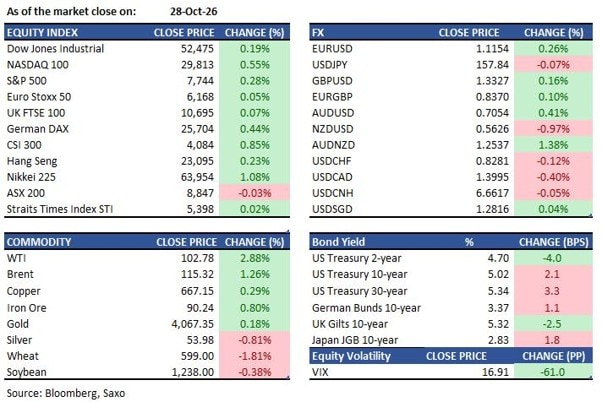
- US — The S&P 500 rose 0.3% to 7,743.98, the Nasdaq 100 gained 0.5% to 29,813.16, and the Dow added ~100 points to 52,475.10 on Wednesday, as the Fed held rates and AI optimism returned. Oracle surged 11% after projecting $30bn in free cash flow by FY2029. Icon Plc jumped 17%. Boston Scientific fell 9% after cutting its sales outlook following a cyberattack. In after-hours trade, Alphabet slumped ~10% on disappointing revenue and negative free cash flow of $9.07b in Q3, while Microsoft jumped 3% after Azure cloud sales grew 48%, beating the 44% estimate and capex of $39.4b was well below estimates. Nasdaq 100 futures fell 0.9% and S&P 500 futures slipped 0.4% in early Asian trading.EU — European equities were broadly flat on Wednesday. The Stoxx 600 edged up 0.07% to 644.14, the DAX rose 0.44% to 25,704.02, the FTSE 100 gained 0.07% to 10,694.50, and the Euro Stoxx 50 closed +0.05% at 6,167.81. UK bank stocks outperformed after Chancellor Healey raised the bank surcharge by only 3 percentage points to 6%, below the feared 8% level — NatWest +4.4%, Lloyds +4.3%, Barclays +3.8%. Stellantis surged 15% on better-than-expected Q3 revenue. Genmab jumped 29.1% in Nordic trading. Unilever fell as much as 3.2% on weak developed-market performance. Logitech dropped 10.8% on the SMI.
- Asia — Asian markets were mixed on Wednesday. The Kospi surged 6.6% to 6,012.44 — its biggest rally in three months — led by SK Hynix, which jumped 10% after reporting a seven-fold surge in profits and announcing a ~$45bn shareholder return plan, lifting the broader AI trade. The Nikkei 225 closed at 63,954.19. The Hang Seng ended at 23,094.83, with PetroChina rising on higher oil prices while Ping An fell after reporting a 27% drop in nine-month net income. The STI closed at 5,397.91. On Thursday morning, the Kospi opened little changed at 6,017.22. Alphabet's after-hours miss is weighing on sentiment, with Nasdaq futures down 0.9%, though MSCI Asia Pacific edged up 0.3% led by Japan and Australia. Japan corporate credit risk widened by the most since September 2022, led by SoftBank and Nissan.
Earnings this week:
- Thursday: Merck, Mastercard, Caterpillar, Intel, Amazon, BYD, Denso, Keyence, Wilmar International
- Friday: Chevron, ExxonMobil, China Construction Bank, Kweichow Moutai, CNOOC, ICBC, Bank of China, Sands China, Panasonic
FX:
- The New Zealand dollar was the weakest G10 currency after the RBNZ's surprise rate hold. NZDUSD fell to 0.5626, lagging all peers.
- AUDUSD rose as much as 0.6% to a one-month high of 0.7065 before settling at 0.7054, supported by the hotter-than-expected Q3 trimmed mean CPI and a softer dollar post-Fed.
- USDCNH slipped to 6.6617 and USDCNY was little changed at 6.666; the PBOC set the fixing at 6.7165.
- USDJPY held at 157.84, keeping the yen near multi-decade lows as the 10-year US yield remained above 5%. JGB yields rose, with the 10-year up ~4.5bp to 2.83% and the 30-year up ~5.5bp.
- The Korean won benefited from the AI/SK Hynix rally, with USDKRW at 1,343.30. Elsewhere, the Thai baht remained near an 18-month trough, all pressured by elevated oil prices and current account deficits.
Commodities:
- Brent crude closed at $115.32/bbl and WTI at $102.78/bbl. Prices were supported by reports that the US may resume military strikes on Iran after the midterms, though an oil rally waned late in the US session after the Wall Street Journal reported that VP Vance had reportedly reached out to de-escalate tensions.
- Spot gold closed at $4,067.35/oz, recovering from a brief dip below $4,000 in prior sessions as bargain hunters returned ahead of the Fed decision. JPMorgan Private Bank cautioned that gold still faces downside risk until rates peak, with the bank expecting the 10-year yield to reach 5.25%–5.50% by mid-2027.
- LME 3-month copper closed at $14,477.50/t, approaching record levels. Aurubis flagged tight market conditions driven by large shipments to the US, and offered a record premium of $347/t for 2027 supply. Chile's copper output remains at a 23-year low due to accidents, weather, and operational disruptions.
Fixed income:
- The Treasury yield curve bear-steepened after Warsh announced that one 2027 FOMC meeting and two 2028 meetings will omit rate votes. The 2s10s spread widened by more than 5bp and the 5s30s by more than 4bp. The 10-year yield closed at 5.02% and the 30-year at 5.35%, while the 2-year fell to 4.70% as front-end yields priced out some near-term hike risk.
- The 10-2 vote — with Cook and Hammack dissenting in favour of a hike — left markets pricing approximately 23bp of tightening for December, little changed from before the decision. Treasury Secretary Bessent noted that "bonds have done a lot of tightening for us."
- US-friendly nations cut net Treasury purchases by over 60% year-on-year in the first eight months of 2026, raising structural demand concerns for the long end. In contrast, the high-yield market posted its best one-day returns in six months on Wednesday, with CCC spreads tightening the most in over eight months and yields falling 28bp, driven by renewed AI optimism and the Fed hold.
For a global look at markets – go to Inspiration.
This content is marketing content and should not be considered investment advice. Trading financial instruments carries risks and historic performance is not a guarantee for future performance.The instrument(s) mentioned in this content may be issued by a partner, from which Saxo receives promotion, payment or retrocessions. While Saxo receives compensation from these partnerships, all content is conducted with the intention of providing clients with valuable options and information.