
Access all our platforms from a single account.

Asia Market Quick Take – 26 October, 2026
Key points:
- Macro: Houthis continues attacks on Saudi. US consumer sentiment edges up.
- Equities: Dow fell 1.2% with risk weaker on higher oil, AI capex concerns
- FX: CME BRL futures plunge 10% after Lula wins Brazil’s presidential election
- Commodities: Brent crude eased after hitting $117, a five-month high
- Fixed income: Treasury yields up across the curve; 10-year near 5.0%
------------------------------------------------------------------
Disclaimer: Past performance does not indicate future performance.
Macro:
- The University of Michigan consumer sentiment index was revised up to 48.0 in late October but remained a five-month low. Year-ahead business conditions improved but stayed well below last year, while current conditions fell on an 18% drop in buying conditions for durables. Sentiment is 10% below a year ago and 15% below February. Year-ahead inflation expectations rose to 4.7%, and long-run expectations to 3.5%.
- Houthi attacks on Saudi Arabia persisted over the weekend as Riyadh’s main airport reopened after a two-week shutdown. Trump said he is close to deciding whether to strike Iran again or pursue a deal, keeping oil markets on edge.
- President Lula reportedly won Brazil’s runoff with about 51% of the vote, ending a right‑wing wave in Latin America, while the real fell sharply in futures trading.
- Moody’s left France’s Aa3 rating unchanged on Friday, with a negative outlook. The OAT-Bund spread surged 29 bps last week—its second-largest weekly rise on record—to about 170 bps, the widest since the 2011 eurozone debt crisis.
- US Composite PMI eased to 57.6 in October from 58.4, still indicating strong expansion. New orders hit a 4.5-year high, exports and employment strengthened, but rising input costs pushed selling-price inflation to its highest since August 2022, while confidence edged down.
- Canadian retail sales are seen up 0.7% m/m in September after a revised 1.2% gain in August. August growth was led by motor vehicle and parts dealers (+1.2%), gasoline stations (+1.7% in value, –0.5% in volume), and higher sales at food and beverage (+1.1%), general merchandise (+1%), and health and personal care stores (+1.6%).
Equities:
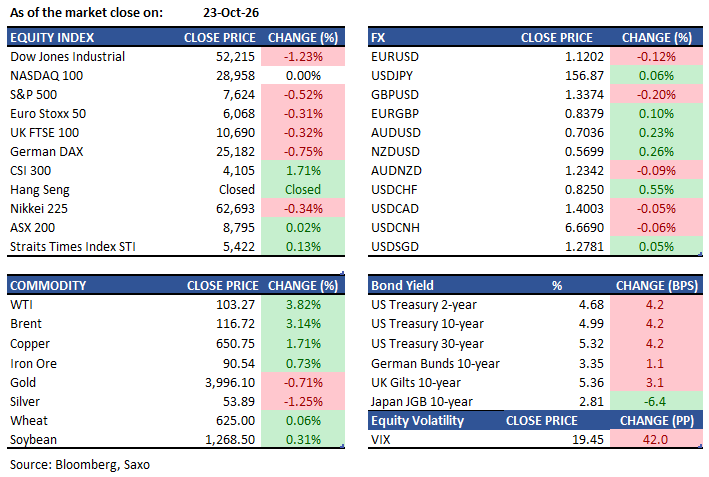
- US: US equities fell for a second consecutive session on Friday as surging oil prices stoked inflation concerns ahead of the Fed decision. S&P 500 dropped 0.5% to 7,623.68, the Dow Jones fell 1.2% to 52,215.16, and the Nasdaq Composite slipped 0.2% to 25,955.34. The Philadelphia Semiconductor Index edged up 0.4% after Thursday's 6.7% rout. Bloom Energy was the largest S&P 500 decliner, falling 11.2%. American Express fell 3.6% after earnings. Fair Isaac (FICO) slumped 8% in after-hours trading after announcing it would hold its wholesale mortgage price flat.
- EU: European equities fell for a second day as disappointing earnings compounded AI trade concerns and elevated oil prices. The Stoxx 600 dropped 0.3% to 635.76, the DAX fell 0.7% to 25,181.65, the CAC 40 declined 0.4% to 7,782.82, and the FTSE 100 lost 0.3% to 10,690.36. Kering was the largest Stoxx 600 decliner, falling 16.6%, as Gucci sales disappointed. Volvo Car sank as much as 32% after reporting a third-quarter loss. Safran fell 10.0%. Electrolux surged as much as 12% after its Q3 EBIT beat expectations. The Euro Stoxx 50 ended the week 2.2% lower, its largest weekly decline since July.
- Asia: Asian equities opened under pressure as investors braced for the busiest earnings week of the season and key central bank decisions. The MSCI Asia Pacific gauge fell 0.2%. The Kospi opened 0.9% lower at 5,499 and extended losses to around 1% as risk sentiment remained fragile; Kospi futures had been weaker overnight partly on the Brazil election result. Nikkei futures slipped 0.4%, though Fanuc surged as much as 6.2% — its biggest gain since July 31 — after raising its full-year operating income guidance to a record on strong AI data centre demand. The Hang Seng closed Friday at 23,093.37, up 0.7%, recovering from Thursday's 3% selloff, led by Xiaomi (+3.9%) and Aluminum Corp of China (+7.0%). The STI reference level stands at 5,422.16. Chinese stocks found some support after entering bear market territory on Thursday, with state-backed funds reportedly stepping in via ETF purchases. SK Hynix is expected to announce a special dividend of approximately $12 billion when it reports Q3 earnings on 28 October.
Earnings this week:
- Tuesday: Coca-Cola, Boeing, PayPal, Visa, HSBC
- Wednesday: Alphabet, Microsoft, Ford, Ping An Insurance, PetroChina, Hitachi, SK Hynix
- Thursday: Merck, Mastercard, Caterpillar, Intel, Amazon, BYD, Denso, Keyence, Wilmar International
- Friday: Chevron, ExxonMobil, China Construction Bank, Kweichow Moutai, CNOOC, ICBC, Bank of China, Sands China, Panasonic
FX:
- USDJPY hovers near 157, up slightly on the day. The yen has broken out of its recent narrow range as AI-driven risk-off demand fades, though Goldman Sachs notes the yen is becoming a more attractive hedge for pro-cyclical portfolios against an AI market shock. Hedge funds reportedly curtailed short yen positions in the week ending 20 October per CFTC data.
- EURUSD edged up 0.1% to around 1.08, though the euro remains under pressure from the French fiscal crisis. The OAT-Bund spread at 15-year highs continues to weigh on the single currency.
- AUDUSD slipped 0.09% and faces technical resistance at the 200-day moving average near 0.7053, with the 50-DMA set to add further headwinds. The pair is consolidating after recent weakness.
- CME BRL futures plunge >10% to below 18 after Lula’s victory, reversing a Brazil rerating built on Bolsonaro-presidency expectations, pressuring the real and equities and steepening the DI curve.
- The Norwegian krone is the best-performing G10 currency year-to-date, up 8.15% against the dollar to around 9.33, outperforming the Bloomberg Dollar Spot Index by approximately 6.7 percentage points, supported by elevated oil prices.
Commodities:
- Brent crude eased approximately 0.9% to $115.63 and WTI fell 1.1% to $102.13 in early Monday trading, pulling back from Friday's close near $117 — a five-month high — as President Trump signalled he is nearing a decision on Iran. Both benchmarks remain sharply elevated on Middle East supply risk, with Houthi attacks on Saudi infrastructure and Iranian strikes on Hormuz shipping continuing to disrupt flows.
- Gold is trading around $3,988/oz, down 0.2% on the day, after posting its biggest weekly decline since June last week — falling more than 4% — as rising real yields and a stronger dollar weighed. Gold briefly dipped below $4,000 on Friday, with the GLD ETF recording its largest single-day outflow since 4 March at $1.56 billion.
- European natural gas futures rose as much as 0.9% at the start of the week, touching the highest level since 2022, driven by elevated energy demand and ongoing geopolitical risk to supply routes.
Fixed income:
- The 10-year yield stands at 4.99% and the 30-year at 5.31% as of Monday morning, with the curve seeing modest bull-flattening overnight after Friday's selloff. On Friday, yields rose across the curve — the 10-year added 4 basis points to close near 5.0% and the 30-year rose 4.3 basis points to 5.33% — as oil-driven inflation fears kept a lid on bonds. The 10-year real yield rose to 2.64%, up 72 basis points year-to-date.
- The France-Germany 10-year spread surged 29 basis points last week to approximately 170 basis points — the second-largest weekly widening on record and the widest since the 2011 eurozone debt crisis — as political unrest and fiscal concerns intensified. Moody's spared France a downgrade on Friday but maintained a negative outlook, citing slower growth, a higher deficit, and social unrest as ongoing risks.
- EM bond funds have recorded 12 consecutive weeks of inflows according to BofA/EPFR data, with investors from JPMorgan Asset Management to Generali loading up on EM debt despite the surge in Treasury yields, citing attractive valuations and a diversification away from rich-world fiscal risk.
For a global look at markets – go to Inspiration.
This content is marketing content and should not be considered investment advice. Trading financial instruments carries risks and historic performance is not a guarantee for future performance.
The instrument(s) mentioned in this content may be issued by a partner, from which Saxo receives promotion, payment or retrocessions. While Saxo receives compensation from these partnerships, all content is conducted with the intention of providing clients with valuable options and information.