Access all our platforms from a single account.

Asia Market Quick Take – 25 November, 2026

Asia Market Quick Take – 25 November, 2026
Key points:
- Macro: Iran says 4 tankers hit mines. US consumer confidence hits 2-year high.
- Equities: AI relief rally fades; Nvidia down 6%, Anthropic falls 6.5% below $83 IPO price.
- FX: CHF strengthens most in G7, up 0.52% against USD.
- Commodities: Copper near bear market closing at 13-month low.
- Fixed income: Treasuries rally on haven demand with 10 year at two week low.
------------------------------------------------------------------
Disclaimer: Past performance does not indicate future performance.
Macro:
- The Trump administration is poised to unveil new, economy-specific Section 301 tariffs as soon as this week on China, the EU, and more than a dozen other countries, targeting excess industrial capacity, with rates kept within existing US trade deal limits.
- US consumer confidence in November 2026 reached a near two-year high, with the Conference Board index at 103.3 and Michigan sentiment at 51.5, lifted by post-election clarity, lower gas prices, and stronger job optimism despite ongoing inflation concerns.
- Iran said four oil tankers caught fire after hitting naval mines and threatened tighter control of the strait. The US expanded sanctions on Iran, blamed Tehran for cyberattacks on energy tankers, and sent a third aircraft carrier to the Gulf to bolster its naval blockade.
- Singapore’s current account surplus reached a record SGD 41.31 billion in Q3 2026, up from SGD 28.48 billion a year earlier, driven by stronger goods and services surpluses despite wider income deficits. The 2025 annual surplus was SGD 131.96 billion, slightly above 2024’s SGD 131.67 billion.
- Japan’s Services Producer Price Index rose 4.2% year-on-year in October 2026, up from 3.8% and above expectations, the highest since March 1990, with strong gains in transport, real estate, and other services. Month-on-month, it increased 1.1%, the fastest rise in six months.
- Germany’s Ifo Business Climate Index rose to 90.6 in November 2026, its highest since May 2023, with both current conditions and expectations improving. Ifo’s Clemens Fuest said the recovery is still narrow and largely reliant on deficit-funded public spending, with export stabilization uncertain.
- The CBI retail sales balance rose to 9 in November 2026 from -10, the first positive reading since September 2024 and highest since December 2022, well above expectations. Confidence improved but stayed negative, retailers plan to cut investment, and selling prices rose at the slowest pace since May 2024.
Equities:
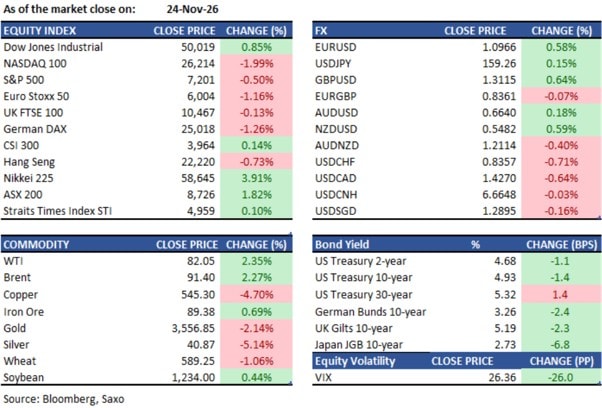
- US: Markets closed mixed as the AI relief rally faded. S&P 500 fell 0.5% to 7,201.09 — its eighth loss in nine sessions — while the Nasdaq Composite dropped 1.5% to 23,733.54 with SOX falling nearly 8%. Dow Jones outperformed, rising 0.85% to 50,018.70, supported by defensive sectors including healthcare and consumer staples. Nvidia fell ~6%, Anthropic sank 6.5% below its $83 IPO price, Micron fell 11% and AMD, Intel and Applied Materials lost 7-9%. Nike gained nearly 6% after Foot Locker sales grew more than 4% last quarter, with the shop selling about 30% of Nike shoes. Moderna surged 7.2% during the session, extending its remarkable 671% 2026 rally. After hours, HP Inc. and Dell Technologies both provided solid outlooks, with Dell rising just under 1% and HP falling 3%.
- EU: European equities retreated as the AI trade pullback and tariff concerns weighed on sentiment. The Stoxx 600 fell 0.7% to 632.74, the DAX dropped 1.3% to 25,017.81, and the Euro Stoxx 50 declined 1.2% to 6,003.76. The FTSE 100 was relatively resilient, slipping just 0.1% to 10,467.07. Key movers: Infineon fell 9.7%, ASML dropped 5.6%, Aixtron slumped 16.3%, and Antofagasta declined 8.1% as miners tracked lower commodity prices. On the upside, Sanofi surged 9.9% after agreeing to acquire US biotech Insmed for ~$41 billion.
- Asia: Asian markets fell sharply, tracking Wall Street's tech-led selloff and compounded by fresh tariff fears. The Kospi was the worst performer, plunging ~4.6% to 4,777.12, with program trading briefly halted at the open as Samsung dropped 4.4% and SK Hynix fell 5% in pre-market. The Nikkei 225 closed at 58,644.63, pressured by ballooning retail margin losses near the 20% forced-selling threshold. The Hang Seng closed at 22,219.65, with Alibaba falling 1.4% and Baidu down 2.8% in their US-listed ADRs. The STI was a relative outperformer, closing Tuesday at 4,958.87 (+0.1%), with Sembcorp Industries rising 2.5%. The MSCI Asia Pacific Index slipped 0.6%, giving back its biggest rally since July. Chow Tai Fook reported 1H net income that beat estimates, though lower margin guidance tempered the positive read-through.
Earnings this week:
- Wednesday - John Deere, Li Auto, OMS, Haidilao
- Friday - Meituan
FX:
- USD softened on Tuesday with the Bloomberg Dollar Spot Index fell 0.2%, its largest single-day decline in about two weeks, as renewed doubts over the durability of the AI trade weighed on risk sentiment and US equities.
- AUDUSD is the weakest G10 mover, down 0.12%, extending recent softness.
- USDJPY holds near 159.22, remaining elevated as the yen stays under pressure.
- CHF was the strongest G10 performer on Tuesday, gaining 0.54% vs. the USD, per the currency scorecard.
- CAD posted its biggest gain since August (+0.7%), after Bank of Canada Governor Tiff Macklem warned that rising oil costs are compounding persistent inflation, prompting traders to increase bets on another rate hike.
- MXN fell 1.2% on Tuesday, its fifth consecutive down session, reaching its weakest level since mid-2025, as the US-Mexico rate differential weighs on the currency.
Commodities:
- LME 3-month copper closed at $11,826/ton on Tuesday, a 13-month low and down approximately 5.3% on the day on Comex (front-month settled at $5.3625/lb, -4.7%). The metal is on the cusp of a bear market, having fallen ~21% from its September record high, pressured by AI spending concerns, soft Chinese demand, looming Fed hikes, and fresh tariff risks.
- Brent crude settled up 2.3% at $91.40/barrel and WTI rose 2.3% to $82.05/barrel on Tuesday, as persistent Middle East shipping threats offset expectations of a global supply surplus in 2027. OPEC+ faces a consequential production decision at its upcoming meeting. WTI edged slightly lower to $81.66 in early Asian trade.
- Gold traded at $3,547.81/oz, slipping marginally (-0.25%) from Tuesday's close of $3,556.85, as the dollar's softness provided partial support even as risk appetite deteriorated. Silver was little changed at $40.84/oz.
Fixed income:
- US Treasuries advanced as the tech selloff and tariff concerns drove risk-off flows. Yields fell 2–5bps across maturities, with the 10-year dropping ~1.6bps to 4.932% — a two-week low — and the 2-year falling ~0.7bps to 4.689%. The belly of the curve led gains.
- The 30-year Treasury yield bucked the trend, rising ~1.4bps to 5.323%, reflecting ongoing concerns about long-run inflation and fiscal dynamics, with stagflation risks increasingly cited as a structural headwind for the long end.
- German Bund yields fell 2–3bps across the curve, tracking Treasuries, as the tech selloff stoked haven demand. UK Gilt yields dropped 1–3bps. The BTP-Bund spread widened 4bps to 109bps and the OAT-Bund spread widened 2bps to 152bps. Markets trimmed ECB and BOE rate hike expectations, with swaps implying 58bps of ECB and 81bps of BOE increases by end-2027.
For a global look at markets – go to Inspiration. This content is marketing content and should not be considered investment advice. Trading financial instruments carries risks and historic performance is not a guarantee for future performance.
The instrument(s) mentioned in this content may be issued by a partner, from which Saxo receives promotion, payment or retrocessions. While Saxo receives compensation from these partnerships, all content is conducted with the intention of providing clients with valuable options and information.