
Access all our platforms from a single account.

Asia Market Quick Take – 22 October, 2026

Asia Market Quick Take – 22 October, 2026
Key points:
- Macro: UK inflation hotter than expected. US orders staff to leave gulf embassies.
- Equities: SpaceX +7.8% on blowout results; Meta +2% on earnings beat, stock split
- FX: Mexican peso hits fresh year-to-date low and Sterling near 1.34 handle
- Commodities: Gold remains under pressure while holding above $4,100
- Fixed income: French 10-year yields hit 5% for first time since 2002
------------------------------------------------------------------
Disclaimer: Past performance does not indicate future performance.
Macro:
- UK annual inflation rose to 3.5% in September 2026, the highest since October 2025 and above the 3.4% forecast, led by higher transport and motor fuel costs, with core CPI up to 2.8%.A deadly drone attack on Saudi Aramco’s Shaybah field and Ukrainian strikes on Russian oil facilities have raised supply risks, but rising Middle East crude exports and Russia’s planned diesel shipment to the US may limit further oil price gains.
- New Zealand’s annual inflation slowed to 3.7% in Q3 2026 from 4.1%, just below the 3.8% forecast but still above the RBNZ’s 1–3% target, with quarterly CPI easing to 0.7%.
- The average 30-year fixed mortgage rate fell 9 bps to 7.41% in the week to October 16, 2026, its first decline in 11 weeks as Treasury yields eased. Total mortgage applications slid 5.3%, with refis down 2% and purchase applications down 7.3%.
- The US ordered some staff to leave Gulf embassies amid rising tensions, while continued attacks in the Strait of Hormuz weighed on sentiment even as oil flows there exceeded pre-war levels.
Equities:
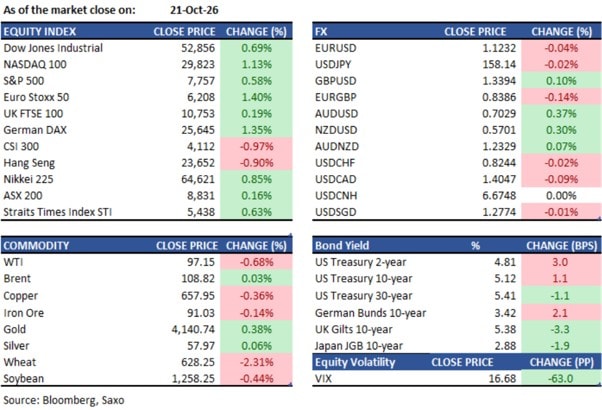
- US: The S&P 500 rose 0.6% to 7,757.17 on Wednesday, its third consecutive gain and largest single-day advance since October 9. The Nasdaq 100 added 1.1% and the Dow gained 0.7% to 52,856. SpaceX surged approximately 7.8% on blowout Q3 results, while Super Micro Computer jumped 9.6% on preliminary earnings that topped estimates. Nvidia notched its best day in over a month, rising ~2.5%. Chipotle fell 5.2% to its lowest level in nearly four years. After hours, Tesla fell ~3.1% despite a profit beat as capex guidance disappointed, while Meta rose 2% after boosting its capital spending outlook and announcing a new class of non-voting stock through a 2 to 1 stock split. CSX gained ~4% post-market on better-than-expected earnings. S&P 500 futures were down ~0.4% in early Asian trading.
- EU: European equities rallied broadly on Wednesday, driven by upbeat corporate earnings and improving AI sentiment. The Stoxx 600 rose 0.9% to 644.49, its biggest gain since October 9. The Euro Stoxx 50 surged 1.4% to 6,207.52 — its largest single-day gain since July 30. The DAX climbed 1.3% to 25,645, led by SAP (+3.5%) and Adidas, which delivered Q3 EBIT 36% ahead of consensus. The CAC 40 gained 1.1% to 7,921.68. The FTSE 100 rose 0.2% to 10,752.88, led by HSBC (+1.0%). Randstad surged ~20% after beating Q3 organic growth estimates. Carrefour plunged a record amount after warning that social unrest in France would hit earnings. French 10-year yields hit 5% for the first time since July 2002, adding a fiscal overhang to the session.
- Asia: Asian equities were broadly higher on Wednesday, buoyed by the AI trade revival following SpaceX and Super Micro earnings. The MSCI Asia Pacific Index climbed ~1.1%, snapping a losing streak. The Kospi surged 3.7% on Wednesday, rebounding sharply after Tuesday's selloff triggered by the dismal IPO debut of AI infrastructure firm Elice (-32%). The Taiex gained 1.4% as AI hardware names rallied. However, as of the Thursday open, the Kospi reversed course, falling ~1.2% to 5,666 as investors focused on Tesla's disappointing capex guidance rather than Meta's AI spending boost. Nikkei futures also pointed lower in early trade. The Hang Seng last traded at 23,651.87. The Nikkei 225 last closed at 64,621.24. The Nasdaq Golden Dragon China Index fell 2.4% on Wednesday. Foreign funds bought a net $357 million of Korean equities on October 21, the highest single-day net buying in one month.
Earnings this week:
- Thursday: Lockheed Martin, Nokia, Comcast, American Airlines, Bloom Energy
- Friday: American Express, Schlumberger
FX:
- The yen remains under pressure as the dollar strengthened on risk-off flows and higher US yields. The pair is up marginally on the day, with the yen near multi-month lows against the dollar.
- The pound is consolidating above its 21-day moving average for the first time since late August, with bulls eyeing the 1.3470 Fibonacci level as the next key resistance.
- The peso fell ~1.4%, the worst performer among major EM currencies, as expectations for a Banxico rate cut consolidated. Latin American currencies broadly weakened as the dollar, US yields and crude prices ground higher.
- The yuan held firm onshore and offshore despite dollar strength, with the PBOC setting the fixing at 6.7192 per dollar. China is reportedly moving toward unifying onshore and offshore yuan pricing, with the PBOC piloting a program allowing offshore clearing banks to trade in the mainland interbank FX market.
- AUDUSD — Vol elevated ahead of Q3 CPI: 1‑week implied vol at 6.70 with tenor covering Q3 CPI, option‑implied range 0.6938–0.7067, and hawkish RBA commentary supportive.
- AUDJPY — Technical resistance in focus: Rallying into clustered 50/100/200‑DMAs at 111.55–112.09.
- NZDUSD — Breaching key levels: NZD is up ~0.11% in G10, with the pair pushing above initial technical thresholds.
Commodities:
- Brent traded at $108.82/bbl, with prices whipsawing during the US session as reports of a potential Qatar-Pakistan peace proposal briefly pushed prices lower before being walked back. WTI rose ~0.8% to $97.93/bbl. A deadly attack on a Saudi oil field overnight added fresh upside pressure. Despite elevated prices, oil flows through the Strait of Hormuz reportedly topped pre-war levels in the week through October 18.
- Gold dipped to about $4,120/oz amid Middle East tensions that stoked inflation risks, despite expectations the Fed will hold rates, after a 0.4% gain in the prior session snapped a three-day slide.
Fixed income:
- The 10-year Treasury yield rose ~1 basis point to 5.123%. The $13 billion 20-year bond reopening stopped at 5.469% — the highest yield for that tenor since it was reintroduced in 2020 — and tailed by approximately 1 basis point, indicating demand fell short of expectations. The 2-year yield rose as much as 5 basis points to 4.83% intraday, its highest level in a week, before paring gains. Option markets are building positions targeting the 10-year yield above 5.3% by month-end, covering the upcoming Fed decision, September core PCE and Q3 GDP releases.
- French OAT yields rose 7–9 basis points to close at 5.009%, the highest level since July 2002, as higher energy prices, persistent fiscal concerns and a widening deficit backdrop weighed on eurozone bonds. The OAT-Bund spread widened ~5 basis points to 158 basis points. European natural gas futures rose ~4%, following oil higher.
- US high yield bond yields climbed to an 18-month high, with BB yields reaching 7.14% and spreads near a six-month peak, marking a third consecutive day of losses. Persistent doubts about the durability of AI-fuelled returns on massive capital investment continued to weigh on risk appetite in credit markets, with stress most pronounced in CCC-rated paper.
For a global look at markets – go to Inspiration.
This content is marketing content and should not be considered investment advice. Trading financial instruments carries risks and historic performance is not a guarantee for future performance. The instrument(s) mentioned in this content may be issued by a partner, from which Saxo receives promotion, payment or retrocessions. While Saxo receives compensation from these partnerships, all content is conducted with the intention of providing clients with valuable options and information.