
Access all our platforms from a single account.

Asia Market Quick Take – January 12, 2026

Asia Market Quick Take – January 12, 2026
Key points:
- Macro: US added less jobs than expected; Unemployment ticks down
- Equities: Chip stocks outperformed with S&P 500 hitting new highs; Intel gained 10%
- FX:USD rises on jobs report strength; CAD weakens to 1.39 despite job growth
- Commodities: Gold at record high; oil up for a third day
- Fixed income: US Treasuries twist-flattened and Australia’s debt sales begin
------------------------------------------------------------------
Disclaimer: Past performance does not indicate future performance.
Macro:
- US added 50K jobs in December, less than November's revised 56K and below the 60K forecast. Employment grew in food services (27K), healthcare (21K), and social assistance (17K), while retail lost 25K jobs. Federal employment and several other sectors saw little change. Revisions reduced October and November totals by 76K. For the year, payrolls increased by 584K, averaging 49K monthly, a drop from 2024's 2 million gain.
- US unemployment rate dropped to 4.4% in December from 4.5% in November, below forecasts. Unemployment decreased by 278,000 to 7.50 million, and employment rose by 232,000 to 163.99 million. The labor force shrank by 46,000, reducing the participation rate to 62.4%. The U-6 rate fell to 8.4% from 8.7%, indicating improved labor market conditions.
- President Trump is set to review kinetic and non‑kinetic options on Iran, signaling possible U.S.intervention as Iran blames Washington for escalating peaceful protests into violence.
- US year-ahead inflation expectations stood at a near one-year low of 4.2% in January, unchanged from December, according to preliminary University of Michigan data. Meanwhile, the five-year outlook increased to 3.4% from December's 3.2%.
- Michigan's consumer sentiment in January increased to 54.0, surpassing forecasts and September levels, with gains among lower-income groups. It remains 25% below January 2025 as concerns over prices and the labor market persist. Year-ahead inflation expectations held at 4.2%, above last year's 3.3%, while long-term expectations rose to 3.4% from December's 3.2%.
- Canada's unemployment rate rose to 6.8% in December from 6.5%, above the expected 6.6%, due to more people entering the job market. The number of unemployed grew by 73,000, and the labor force expanded by 81,000, raising the participation rate to 65.4%. Net employment increased by 8,200, led by a 50,200 rise in full-time jobs, which offset a 42,000 decline in part-time work.
- Trump remarked that a potential government shutdown could occur on January 30th, stating, "we'll see."
Equities:
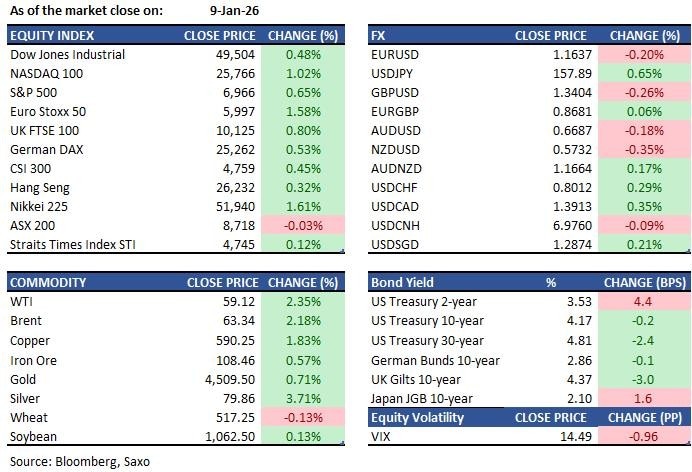
- US - S&P 500 rose 0.6% and the Dow gained 0.5%, both hitting new records, while the Nasdaq added 0.8%. December payrolls increased by 50,000—below forecasts—though unemployment edged down to 4.4%, indicatinga steady but cooling labormarket. Chipmakers led gains, with strong advances from Broadcom, Intel, and Lam Research on optimism around AI and semiconductors. Homebuilders also rallied after President Trump ordered mortgage bond purchases to lower rates. For the week, all major indexes posted solid gains.
- EU - The Eurozone’s STOXX 50 jumped 1.6% and the STOXX 600 rose 1%. Tech led the advance, tracking U.S. momentum, with ASML up nearly 7% and SAP and Infineon gaining over 2%. Luxury names also climbed despite uncertainty around Chinese demand, as Hermes, LVMH, and L’Oréal gained 3–6%, with L’Oréal announcing it will acquire Kering’s cosmetics business. Outside the Eurozone, Glencore surged 8% after restarting merger talks with Rio Tinto, which slipped 2%.
- HK - Hang Seng Index rose 0.3% (82 points) to 26,232 on Friday, snapping a two‑day decline.The Shanghai composite Index hovered near a 10‑year high after data showed Dec consumer prices rising at the fastest pace in nearly three years, driven by stronger food inflation. Producer price deflation also eased to its mildest decline in 16 months, reflecting efforts to stabilize margins. Notable movers included Laopu Gold, Kuaishou, Zhaojin Mining, CK Hutchison, and Zijin Gold. Despite Friday’s rebound, Hong Kong markets fell 0.4% for the week.
Earnings this week:
- Monday: No notable earnings
- Tuesday: JPMorgan Chase, Bank of New York Mellon, Delta Air Lines
- Wednesday: Citigroup, Bank of America, Wells Fargo
- Thursday: First Horizon, TSMC, Morgan Stanley, Goldman Sachs, BlackRock
- Friday: No notable earnings
FX:
- USD rose following December’s jobs report, with payrolls at 50k versus 60k expected, while the unemployment rate fell to 4.4%. DXY reached 99.264, supported by USD strength despite delayed Supreme Court action on Trump tariffs. Consumer sentiment improved to its highest since September 2025, notably among low-income households.
- JPY lagged G10 peers due to political instability as Japan’s PM Takaichi considered dissolving the Lower House, possibly triggering February elections. Reports suggest the BoJ will keep rates steady in January, with potential CPI outlook revisions. USDJPY traded above 158 level.
- CAD followed USD trends despite slower job growth. Employment rose by 8.2k against expectations of a 5k decline, driven by full-time job gains. The unemployment rate increased to 6.8%, slightly above forecasts, alongside a higher participation rate.CAD weakened to 1.39 against the dollar.
Commodities:
- Oil rose for a third day as escalating protests in Iran threatened supply from OPEC’s fourth-biggest producer, with Brent nearing $64 and WTI close to $60 after an almost 6% two-day jump—the biggest since October—as President Trump warned of repercussions if Tehran targets demonstrators and Iran cautioned the US and Israel against intervention.
- Gold rose after US jobs data kept expectations for further US interest-rate cuts intact and intensifying protests in Iran elevated geopolitical tensions, with bullion above $4,550 an ounce—breaking of its late-December record, while silver climbed 2% after nearly 10% last week, and palladium and platinum advanced.
Fixed income:
- US Treasuries twist-flattened Friday after a mixed December jobs report with unemployment down to 4.4%, as headline payrolls missed, swaps pared rate-cut pricing to almost no chance of a January cut and just 7bp of easing across January–March versus 10bp at Thursday’s close, and options activity in SOFR and Treasury products stayed elevated ahead of a busy risk week. Australia begins its 2026 issuance this week—A$300m of 2054s Tuesday, A$1b of 2036s Wednesday, A$700m of 2029s Friday—and there is no cash trading in Treasuries today due to a holiday in Japan.
For a global look at markets – go to Inspiration.
This content is marketing content and should not be considered investment advice. Trading financial instruments carries risks and historic performance is not a guarantee for future performance. The instrument(s) mentioned in this content may be issued by a partner, from which Saxo receives promotion, payment or retrocessions. While Saxo receives compensation from these partnerships, all content is conducted with the intention of providing clients with valuable options and information.