
Access all our platforms from a single account.

Asia Market Quick Take – 29 September, 2026

Key points:
- Macro: Trump rejects Iran’s proposal to reopen Straits of Hormuz
- Equities: Nvidia announces $150b record share buyback
- FX: CAD extends losses; USDCAD up for the 13th time in 14 sessions
- Commodities: Gold hits seven-week low while oil remains elevated
- Fixed income: US Treasuries selloff deepens with 10 year at 5.25%
------------------------------------------------------------------
Disclaimer: Past performance does not indicate future performance.
Macro:
- Trump rejected Iran’s latest proposal to reopen the Strait of Hormuz, dashing ceasefire hopes and pushing oil and bond yields higher, while denying an Axios report that he offered Iran sanctions relief.
- Saudi Arabia resumed oil exports via the East-West pipeline after repairs, running at about 3.5 million bpd.
- UK shop price inflation eased to 1.4% y/y in September from 1.5%. Food inflation slowed to 2.5% on meat and dairy promotions, while fruit and confectionery stayed high. Non-food inflation dipped to 0.8% amid discounting. The BRC warned retailers cannot keep absorbing rising costs. CPI was 3.1% in August and is expected to exceed 4% in early 2027 as the Iran war lifts energy prices.
- The Dallas Fed’s Texas manufacturing index dipped to 9.8 in September from 11.6, as business conditions improved more slowly, uncertainty rose, and price and wage pressures intensified, even as employment growth strengthened and future expectations remained positive but less upbeat.
- Lagarde said inflation forecasts for 2027–28 have risen due to higher energy prices, though there is no sign yet of energy costs lifting wages. She called for a measured policy response. Markets now price in about 100 bps of ECB hikes by end-2027, with investors awaiting eurozone inflation data later this week for policy clues.
Equities:
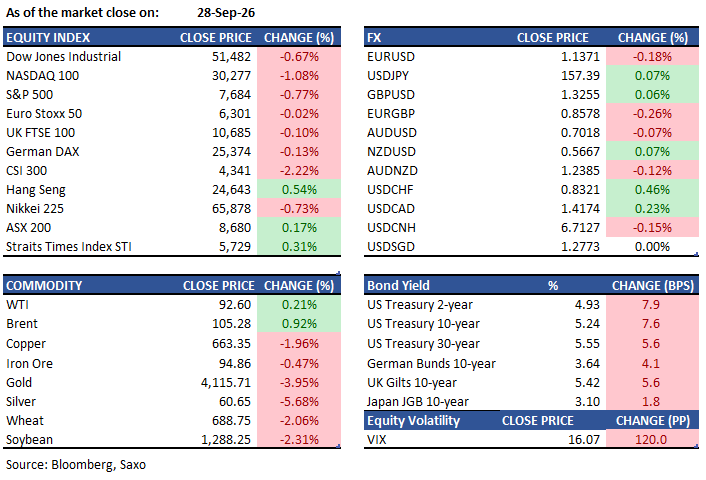
- US — US equities fell sharply on Monday as the US-Iran standoff stoked inflation fears. The S&P 500 dropped 0.8% to 7,683.69, wiping out September's gains, while the Nasdaq 100 lost 1.1% and the Dow Jones fell 0.7% (approximately 347 points). Nvidia (+3%) was a notable outperformer after announcing a $150b record share buyback and a cybersecurity industry initiative, with CrowdStrike and Palo Alto Networks also outperforming. Steel stocks fell as much as 2% after Trump announced a $15bn Iowa steel plant, with Cleveland-Cliffs down 8.3%. Getty Images collapsed 41% on reports it is exploring debtor-in-possession financing. In after-hours trading,Jefferies (JEF) fell despite reporting Q3 EPS of $1.08, beating the $1.00 consensus, as asset management revenue slumped over 50% year-on-year.
- EU — European equities closed mixed on Monday, broadly shrugging off the bond rout. The Stoxx Europe 600 was little changed at 638.68, the DAX fell 0.1% to 25,374, the FTSE 100 edged down 0.1% to 10,684.88, and the CAC was fractionally higher. UK homebuilders surged — Persimmon +14.7%, Taylor Wimpey, Bellway, and Barratt Redrow all rose more than 10% — after the UK government announced a new first-time buyer loan programme described by JPMorgan as a potential "game changer." ASML led gains on the Stoxx 600, rising 1.0%, while Fresnillo was the FTSE 100's worst performer, falling 5.1%, and Rheinmetall dropped 1.6% in Frankfurt. Roche held its Pharma Day investor event, expressing confidence in its drug pipeline through 2030.
- Asia — Asian equities are under pressure on Tuesday morning, tracking Monday's US selloff, with the macro triple threat of rising yields, higher oil, and a firmer dollar weighing on risk appetite. South Korea's Kospi opened 0.7% lower at 6,844.41, extending Monday's sharp decline — the index had plunged 2.7% on Monday as markets reopened after a holiday, with Samsung Electronics and SK Hynix among the heaviest drags. The Topix fell approximately 1% in early Tokyo trade, with SRS Holdings down 4.3% and IHI flagging a ~¥14bn transaction loss. The STI closed up 0.3% on Monday at 5,729.02, led by UOB (+1.7%), DBS (+0.1%), and OCBC (+0.7%). The Hang Seng and broader China markets are set to open with a cautious tone, though the Nasdaq Golden Dragon China Index rose 1.1% on Monday. Beijing's stimulus signals and a stronger PBOC yuan fixing are providing some support for China-linked names. Micron's earnings on Wednesday are a key focus for the semiconductor complex across the region.
Earnings and events this week:
- Tuesday: Carnival, RBA rate decision
- Wednesday:Micron Technology — Q4 FY2026 results (widely watched for AI/semiconductor demand signals), Factset
- Thursday: Nike
- Friday: No major earnings expected; focus shifts to the September Non-Farm Payrolls report.
FX:
- USDJPY ticked higher in New York after rallying earlier in the session following a warning from Japan's top currency official Atsushi Mimura, who said Japan, the US, and the Finance Ministry have sent a "very clear" message on FX depreciation. The yen briefly strengthened to 156.51 per dollar before fading.
- USDCNH fell 0.2% to 6.7125 as the PBOC set the yuan fixing at 6.7399, strengthening it by the most since April, offsetting broader dollar gains.
- USDCAD climbed for a 13th time in 14 sessions, approaching the key 1.42 level and eyeing the year-to-date high of 1.4248, with the pair in overbought territory on the 14-day RSI.
- AUDUSD was little changed at 0.7017 as the Aussie consolidated ahead of 11:30 a.m. Sydney household spending data and a 2:30 p.m. RBA decision, with all economists expecting a 25 bp hike to 4.60% and swaps nearly fully pricing it, implying ~70 bps of tightening over the next year (including Tuesday) and a 71% chance of another hike by year-end.
Commodities:
- Brent crude held around $105–$106 per barrel on Monday, with WTI trading above $93/bbl, as Trump's rejection of Iran's Strait of Hormuz proposal sustained supply disruption fears. Trump also said the US is "very seriously" considering a diesel export ban, which analysts estimate could boost European diesel prices by up to 50%.
- Gold slid 4% on Monday to $4,115.71 per ounce, its lowest since early August, as rising real yields and oil-driven inflation concerns dented the appeal of non-yielding metals. Silver fell more than 5% and platinum dropped over 3%, with precious metals miners broadly lower.
Fixed income:
- The 10-year yield rose 9 basis points to 5.25%, a fresh 19-year high, while the 30-year yield climbed to 5.56% (highest since 2004) and the 2-year reached 4.92%. Options trading on the TLT (iShares 20+ Year Treasury Bond ETF) surged to a record 20-day average, reflecting intense hedging activity. The Committee for a Responsible Federal Budget warned the US is "entering a debt spiral" as Treasury rates run above expected nominal growth.
- German 30-year Bund yields climbed nearly 6bps to 3.97%, the largest single-day move since September 9, with the 10-year Bund yield at its highest since 2009. ECB President Lagarde noted that rising bond yields would slow growth and inflation, causing traders to pare back ECB rate hike bets.
- JGB futures fell 7 ticks to 124.28, with the 10-year JGB yield at 3.085%, as the market expects further bear flattening. New Zealand and Australian bonds also edged lower, with the 10-year Australian yield steady at 5.42% ahead of the RBA decision.
For a global look at markets – go to Inspiration.
This content is marketing content and should not be considered investment advice. Trading financial instruments carries risks and historic performance is not a guarantee for future performance.
The instrument(s) mentioned in this content may be issued by a partner, from which Saxo receives promotion, payment or retrocessions. While Saxo receives compensation from these partnerships, all content is conducted with the intention of providing clients with valuable options and information.