
Access all our platforms from a single account.

Asia Market Quick Take – 15 October, 2026

Asia Market Quick Take – 15 October, 2026
Key points:
- Macro: Headline CPI rises 0.6% MoM; Core CPI remains at 0.3%
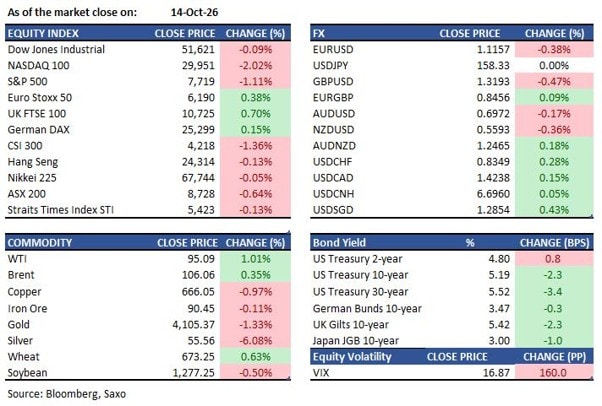
- Equities: S&P fell 1.11%, Nasdaq down 1.88%. Chip sector down 4.5%.
- FX: USD surges on hot CPI; weak Australian jobs data pressures AUD
- Commodities: Precious metals recoup some of their sharp losses
- Fixed income: Treasuries slump post-CPI, then pare losses; curve flattens
------------------------------------------------------------------
Disclaimer: Past performance does not indicate future performance.
Macro:
- US inflation rose to 3.7% year-on-year in September 2026 from 3.4%, above the 3.6% forecast, mainly on surging energy costs (gasoline +34.2%, fuel oil +74.2%). Shelter inflation climbed to 3.2% while food eased to 2.5%. Monthly CPI gained 0.6%, led by a 9.1% jump in gasoline. Core inflation increased to 2.6%, with monthly core CPI steady at 0.3%.
- Germany’s wholesale prices rose 8.7% year-on-year in September 2026, up from 6.8% and the fastest since February 2023, driven by higher energy and intermediate goods costs. Mineral oil products jumped 48.8% and metals 24.9%, while prices for live animals, dairy, and meat fell. Month-on-month, prices climbed 1.9%, beating the 0.7% forecast.
- Japan’s core machine orders rose 5.2% month-on-month in August 2026 to JPY 1,069.8 billion, reversing July’s 3.7% fall and beating expectations of 3%. Both manufacturing and non-manufacturing orders rebounded, with especially strong gains in non-ferrous metals and goods leasing. Year-on-year, orders jumped 18.6%, the fastest in six months.
- A container ship sank in the Strait of Hormuz after being hit by unidentified projectiles, as Houthi attacks on Saudi Arabia and rising Iranian threats disrupted tanker routes. Russia accused Ukraine of hitting two oil refineries, including the 400,000 bpd Ryazan plant, breaching Trump’s “energy ceasefire.” US API data showed crude stocks down 11.1 million barrels, the biggest fall since June 2025.
- Australia’s employment fell by 39,300 in September 2026 to 14.78 million, missing expectations for a 20,000 gain. Part-time jobs dropped 73,700 while full-time roles rose 34,400. The employment-to-population ratio slipped to 63.6% and participation to 66.8%. Year-on-year, employment was up 168,300 (1.2%). Unemployment rate held at 4.7% in September, the highest since October 2021 and above the 4.6% forecast, as joblessness rose to 732,000 and employment fell by 39,300 to 14.78 million.
Equities:
- US: US equities suffered their worst session since late July on Wednesday. S&P 500 fell 1.11% to 7,718.94, snapping its longest streak without a 1% decline in over six years. The Nasdaq Composite dropped 1.88% to 26,692.87 and the Dow slipped 0.09% to 51,621.48. The Philadelphia Semiconductor Index sank 4.5%, with CoreWeave tumbling more than 15% on concerns on AI debt load. The Russell 2000 entered correction territory, falling nearly 2% and now more than 10% below its August peak. Bank of America fell 4.8% after reporting weaker-than-expected trading revenue and a $1.2 billion regulatory fine. Morgan Stanley fell 2.75% despite its wealth arm posting a record IPO haul. Anthropic says Q3 revenue hit $16.8b, with adjusted operating margin at 11%, achieving positive FCF. Target for IPO debut by year end.
- EU: European equities bucked the global selloff on Wednesday, with the Stoxx Europe 600 rising 0.4% to 637.75, its highest close since 29 September. The Euro Stoxx 50 gained 0.38% to 6,190.37. The DAX rose 0.2% to 25,298.61, led by Rheinmetall (+3.1%). The FTSE 100 advanced 0.7% to 10,724.86, with AstraZeneca (+3.4%) and Barratt Redrow (+4.0%) leading gains. The Swiss SMI climbed 1.5%, its biggest daily gain since July, driven by Roche (+3.1%) and Lonza (+3.4%). Investors rotated into defensive healthcare and food and beverage names following the hot US CPI print. ASML raised its full-year sales outlook in its Q3 release, though the stock's initial positive reaction faded as rate-hike fears dominated sentiment.
- Asia: Asian equities are declining this morning, tracking Wednesday's tech-led Wall Street selloff. The MSCI Asia Pacific gauge is down approximately 0.8%, with South Korea leading losses for a fourth consecutive session. The Kospi has fallen as much as 5.7% to its lowest level since 31 July, with Samsung Electronics and SK Hynix each down more than 5% as the chip rout deepens on AI trade doubts. The Hang Seng closed Wednesday at 24,314.17 (-0.1%), weighed by HSBC (-1.8%) and Innovent Biologics (-4.2%), while mainland investors sold a net HK$135 million via Stock Connect. The Nikkei 225 finished Wednesday essentially flat at 67,744.29. The STI stands at 5,423.33. Nasdaq futures remain weak, suggesting further pressure on North Asia's chip-heavy benchmarks at the open. HSBC cut its end-2026 targets for the CSI 300, SHCOMP, and SZCOMP by 9–15%, citing tighter global liquidity and lower risk appetite.
Earnings this week:
- Thursday: Alcoa, Charles Schwab, Interactive Brokers, Prologis, Bank of New York Mellon, US Bancorp, PNC Financial, TSMC
FX:
- USD rallied after a hotter‑than‑expected US CPI print pushed the Bloomberg Dollar Spot Index up as much as 0.6% and drove broad USD strength.
- USDSEK was the largest mover in the G10 space, with the SEK weakening 0.61% against the USD — the biggest single-day move in the set.
- GBPUSD was the worst performer among dollar-quoted pairs, falling 0.47% as sterling bore the brunt of the dollar's CPI-driven rally.
- AUDUSD trades around 0.6954, extending recent losses amid USD strength and a weak Australian September jobs report. Australia shed 39,300 jobs versus an expected gain of 20,000, though full-time employment rose 34,400 and the unemployment rate ticked up to 4.7%.
Commodities:
- Brent crude settled above $106 per barrel, supported by Houthi missile and drone strikes on Saudi Arabia — including a reported hit on Saudi Aramco's headquarters — and intensifying Iranian attacks on tankers in the Strait of Hormuz. WTI is at $94.78 this morning, easing 0.33% from Wednesday's close. Geopolitical risk premium remains elevated.
- Gold fell as much as 2.1% after the hot CPI print reignited expectations for further Fed tightening, with bullion trading near $4,100 per ounce intraday. The metal has recovered to $4,142 this morning (+0.9%), but remains under pressure as real yields stay elevated — the US 10-year real yield rose to 2.88%. Silver spot trades at $56.03/oz, up +0.85% on the day — a modest bounce after a brutal session yesterday when Comex front-month silver tumbled 6.1% to settle at $55.55, its lowest close in nearly a year. The move yesterday was the largest single-day percentage decline since June 2026.
Fixed income:
- The hot September CPI print triggered an immediate selloff across the curve on Wednesday. The 2-year yield spiked as high as 4.95% (+16bps intraday) and the 10-year reached 5.30% (+9bps), while the 30-year briefly touched 5.625%. Long-end yields subsequently recovered as real-money and fast-money buyers stepped in; the 30-year closed at 5.526% and the 10-year at 5.192%. This morning, yields are pulling back further — the 2Y is at 4.768% (-3.6bps), the 10Y at 5.156% (-3.4bps), and the 30Y at 5.501% (-2.5bps).
- The post-CPI move was led by the front-end and belly of the curve, compressing the 2s10s and 5s30s spreads. The 5s30s spread narrowed to approximately 50bps from 55.5bps at the prior close, reflecting the market's view that near-term rate hikes are more likely while long-end demand provides some anchor. Oxford Economics noted that the surge in bond yields is unlikely to deter central banks from further hikes.
- Euro-area bonds fell but outperformed Treasuries: German 10-year Bund yields rose 4bps to 3.51% on Wednesday, while French and Italian 10-year yields climbed 6bps each to 4.90% and 4.59% respectively. UK Gilts also fell, with the 10-year Gilt yield rising 1bp to 5.46%. JPMorgan strategists pushed back on market speculation that the US Treasury may cut 20-year bond issuance at the November refunding, calling there "no prudent reason" to do so.
For a global look at markets – go to Inspiration.
This content is marketing content and should not be considered investment advice. Trading financial instruments carries risks and historic performance is not a guarantee for future performance.The instrument(s) mentioned in this content may be issued by a partner, from which Saxo receives promotion, payment or retrocessions. While Saxo receives compensation from these partnerships, all content is conducted with the intention of providing clients with valuable options and information.