
Access all our platforms from a single account.

Asia Market Quick Take – September 3, 2025

Key points:
- Macro: Trump’s tariffs deemed illegal by Federal Appeals Court
- Equities: Google is up 6.5% in the post market after court rule on Chrome web browser
- FX: GBP fell to 1.3380 amid fiscal concerns and rising borrowing costs
- Commodities: Gold hovers near record after six-day rally
- Fixed income: US Treasuries fell, mirroring long‑dated European losses
------------------------------------------------------------------
Disclaimer: Past performance does not indicate future performance.
Macro:
- The August ISM US Manufacturing PMI increased to 48.7 from July's 48.0, missing the forecast of 49.0. It marked the sixth month of contraction, with sharp production drops partly offset by new order rebounds. Employment fell at a slower pace, while shrinking inventories and backlogs indicated weaker demand. Input price inflation eased slightly to 63.7, yet stayed high.
- A federal appeals court deemed Trump's tariffs illegal, requiring suspension by October 14. Trump will appeal to the Supreme Court, possibly leading to a prolonged legal battle. Tariffs of 10% to 50% were imposed last month. A ruling against them may necessitate renegotiating recent trade deals, potentially disrupting global trade.
- The US Logistics Manager's Index slightly increased for August to 59.3 from 59.2 in July, driven by rising inventory and warehousing costs. Warehousing capacity growth slowed, while transportation metrics declined, with prices and utilization down and capacity up.
- U.S. construction spending decreased by 0.1% to $2,139.1 billion, marking the ninth monthly drop. Private spending fell 0.2%, with nonresidential down 0.5%, led by a 1% drop in amusement and recreation buildings. Residential construction rose 0.1%, as single-family increased but multi-family fell 0.4%. Public spending grew 0.3%, driven by residential and gains in conservation and power projects. Yearly spending fell 2.8%.
Equities:
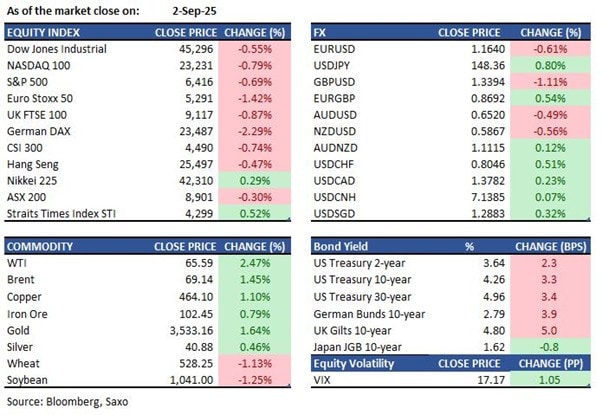
- US - S&P 500 fell 0.7%, the Nasdaq dropped 0.9% for a second sharp loss, and the Dow declined 250 points. Rising Treasury yields—10-year near 4.3% and 30-year close to 5%—added pressure, while sentiment worsened after a court ruled most Trump-era tariffs illegal, though they remain until Oct. 14 pending appeal. Meanwhile, U.S. manufacturing contracted for a sixth month, and corporate movers included Nvidia (-2%), Qualcomm (-1.2%), and Kraft Heinz (-7%) after announcing a split into two companies. Google is up 6.5% after hours after a judge ruled that they are not required to sell the Chrome web browser to keep up with antitrust rules. Apple rose 4% after hours, benefiting from Google's payments.
- EU - Frankfurt’s DAX fell 2.3% to 23,487 on Tuesday, its lowest since August 1, as global markets slid on rising bond yields. Investors weighed fresh data showing Eurozone inflation edged up to 2.1% in August, above expectations and the ECB’s target, reinforcing bets on steady rates next week. Geopolitical tensions, political uncertainty in France, and tariff concerns further pressured sentiment. All sectors closed lower, with sharp losses in Vonovia (-6.1%), Siemens Energy (-5.8%), Fresenius Medical Care (-5.3%), Infineon (-4.5%), Siemens (-4.4%), and Sartorius (-3.9%).
- HK - Hang Seng fell 0.5% to 25,497 on Tuesday, reversing a prior 2% surge as U.S. futures dropped ahead of the jobs report and trade policy concerns resurfaced. Tech stocks led declines on profit-taking after an AI-driven rally, while property and consumer shares also slipped, tracking mainland losses. Meanwhile, Xi Jinping announced plans for a development bank and energy cooperation platform at a summit with Russia and India, highlighting Beijing’s global ambitions. Hong Kong retail sales rose 1% in July, rebounding from 0.3%. Major laggards included Simcere Pharma (-7.6%), SMIC (-4.2%), China Unicom (-4.6%), Kuaishou (-2.7%), and HKEX (-2.3%).
- SG - Singapore’s STI cracked 4,300 for the first time, powered by SingTel’s 9-year high. YTD gains led by ST Engineering +65% and Jardine +46%. The index ended the session up 0.52%.
Earnings this week:
- Wednesday - Salesforce, Hewlett Packard Enterprise, GitLab, Dollar Tree, Asana, American Eagle Outfitters, Macy's, Campbell's, ChargePoint, C3.ai
- Thursday - Broadcom, Lululemon, DocuSign
FX:
- USD gained strength due to rising global bond yields amid debt issuance concerns, overshadowing weaker-than-expected ISM Manufacturing PMI results. The Dollar Index rose to 98.60 before settling around 98.35, supported by EUR, GBP, and JPY weakness.
- EUR, JPY, and GBP were the weakest G10 currencies, while the CAD performed well. ECB members suggested no immediate rate cuts, with Eurozone inflation data hotter than expected. EURUSD dropped to around 1.1640.
- GBP was hit by UK fiscal concerns and rising borrowing costs, with bearish sentiment in FX options. The gilt market saw pressure, leading to new highs in the 30-year yield. GBPUSD is trading at about 1.3380.
- The PBoC favoured a stronger Yuan, setting the USDCNY midpoint at 7.1089.
Economic Calendar – AU GDP Growth Rate, China RatingDog Service PMI, US JOLTs Job Openings, ECB President Lagarde Speech, BoE L Mann Speech
Commodities:
- Oil notched its biggest gain since late July as technical buying and tight physical supply lifted prices. WTI rose 2.5% to settle near $66. Ukrainian strikes on two Russian refineries curbed flows, pushing Russia’s crude runs to the lowest since May 2022 and adding to an unexpected squeeze despite seasonal OPEC supply.
- Gold held near a record after a six‑day rally, buoyed by US rate‑cut hopes and risk‑off flows after equity and bond sell‑offs. Spot hovered around $3,530 after touching $3,540.04 amid Fed‑policy uncertainty and developed‑market fiscal strains.
Fixed income:
- US Treasuries fell, tracking a slump in long‑dated European debt, with the US 30‑year yield climbing back toward 5% as a historically tough month for long bonds began. The move echoed Europe’s long end, where the UK 30‑year hit its highest since 1998. Dip‑buyers emerged near futures session lows, but losses were only partly pared as the post‑holiday market absorbed a wave of dollar investment‑grade issuance—27 deals that added duration and cheapened Treasuries.
For a global look at markets – go to Inspiration.
This content is marketing content and should not be considered investment advice. Trading financial instruments carries risks and historic performance is not a guarantee for future performance. The instrument(s) mentioned in this content may be issued by a partner, from which Saxo receives promotion, payment or retrocessions. While Saxo receives compensation from these partnerships, all content is conducted with the intention of providing clients with valuable options and information.