
Access all our platforms from a single account.

Asia Market Quick Take – January 26, 2026

Key points:
- Macro: Trump threatens 100% tariffs on Canada regarding China deal
- Equities:Equities ended mixed; Intel fell 17% on weak outlook
- FX: Dollar down on geopolitical risks; JPY rises to 155 on intervention concerns
- Commodities: Gold hits $5,000; silver breaks $100; US natural gas tops $6.
- Fixed income: Treasuries up; Australian bond trading closed
------------------------------------------------------------------
Disclaimer: Past performance does not indicate future performance.
Macro:
- JPY strengthened to around 155 per dollar on Monday, supported by potential Tokyo-Washington intervention. PM Sanae Takaichi vowed to act against speculation, and the New York Fed's check on dollar/yen levels suggested joint action. Dollar weakness amid geopolitical risks and speculation of a dovish successor to Fed chair Jerome Powell also bolstered the yen.
- Trump threatened 100% tariffs on Canada over a trade deal with China, claiming the deal is disastrous and one of the worst in history. He also stated that China is taking over Canada.
- The University of Michigan's consumer sentiment index increased to 56.4 in January 2026, the highest since August, with broad gains despite remaining over 20% below last year. High prices and labor market concerns persist. Year-ahead inflation expectations dropped to 4.0%, with long-term expectations up slightly to 3.3%.
- The University of Michigan survey revised U.S. year-ahead inflation expectations to 4% in January 2026, the lowest in a year, down from 4.2% initially and in December. The five-year outlook was 3.3%, slightly below the preliminary 3.4% but above December's 3.2%.
- The S&P Global US Flash Composite PMI increased slightly to 52.8 in January 2026 from 52.7 in December, with modest growth in manufacturing (54.8) and stable services (52.5). Export orders weakened, jobs remained stable, and tariffs maintained inflation pressures, especially in manufacturing. Service inflation eased amid competition, and confidence dipped slightly amid political and price concerns.
- The S&P Global US Manufacturing PMI rose slightly to 51.9 in January 2026, from 51.8 in December. It indicated weak factory conditions, with employment at a six-month low, though output growth increased and new orders rebounded. Delivery times lengthened moderately, and input inventories remained unchanged.
Equities:
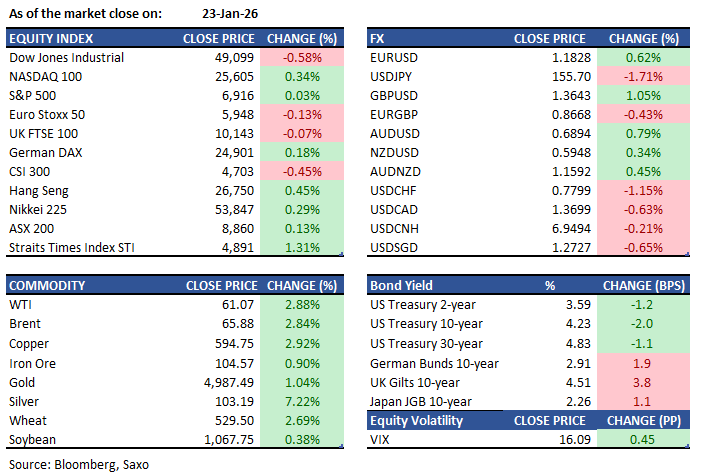
- US - U.S. equities ended mixed Friday, with the S&P 500 up 0.1% and the Nasdaq 100 rising 0.3%, while the Dow fell 0.6% as financials and utilities lagged and energy outperformed. Nvidia gained 1.5% on reports that China may allow domestic firms to order its H200 AI chips, and AMD rose 2.3%. Intel sank 17% after issuing a weak outlook, pressuring chip stocks, while Broadcom slipped 1.7%. Macro data was mixed: University of Michigan sentiment improved, but S&P Global PMIs signaled mild cooling. For the week, the S&P 500 fell 0.5%, the Dow 0.6%, and the Nasdaq rose 0.2%.
- EU – European stocks slipped Friday, easing after Thursday’s rally as bank and consumer cyclical weakness weighed on markets. The STOXX 50 fell 0.3% and the STOXX 600 dipped 0.2%. Traders assessed growth risks despite steady Eurozone PMI data supporting an unchanged ECB stance. Banks including Santander, ING, and Nordea dropped over 1.5%, while defense names Rheinmetall and Safran outperformed. SAP rose 4.3% ahead of earnings.
- HK - Hang Seng Index rose 0.45% to 26,749 on Friday, its third straight gain, supported by consumer and tech stocks and firmer U.S. futures. Chinese markets inched higher as liquidity optimism offset tighter regulatory scrutiny. Alibaba gained 2.3% on plans to list its chip unit, while Xiaomi jumped nearly 3% on a buyback. Other strong performers included Zijin Gold, Pop Mart, MTR, and Kuaishou. Still, the index ended the week down 0.4% amid higher inflation and caution ahead of trade data.
Earnings this week:
- Monday - Ryanair, Steel Dynamics, Baker Hughes,
- Tuesday – United Health Group, Boeing, UPS, GM, Texas Instruments
- Wednesday - ASML, GE Vernova, AT&T, Microsoft, Meta, Tesla, Lam Research, IBM
- Thursday - Mastercard, Caterpillar, Nokia, Visa, Apple, Sandisk, SAP
- Friday - Verizon, American Express, CN, Chevron, ExxonMobil
FX:
- Dollar Index experienced a significant drop of 0.7%, culminating in its largest weekly decline since May, with an overall decrease of 1.6%. This downturn was primarily attributed to geopolitical risks affecting market sentiment.
- JPY climbed almost 1% to 154.22 against dollar before stabilizing at 155.35, as concerns over Japan's intervention grew after Prime Minister Takaichi's warning against speculation. Potential joint US-Japan action raises intervention risks, with 160 yen against dollar eyed as a crucial intervention marker.
- USDCAD declined 0.6% to 1.3700. This was partly supported by a rise in oil prices due to concerns over potential US military action in Iran.
- GBPUSD saw a 1% increase to 1.3634, while USDCHF decreased by more than 1% to 0.7807. These fluctuations reflect the broader trend of traders hedging against swings in the US dollar, evidenced by the rise in the cost of one-month option contracts tied to the dollar index, which reached the highest since September.
Commodities:
- Oil prices steadied as investors assessed the restart of a key Black Sea export terminal and monitored risks to Iranian output after Trump renewed threats against Tehran, with Brent hovering below $66 a barrel after Friday’s 2.8% jump—its largest in two weeks—and WTI near $61. The Caspian Pipeline Consortium said it has returned an offshore mooring to service, restoring crude flows along a route that carries most of Kazakhstan’s exports.
- Gold climbed past $5,000 an ounce for the first time, extending a rally driven by Trump’s reshaping of international relations and investors’ flight from sovereign bonds and currencies, having more than doubled over the past two years and risen 15% so far this year as heightened geopolitical risks add impetus to the debasement trade; it was up 0.8% to $5,029.05, silver advanced 1.7% to $105, palladium climbed, while platinum declined.
- US natural gas soared above $6 for the first time since 2022 as freezing weather swept across much of the country, boosting heating demand and disrupting supplies, with February futures surging as much as 19% in early Asian trading on Monday to $6.288 per million British thermal units following a 70% rally last week—the biggest weekly advance in records dating back to 1990.
Fixed income:
- Treasuries ended Friday modestly higher, with 5- to 30-year yields down about 1bp and shorter maturities little changed amid a lack of fundamental catalysts and scant reaction to the yen’s biggest one-day gain in nearly six months on intervention speculation; as Davos wound down, swap spreads resumed widening with the long end at its widest since late 2022, and Australian government bond trading is closed on Monday due to a public holiday.
For a global look at markets – go to Inspiration.
This content is marketing content and should not be considered investment advice. Trading financial instruments carries risks and historic performance is not a guarantee for future performance.
The instrument(s) mentioned in this content may be issued by a partner, from which Saxo receives promotion, payment or retrocessions. While Saxo receives compensation from these partnerships, all content is conducted with the intention of providing clients with valuable options and information.