
Access all our platforms from a single account.

Asia Market Quick Take – January 16, 2026

Key points:
- Macro: US and Taiwan signs trade agreement; Tariffs on Taiwan
- Equities: TSMC gained 4.4% on strong earnings; Trip.com fell 18.7%
- FX: USD strengthens on claims data; MXN hits high on carry-trade inflows
- Commodities: Silver recovers most losses; on track for a 13% weekly gain
- Fixed income: 10y yield flat for fifth week; Treasuries bear-flattened
------------------------------------------------------------------
Disclaimer: Past performance does not indicate future performance.
Macro:
- U.S.-Taiwan trade agreement, signed Thursday, aims to enhance U.S. semiconductor production and lower tariffs. Taiwan Semiconductor Manufacturing will build factories in Arizona, with a $250 billion investment. The U.S. will cut tariffs on Taiwanese goods to 15% and exempt expanding chipmakers.
- U.S. initial jobless claims fell by 9,000 to 198,000 for the week ending January 10th, contrary to forecasts of 215,000, marking the second-lowest in two years. Continuing claims decreased by 19,000 to 1,884,000, meeting expectations. Federal employee claims increased by 170 to 646 amid the government shutdown.
- Germany's GDP rose 0.2% in 2025, following a 0.5% drop in 2024, driven by increased household consumption and government spending. Exports declined due to US tariffs and competition. Manufacturing saw losses, especially in automotive, and construction faced high costs. Services showed mixed results, with support from trade and transport.
- The NY Empire State Manufacturing Index increased to 7.7 in 2026, up from December's -3.7, exceeding expectations. In January, new orders and shipments rose, while employment and the average workweek decreased. Input prices stayed high, but selling prices slowed. Capital spending grew for the third month, and firms were optimistic about future conditions.
Equities:
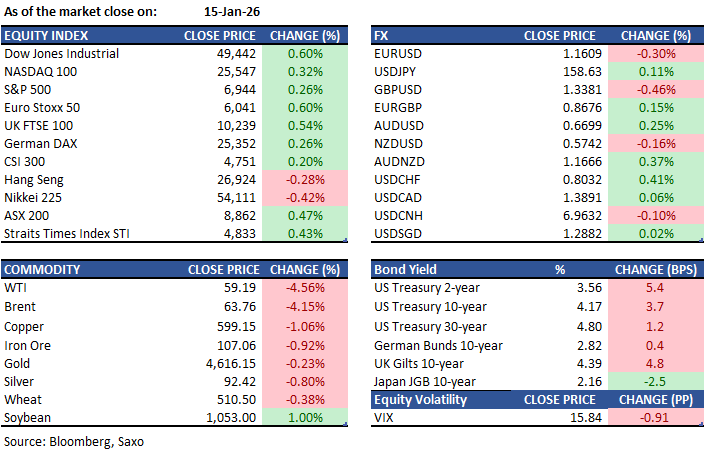
- S&P 500 and Nasdaq each rose 0.2%, while the Dow gained 292 points. Taiwan Semiconductor’s upbeat results and plans to boost 2026 capital spending fueled optimism around AI demand, pushing Nvidia, Applied Materials, Micron and Broadcom higher. Bank stocks also advanced, with Goldman Sachs and Morgan Stanley reporting better‑than‑expected profits on solid dealmaking, and BlackRock reaching record assets under management. Economic data showed resilient US labour conditions and a rebound in New York state manufacturing activity.
- EU - DAX 40 rose 0.3% to 25,352 on Thursday, nearing record highs and tracking gains across Europe. Germany’s economy returned to modest growth in 2025, expanding 0.2% after two years of contraction. Geopolitical tensions remained in focus as President Trump softened his stance on Iran while maintaining pressure over Greenland, prompting several European NATO members to join Danish military exercises. Top gainers included Vonovia, Merck and Siemens Energy, while Fresenius SE and Commerzbank lagged.
- HK - Hang Seng Index fell 76 points, or 0.3%, to 26,924 on Thursday, snapping a five‑day winning streak after early gains faded. Chinese regulators also unexpectedly raised margin requirements to curb surging leverage, resulting in negative sentiment. Losses in tech and consumer names outweighed gains in property and financials. Trip.com plunged 18.7% on an antitrust probe, while Alibaba fell 2.1%. Other laggards included Kuaishou, Pop Mart and China Hongqiao.
Earnings this week:
- Friday: No notable earnings
FX:
- USD strengthened on positive US claims data, with initial claims dropping to lows not seen in two years, lifting short-duration yields. Regional Fed surveys boosted January outlooks. The DXY rose to 99.49 before easing to 99.31.
- In G10 FX, most currencies weakened against the USD, except for AUD, which showed resilience. GBP fell despite surpassing GDP expectations for November, while CHF and EUR lagged.
- JPY was slightly weaker, with Bloomberg noting the BoJ might maintain rates in January due to concerns over a weak JPY's impact. USDJPY peaked at 158.88 before easing to 158.53.
- MXN surged to 17.65 against USD, hitting its highest since July 2024, fuelled by renewed carry-trade inflows as Mexico's elevated real interest rates attract investors.
Commodities:
- Oil steadied, with WTI near $59 and Brent below $64 after a 4.6% slide, as reports that Netanyahu asked Trump to postpone any strike on Iran signalled a US pause and reduced perceived risks to production and shipping.
- Silver dipped, 2% lower at $90.8611 in early Asian trade as investors looked past the US decision to forgo tariffs on critical minerals; it remains on track for a 13% weekly gain amid a broader commodities rotation that sent silver, gold and some base metals to records earlier, after a 7.3% drop Thursday that mostly reversed when President Trump stopped short of sweeping tariffs, while gold, platinum and palladium were steady.
Fixed income:
- The 10‑year Treasury yield is set for a fifth straight week of minimal change—rivaling one of the longest stretches in two decades—as Treasuries bear‑flattened on a front‑end‑led selloff after softer jobless claims and stronger Empire/Philly Fed data, with rate‑cut premia trimmed, the long end only marginally cheaper, and dollar swap spreads widening. USD IG supply saw six issuers price $34.75bn led by Goldman Sachs’ $16bn six‑part deal, while through December President Donald Trump bought municipal and corporate bonds, including of firms affected by his policies, totalling at least $51m.
For a global look at markets – go to Inspiration.
This content is marketing content and should not be considered investment advice. Trading financial instruments carries risks and historic performance is not a guarantee for future performance.
The instrument(s) mentioned in this content may be issued by a partner, from which Saxo receives promotion, payment or retrocessions. While Saxo receives compensation from these partnerships, all content is conducted with the intention of providing clients with valuable options and information.