
Access all our platforms from a single account.

Asia Market Quick Take – 9 March, 2026
Key points:
- Macro: Iran names Mojtaba Khamenei new leader
- Equities: US futures drop; Nikkei 225 falls over 6%, KOSPI plunges 7% amid oil surge
- FX: USD strengthens against G10 currencies; USDJPY above 158
- Commodities: Oil exceeds $100; Middle Eastern output cuts fuel energy market turmoil
- Fixed income: Treasuries fall; global yields rise as oil prices spark inflation concerns
------------------------------------------------------------------
Disclaimer: Past performance does not indicate future performance.
Macro:
- Iran appointed Mojtaba Khamenei as its new supreme leader amid escalating Middle East tensions and ongoing missile attacks from Iran on Persian Gulf countries. The US State Department ordered US employees to leave Saudi Arabia due to increased threats, and President Trump signaled potential expansion of US military actions against Iran.
- President Trump faces mounting pressure in the second week of the Iran conflict, dealing with rising gas prices, strained munitions supplies, and opposition from voters, including his MAGA base. He dismissed concerns, claiming oil price hikes are "short-term" and necessary for "safety and peace”.
- U.S. experienced a loss of 92,000 jobs in February, significantly lower than January's increase of 126,000 and falling short of economists' expectations of 50,000. The unemployment rate also rose to 4.4%.
Equities:
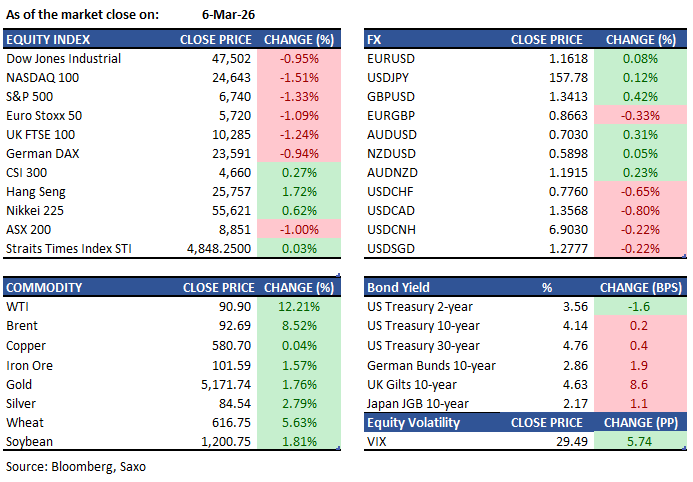
- US - Friday's close marked a tumultuous week for U.S. stocks, their worst since October, impacted by Middle East tensions and disappointing economic data. The Dow Jones fell 450 points, the S&P 500 declined 1.3%, and the Nasdaq Composite dropped 1.6%. This downturn was driven by a staggering February jobs report, with a loss of 92,000 jobs, and surging oil prices, with WTI crude topping $90 per barrel. Fears of stagflation are growing as the VIX Index spiked near 30. On Monday morning, US futures are extending losses, with S&P 500 and Nasdaq 100 futures down 1.8% and 2%, respectively, and Dow futures plummeting 800 points. The escalating Iran conflict and oil surging over $100 per barrel contribute to increased volatility and market anxiety. The prolonged conflict is raising concerns about further economic impact and infrastructure risks.
- Europe - European stocks closed sharply lower on Friday amid Middle East tensions escalating energy prices. The Eurozone's STOXX 50 dropped 1.3% to 5,707, capping a 7.2% weekly decline. Similarly, the STOXX 600 fell 1.2% to 598, down 5.7% for the week. Rising bond yields have raised expectations of an ECB rate hike, impacting banks like Deutsche Bank and Intesa Sanpaolo, which fell 3.5% and 2.5% respectively. Credit-sensitive tech firms like ASML fell 3.3%, and Infineon plunged 7%. German automakers Volkswagen and BMW were also down over 3% due to increasing metal costs and shipping constraints.
- Asia - Asian markets faced sharp declines, with the ASX 200 in Australia dropping 3.1% to 8,572, marking its largest plunge since April 7, as panic spread among investors due to a swift 22% surge in WTI oil prices. In Japan, the Nikkei 225 fell more than 6% to 52,441, experiencing its most severe drop since the April tariffs selloff, while the Topix index declined by 4.4% to 3,554. South Korea's KOSPI plunged 7% to 5,192, driven by a 7% fall in major tech stocks Samsung Electronics and SK Hynix, extending last week's 11% loss.
Earnings this week:
- Monday: Hewlett Packard Enterprise, Casey's, Vail Resorts, Korn Ferry, Repay, 3D Systems, FuelCell Energy, Kronos,
- Tuesday: Oracle, Kohl's, NIO, ABM Industries, AeroVironment, UNFI, BioNTech, Uranium Energy Corp
- Wednesday: Campbell's, Sprinklr, UiPath, Algoma, OppFi, Descartes
- Thursday: Adobe, Li Auto, Dollar General, Dick's Sporting Goods, SentinelOne
- Friday: VEON, Century Casinos, Acurx Pharmaceuticals
FX:
- USD strengthened broadly against all major G10 currencies, driven by increased demand for safe-haven assets amid escalating tensions in the Middle East and surging oil prices, which climbed above $100 a barrel. The dollar's widespread strength underscores an indiscriminate rush for stability as geopolitical risks deepen.
- USDJPY increased by 0.4% to 158.41, marking the yen's weakest level since January. Investors anticipate possible verbal intervention from Japanese authorities to counter yen losses, but in the current environment, such intervention might be viewed as a buying opportunity for USDJPY.
- AUDUSD dropped by 0.6% to 0.6985 as traders opted for the USD as a safe haven amidst geopolitical uncertainties.
- EURUSD declined by 0.5%, trading at 1.1560, with similar downward pressures from the dollar's demand due to conflict-related risks and inflation concerns from higher oil prices.
Commodities:
- Oil surged past $100 a barrel as the Strait of Hormuz remained effectively closed and more major Middle Eastern producers—including Kuwait, the UAE and Iraq—curtailed output as storage rapidly filled due to the Hormuz shutdown, driving Brent up as much as 20% to $111.04, its highest since July 2022, and WTI up 22%, amid US threats to deepen the conflict that has upended energy markets.
- Gold tumbled, pressured by a stronger US dollar and concerns over higher interest rates, as the Middle East war entered a second week and oil surged above $100 a barrel, with bullion falling as much as 2.5% to below $5,050 an ounce after its first weekly decline in more than a month, while major Persian Gulf producers curbed output amid the US‑Israeli war with Iran, which shows no sign of resolution, and a dollar gauge jumped as much as 0.6%.
Fixed income:
- Treasuries opened lower across the curve in Asian trading as surging oil prices fuelled inflation concerns, lifting US 2‑year yields by 5 bps to 3.61% and 10‑year by 5 bps to 4.19%, while Australian bonds sold off with the 3‑year up as much as 10 bps to 4.53% (the highest since July 2011) and the 10‑year up 8 bps to 4.92%, and futures slid with German 10‑year down as much as 46 ticks to 126.47 (the lowest since July 2011), French 10‑year down 51 ticks to 119.98, and Canadian 10‑year down as much as 83 ticks to 119.67 (the lowest since September).
For a global look at markets – go to Inspiration.
This content is marketing content and should not be considered investment advice. Trading financial instruments carries risks and historic performance is not a guarantee for future performance.
The instrument(s) mentioned in this content may be issued by a partner, from which Saxo receives promotion, payment or retrocessions. While Saxo receives compensation from these partnerships, all content is conducted with the intention of providing clients with valuable options and information.