
Access all our platforms from a single account.

Asia Market Quick Take – 8 June, 2026

Key points:
- Macro: NFP 172k vs 85k forecasts. Iran launches attacks on Israel.
- Equities: Nasdaq Composite -4.2%, biggest point drop on record after NFP
- FX: Stronger US payrolls boosted Fed hike bets, driving broad-based dollar gains
- Commodities: Oil rallies while precious metals plunge with silver below $70
- Fixed income: Yield curve aggressively bear flattens with 2 year rising to 4.18%
------------------------------------------------------------------
Disclaimer: Past performance does not indicate future performance.
Macro:
- Iran launched missile barrages toward Israel, warning against action in Lebanon and straining a fragile ceasefire. Israel said all were intercepted with no casualties. Donald Trump reportedly criticized Israel’s Beirut strikes, urged Netanyahu not to retaliate, and pressed Iran to resume talks.
- The US added 172K jobs in May 2026, beating 85K forecasts and following a revised 179K gain. Leisure and hospitality, local government, health care, and manufacturing added jobs, while financial activities lost 22K. Revisions raised March–April employment by 93K, underscoring labor market resilience.
- Japan’s GDP grew 0.5% qoq in Q1 2026, up from 0.2% in Q4, beating 0.3% forecasts and marking the strongest growth since Q1 2025.
- Andy Burnham plans to challenge Keir Starmer for UK prime minister, contingent on winning the June 18 Makerfield by-election to enter Parliament. Starmer says he will not step down. Markets expect nearly two BoE rate hikes this year, starting in September.
- The US unemployment rate stayed at 4.3% in May 2026, as expected. Unemployment fell by 66K, employment rose by 149K, labor force participation held at 61.8%, the employment rate edged up to 59.2%, and the U-6 rate dipped to 8.1%.
Equities:
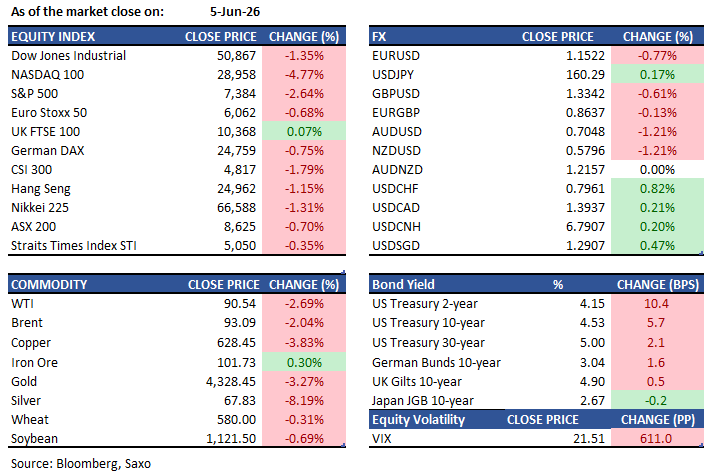
- US — On Friday, the S&P 500 fell 2.6%, its worst session since October, while the Nasdaq Composite plunged 4.2% — its biggest one-day point drop on record — as the strong payrolls print fuelled rate hike fears and triggered a sharp rotation out of AI and megacap tech. Nvidia fell 6.2%, Broadcom dropped 7.9%, and Meta slid 5.5% on reports it is reportedly considering raising tens of billions in a new equity offering. The VIX surged 40% on the week to 21.51. S&P 500 and Nasdaq 100 futures extended losses in early Asia trading Sunday evening, falling as much as 0.6% and 0.7% respectively after Iran's missile strikes.
- EU — European equities ended last week modestly lower, with the Stoxx 600 down 0.5% on Friday and the DAX falling 1.38% for the week to 24,759, its largest weekly decline since mid-May. The FTSE 100 ended little changed at 10,368. Tech and rate-sensitive sectors led declines, with Infineon dropping 9.1% on Friday after a downgrade. ASML fell 2.4%. Retail outperformed, with Inditex gaining on an upgrade from Morgan Stanley. The Euro Stoxx 50 edged 0.19% higher for the week at 6,062.
- Asia — Asian markets face a bruising open this Monday, with Nikkei futures down 3.8% on the SGX as of Sunday evening, weighed by the US tech selloff and Iran's fresh missile strikes. The Kospi triggered a circuit breaker in early Monday trading, halting trade after the index plunged as much as 8.4%, extending last week's 7%+ two-day rout driven by heavy selling in Samsung and SK Hynix. South Korea's government convened an emergency market meeting over the weekend and unveiled measures to stabilise the won and curb speculative trading. Hang Seng and broader China markets are also expected to open under pressure. The MSCI Asia Pacific Index fell 1.7% as of early Monday. Toho Co. was a rare bright spot in Japan, rising 5.5% after a new Buy rating from UBS.
Earnings this week:
- Monday: Campbell’s, Graham, FuelCell Energy, Oil-Dri
- Tuesday: Casey’s General Stores, JM Smucker, SailPoint, Uranium Energy, Academy Sports
- Wednesday: Oracle, Core & Main, Chewy, Navan, Pennon Group
- Thursday: Chow Tai Fook, Adobe, Halma, Lennar, LPP, Do & Co
FX:
- On Friday, the USD rallied across the board after May nonfarm payrolls beat all forecasts with a 172,000 gain, lifting Fed rate-hike expectations and pushing the Bloomberg Dollar Spot Index up 0.6%.
- In G10, AUDUSD fell 1.21% to 0.7048, the largest G10 move, broke below its 100-day moving average, trading around 0.7032, with technicals pointing toward further downside toward the 0.6833 March low.
- EUR fell 1.18% last week to around 1.1519, weighed by the stronger dollar and ahead of the ECB meeting, where a hike is expected but may not be enough to offset dollar strength.
- USDJPY traded around 160.35, near its weakest level since end-April, keeping Japanese intervention risk elevated.
- USDSGD rose 0.47% to 1.2907, while USDCNH edged up 0.20% to 6.7883, as both the SGD and CNH weakened modestly in line with broader dollar strength following the stronger‑than‑expected US jobs report.
Commodities:
- WTI and Brent crude jumped more than 3% in early Asia trading Monday after Iran fired missiles at Israel, with Brent rising as much as 3.6% to $96.47/bbl. Oil had already been elevated due to the ongoing Iran war disrupting Strait of Hormuz flows, with HSBC describing commodities as being in a "super-squeeze."
- Bullion traded near $4,325–$4,335/oz, having given up nearly 5% last week as the strong jobs report boosted the dollar and rate hike expectations. ETFs cut gold holdings for five consecutive days last week. China's PBOC extended its gold-buying streak to 19 months in May, adding 320,000 troy ounces.
- Hedge funds boosted net bullish Comex copper bets to a five-year high in the week ending 2 June, with long-only positions at their highest in over 22 months, underpinned by AI data centre construction driving structural demand for the metal.
Fixed income:
- The May payrolls report triggered aggressive bear flattening in Treasuries on Friday, with the 10-year yield surging to 4.53–4.55%, a two-week high, and the 2-year touching 4.18%. Markets fully priced in a 25bp Fed hike by December, with the 5s30s spread compressing to its tightest since April 2025.
- JPMorgan strategists raised their 2-year and 10-year Treasury yield forecasts by 30bp and 20bp respectively, now projecting 4.20% and 4.70%, and recommend staying short Treasuries versus bunds.
- With the ECB expected to hike Thursday and the Fed on hold for now, attention turns to the bund-Treasury spread dynamic. The Germany 10-year yield premium over the US stood at approximately -148bps recently, having narrowed significantly from -195bps a year ago as European yields rise on tightening expectations.
For a global look at markets – go to Inspiration.
This content is marketing content and should not be considered investment advice. Trading financial instruments carries risks and historic performance is not a guarantee for future performance.
The instrument(s) mentioned in this content may be issued by a partner, from which Saxo receives promotion, payment or retrocessions. While Saxo receives compensation from these partnerships, all content is conducted with the intention of providing clients with valuable options and information.