
Access all our platforms from a single account.

Asia Market Quick Take – 3 August, 2026

Key points:
- Macro: US-Iran peace talks to resume after Trump cancels strikes
- Equities: Amazon gains 15% while Apple falls 7.4% following earnings
- FX: Yen intervention focus, risk-on boosts AUDNZD; NOK softens on oil drop
- Commodities: Gold rises and oil gaps down trading near $80
- Fixed income: Treasury yield reverses Friday’s gains
------------------------------------------------------------------
Disclaimer: Past performance does not indicate future performance.
Macro:
- Trump said peace talks with Iran will resume today after he canceled a planned military strike, following appeals from allies like Saudi Arabia to prioritize negotiations. He also renewed his call to quickly reopen the Strait of Hormuz.
- Australia’s Cotality Home Value Index fell 0.7% in July 2026, the sharpest drop since December 2022, as higher borrowing costs and weak sentiment hit demand. Sydney and Melbourne led declines (down 1.4% and 1.2%), with Brisbane and Adelaide also falling, while Perth inched up 0.1%. Regional prices slipped 0.2%, their first drop since January 2023, though national prices were still 5.3% higher than a year earlier.
- The University of Michigan's Consumer Sentiment Index was revised up to 55.2 in July 2026 from 54.0, the highest since February, with gains across all groups. Still, sentiment was 11% below a year earlier amid concern over high prices. Year-ahead inflation expectations eased to 4.2% from 4.6%, while long-run expectations stayed at 3.3%.
- Year-ahead US inflation expectations fell to 4.2% in July 2026 from 4.6% in June, a second straight decline and the lowest since March, but still above February’s 3.4% and any 2024 reading. The five-year outlook held at 3.3%, slightly above the 2.8%–3.2% range seen through 2024.
- The University of Michigan's Consumer Sentiment Index was revised up to 55.2 in July 2026 from 54.0, the highest since February, with gains across all groups. Still, sentiment was 11% below a year earlier amid concerns over high prices. Year-ahead inflation expectations eased to 4.2%, and long-run expectations stayed at 3.3%.
- Canada’s GDP is expected to grow 0.2% in June 2026, implying 0.8% Q2 growth, as gains in wholesale, finance, insurance, and retail offset declines in utilities and agriculture. May GDP rose 0.3%, with goods output up 0.6% on stronger oil and gas and services up 0.2%.
- Eurozone inflation rose to 2.9% in July 2026 from 2.8%, above the ECB’s 2% target, mainly due to energy inflation jumping to 10%. Core inflation inched up to 2.5%, with most major economies seeing faster price growth except Italy, where it dipped slightly.
- Germany’s jobless rate rose to 6.4% in July 2026 from 6.3%, above forecasts, as unemployment grew by 6,000 to 2.99 million. The labor market is weakening after the Iran war shock, while inflation climbed to 2.8% on higher energy costs, darkening the outlook despite stronger‑than‑expected Q2 GDP.
Equities:
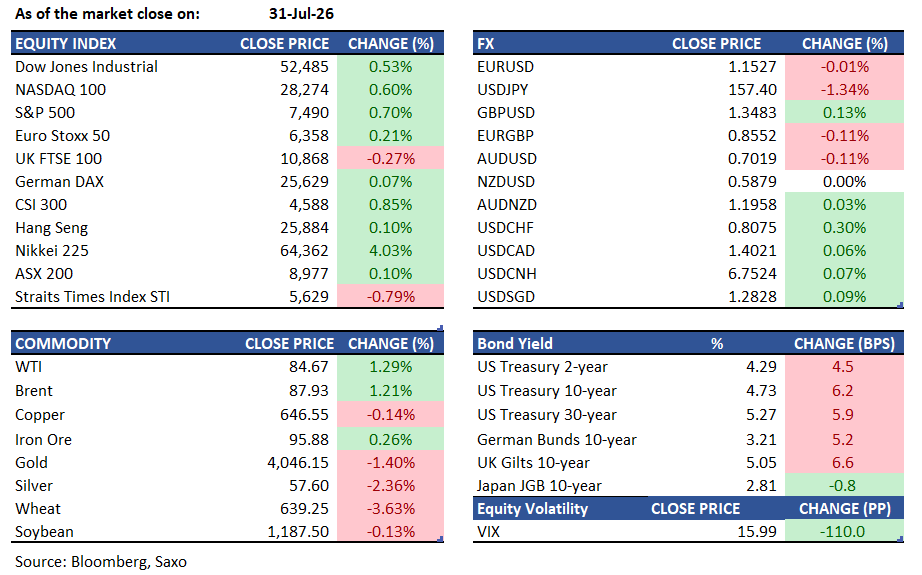
- US — On Friday 1 August, the S&P 500 rose 0.7%, the Dow gained 0.5%, and the Nasdaq-100 added 0.6%, as Amazon surged ~15% following strong earnings, offsetting a sharp 7.4% decline in Apple — its largest single-day market cap loss on record at ~$358bn — driven by chip-related concerns. The UBS Hyperscaler basket surged nearly 7%. US equity index futures are pointing higher in early Monday trade, with S&P 500 futures up ~0.4% and Nasdaq-100 futures up ~0.9%, buoyed by Iran deal optimism. The equal-weighted S&P 500 outperformed the Nasdaq-100 in July as the momentum unwind in semiconductors deepened.
- EU — The Stoxx Europe 600 reached a record high in July, gaining 1.2% for the month and extending its winning streak to a fourth consecutive month. The index has pulled decisively ahead of the S&P 500 year-to-date, benefiting from its lighter technology weighting and heavier value and bank composition. UK stocks also saw gains, with value and income-oriented names outperforming as global investors rotated away from crowded AI momentum trades. European earnings are broadly tracking one of the best quarterly profit increases in years.
- Asia — Japanese stock futures pointed lower at the open, with Nikkei 225 September futures on the CME trading at 63,475 versus 63,720 for Osaka contracts, as traders remain on high alert for further yen intervention. Kioxia Holdings may face additional pressure after its profit forecast missed analyst expectations. The Kospi recorded a record single-day rise on Friday 31 July but is expected to struggle Monday, with Samsung and SK Hynix shares pointing lower in pre-market trade as a new DeepSeek model release weighed on memory sentiment, offsetting the positive oil price drop. Morgan Stanley upgraded Korean equities to overweight, citing 36% upside to its 9,000 target following the "leverage washout." Asian energy shares are expected to fall in line with oil. The Nasdaq Golden Dragon China Index rose 1.5% on Friday. STI and broader Southeast Asian markets are expected to take cues from the Iran deal optimism and softer oil prices.
Earnings this week:
- Monday: Palantir, Marriott, Mitsubishi UFJ Financial, Mitsubishi, Itochu, WuXi AppTec, Marubeni
- Tuesday: SpaceX, McDonald's, Booking, AMD, Pfizer, HSBC, Toyota
- Wednesday: Walt Disney, Uber, Shopify, SanDisk, Eli Lilly, Novo Nordisk, Block, Honda
- Thursday: Molson Coors, Monster Beverage, Warner Bros Discovery, Airbnb, SoftBank Group, DBS, Nintendo, Orix
- Friday: OCBC
FX:
- USDJPY is at 157.64, with markets on alert for a third round of joint intervention after Japan’s MoF confirmed Friday’s rare coordinated action with the US to counter yen weakness and volatility. Authorities reportedly sold euros as well as dollars to buy yen, with EURJPY at 181.98 and GBPJPY at 212.68, aiming for broader yen strength.
- AUDUSD at 0.7046 and NZDUSD at 0.5898, supported by better risk sentiment after Trump called off a planned strike on Iran.
- USD is softer against most majors (EURUSD at 1.1544, GBPUSD at 1.3492, USDSEK lower, USDCHF marginally down), while USD/CAD is slightly weaker.
- NOK is the main laggard as USDNOK edges higher and EURNOK and GBPNOK rise, with NOK pressured by a sharp drop in Brent crude amid optimism over an Iran deal. The Norwegian krone is the best-performing G10 currency year-to-date, up 6.45% against the dollar at approximately 9.48.
Commodities:
- Brent crude for October fell as much as 7.3% to $81.55/bbl in early Asia trade Monday after Trump called off the Iran strike and fresh talks were announced. WTI dropped below $81. This follows a near-25% surge in Brent during July — the biggest monthly gain since March — driven by Strait of Hormuz disruption fears. OPEC+'s sixth consecutive monthly output hike adds further downward pressure on the supply side.
- Gold was trading around $4,070/oz in early Asia, advancing as Iran de-escalation raised hopes of easing energy-driven inflation and reduced the urgency of aggressive Fed rate hikes. Gold posted a 1% gain in July, its first monthly increase since February.
Fixed income:
- 10-year Treasury futures rose 11/32 to 108 11/32 in early Asia trade Monday as oil prices slumped on the Iran de-escalation. Cash Treasuries had sold off on Friday, with the 2-year yield closing ~5bps higher at 4.29% after three Fed dissenters signalled hawkish concern over delayed action on inflation.
- Japanese government bonds are expected to fall at Monday's open, tracking Friday's US Treasury weakness.
For a global look at markets – go to Inspiration.
This content is marketing content and should not be considered investment advice. Trading financial instruments carries risks and historic performance is not a guarantee for future performance.
The instrument(s) mentioned in this content may be issued by a partner, from which Saxo receives promotion, payment or retrocessions. While Saxo receives compensation from these partnerships, all content is conducted with the intention of providing clients with valuable options and information.