
Access all our platforms from a single account.

Asia Market Quick Take – 13 October, 2026

Key points:
- Macro: Trump considers joining Saudi in retaliation to Houthis
- Equities: S&P 500 closed almost flat; Memory names fell on CXMT chip breakthrough
- FX: Dollar strengthens on oil and Fed; EUR hits new 2026 and 52-week lows
- Commodities: Brent-WTI spread ~$13, double norms, on record shipping costs
- Fixed income: Treasury futures flat; volume 20% of average
------------------------------------------------------------------
Disclaimer: Past performance does not indicate future performance.
Macro:
- The Trump administration faces pressure to aid Saudi Arabia after deadly Houthi strikes on Riyadh’s airport. Zelenskyy vows continued strikes on Russia as it targets Ukraine’s energy grid, defying Trump’s “energy ceasefire,” while Kushner and Witkoff say allowing Russian diesel exports aims to lure Moscow back to talks.
- Japan’s producer prices rose 6.8% year-on-year in September 2026, the weakest since May and below the expected 7.6%, signaling easing but still high inflation. Month-on-month, prices fell 0.3% for a second straight month, versus forecasts for a 0.5% rise.
- UK like-for-like retail sales rose 1.0% year-on-year in September 2026, above forecasts and August’s 0.5%. Total sales grew 1.3%, below the 1.5% 12‑month average. Food sales rose 2.5% and non-food 0.3%. Consumer spending increased 2.0%, with essential spending up 2.5% (fuel +17.3%) and non-essential up 1.8%. Financial confidence reached 67%, though 68% were worried about the budget and 30% cut non-essential spending.
- China’s vehicle sales fell 8.4% year-on-year to 2.956 million in September 2026, with passenger cars down 9.5% and commercial vehicles up 0.2%. NEV sales rose 13.6% to 1.823 million, 61.6% of total sales. Over January–September, total sales fell 4.5% while NEVs rose 11.1% to 12.47 million (53.6% of new sales). Month-on-month, total sales rose 9% in September.
- Japan’s bank lending rose 5.3% year-on-year in September 2026, unchanged from August and below the 5.5% forecast, with total loans at JPY 681.97 trillion. Major and regional banks’ lending grew 5.7%, shinkin banks 2.0%, while foreign-bank lending slowed to 14.5% from 25.6%.
- RBA minutes say it lifted the cash rate to 4.6% two weeks ago as upside inflation risks materialized and delays could be costly, noting the Middle East conflict will heavily shape the outlook and that it stands ready to raise rates further if needed.
Equities:
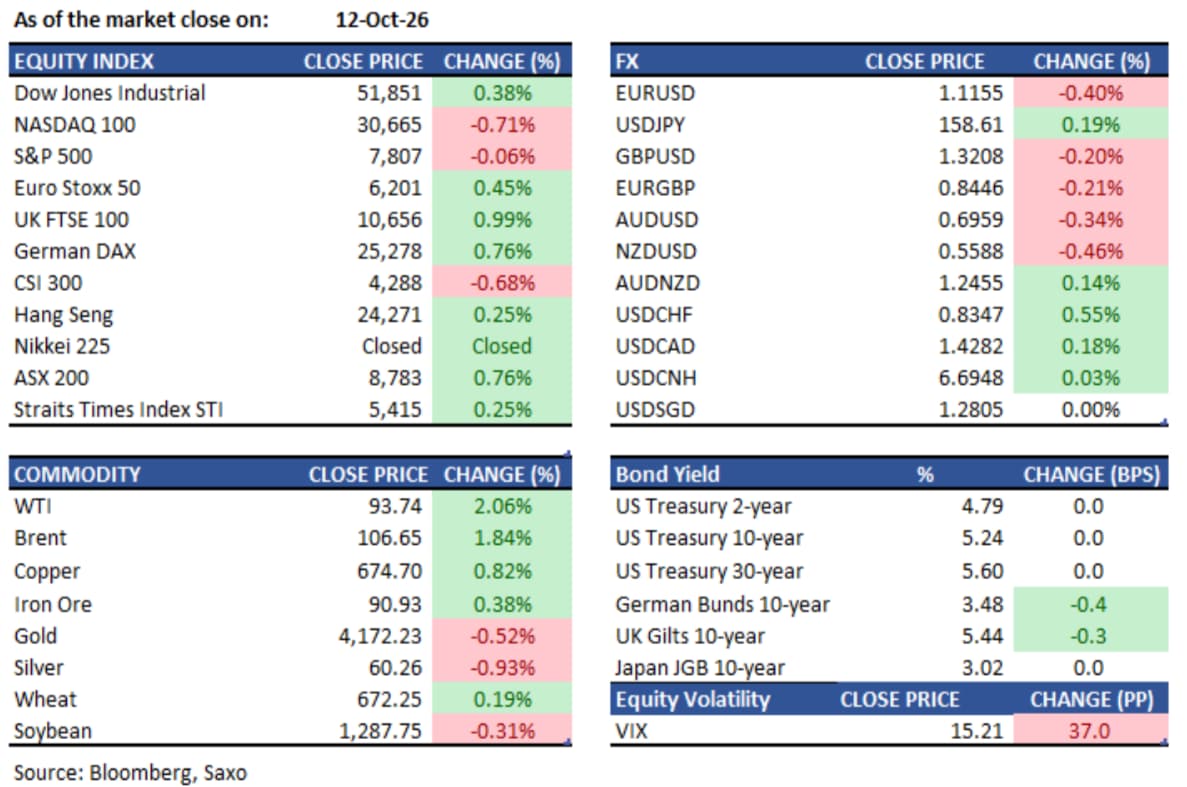
- US — S&P 500 closed Monday essentially flat at 7,807.24 (-0.1%), while the Nasdaq 100 fell 0.7% and the Dow edged up 0.4%. A selloff in chipmakers was the dominant theme — the Philadelphia SOX index fell 2.7% — after Chinese rival CXMT reported progress on a competing memory chip design, resulting in Micron falling nearly 4% while SanDisk dropped 6%. US-listed SK Hynix each dropped ~4%. Meta gained 3.4% on its new Muse AI models while eBay rallied 4% after Morgan Stanley named it a top pick. In after-hours, FormFactor rose 5% after announcing a $300M technology collaboration with Teradyne. Major bank earnings kick off today with JPMorgan, Goldman Sachs, Wells Fargo, and Citigroup all reporting before the bell.
- EU — European equities rebounded on Monday, with the Stoxx 600 rising 0.6% to 635.65 and the FTSE 100 gaining 1.0% to 10,656. The DAX added 0.8% to 25,277. Banks led the recovery, bouncing after losing 8% over the prior two weeks amid French fiscal concerns. HSBC was the top contributor to both the FTSE 100 and Stoxx 600, rising 2.3%. Hensoldt surged 5.8% and Rheinmetall gained 2.5%. Telecoms and tech lagged. The pan-European benchmark remains below its August record highs.
- Asia — Asian equities are trading lower this morning, tracking Monday's US chip losses. The MSCI Asia Pacific Index is down 0.3%. South Korea's Kospi is the regional underperformer, falling over 3% — SK Hynix dropped nearly 4% after the CXMT news, and the Kospi closed right on its 200-day moving average on Monday. The Hang Seng is under pressure, with Man Wah Holdings flagging a profit warning of ~70–90% decline in 1H 2026 profit year-on-year. Singapore's STI has slid 6.6% from its recent peak, dragged by DBS, OCBC, and UOB on fears of earnings downgrades from rising long-end yields. Australia's ASX 200 is down 0.1% to 8,770, with mining and tech shares the main drag. The Nikkei is also softer as the yen hovers near 158.6 and JGBs are expected to fall on return from a three-day weekend.
Earnings this week:
- Tuesday: Aeon, JPMorgan Chase, UnitedHealth Group, Goldman Sachs, Wells Fargo, Citigroup, Johnson & Johnson, Domino's Pizza
- Wednesday: ASML, Bank of America, Morgan Stanley, BlackRock, State Street
- Thursday: Alcoa, Charles Schwab, Interactive Brokers, Prologis, Bank of New York Mellon, US Bancorp, PNC Financial, TSMC
FX:
- USD strengthened on Monday, supported by rising oil prices, risk-off sentiment and hawkish Fed rhetoric, before giving back some gains in early Asian trading, leaving most major pairs within ±0.1% on the day.
- EURUSD hit a new 2026 and 52-week low at 1.1157; the pair is down ~7.4% from its January peak.
- USDJPY traded near a 3-week high around 158.6, with further upside tempered by intervention concerns.
- AUD remains under pressure despite the RBA’s hawkish stance and the widest US–AU rate premium since 2017. RBA remains hawkish: Raised the cash rate 25bp to 4.60% at the 29 Sep meeting, citing growing upside inflation risks and the cost of delaying action.
- KRW outperformed, reaching a near 2-year high versus the dollar.
Commodities:
- Brent crude is trading close to $107 a barrel, supported by Iran-linked supply risk, Houthi attacks on Saudi infrastructure, and ongoing Middle East tensions. The Brent-WTI spread has blown out to ~$13, nearly double recent norms, with record shipping costs cited as a key factor preventing the gap from closing. WTI is around $92–93.
- Gold is trading near $4,170 per ounce, holding a loss as elevated oil prices stoke inflation fears and raise the prospect of further Fed rate hikes. The non-yielding metal has been weighed by multi-decade highs in Treasury yields. Kazakhstan's central bank has switched from buyer to seller of gold, citing the appeal of high-yielding Treasuries.
- Copper gained after an avalanche at a Codelco mine in Chile caused fatalities, raising fresh supply concerns. The move came alongside a broader reassessment of the interest rate outlook. Separately, Chinese lithium plunged 10% after an EU trade deal is set to curb hybrid-vehicle exports.
Fixed income:
- Cash Treasuries were shut for Columbus Day. Treasury futures ended the session near unchanged with volumes at just 20% of recent averages. Ultra-long bond futures implied a slight bear steepening bias. The 10-year yield slipped 1bp on reopening this morning. Swaps markets showed 3–4bps of upward pressure on OIS rates with 2027 maturities, reflecting the oil-yield correlation reasserting itself.
- 10-year Treasury yields are near 24-year highs and 30-year yields recently touched 5.6%, the highest since 2002. Goldman Sachs and Citigroup strategists are beginning to call value in duration, with Goldman citing easing technical risks and stretched forward levels. BlackRock has formally unwound a six-year underweight on Treasuries. Three rate hikes are fully priced by June 2027.
- European bonds found some footing last week as oil prices eased, with French OATs posting their first weekly gain in six weeks. However, the France-Germany 10-year spread remains a key watch — it has been tethered to EUR/USD and continues to weigh on European bank stocks. ECB repo facility usage is in focus as a potential liquidity backstop should conditions tighten further.
For a global look at markets – go to Inspiration.
This content is marketing content and should not be considered investment advice. Trading financial instruments carries risks and historic performance is not a guarantee for future performance.
The instrument(s) mentioned in this content may be issued by a partner, from which Saxo receives promotion, payment or retrocessions. While Saxo receives compensation from these partnerships, all content is conducted with the intention of providing clients with valuable options and information.